Working a Pomsky on a Fifty Foot Line
It’s a tale as old as time for many Pomsky parents: you desperately want your energetic, intelligent companion to experience the joy of real freedom, to run and sniff to their heart's content in a wide-open space. But then, the nagging voice of reality kicks in. That infamous Husky wanderlust, combined with a Pomeranian's occasional selective hearing and a Pomsky’s often surprising speed and agility, makes the thought of letting them off-leash feel like an invitation to a frantic search party. This guide is all about bridging that frustrating gap, showing you how a fifty-foot long line can be your Pomsky’s ticket to more freedom and your tool for building a rock-solid recall, all while keeping them safe and sound.
Why a Fifty-Foot Line for Your Pomsky?
Let's face it, our Pomskies are a fascinating blend of independent spirit and playful zest. They aren't content with just a quick walk around the block on a standard six-foot leash every day. They crave exploration, the thrill of a good scent trail, and the sheer exhilaration of a proper sprint. But giving them that freedom can feel like a huge risk when you know how quickly they can disappear over the horizon if something exciting catches their eye. This is where the long line becomes an absolute game-changer, offering a crucial stepping stone between restricted walks and the elusive dream of a reliable off-leash existence.
Bridging the Gap Between Leashed and Off-Leash Freedom
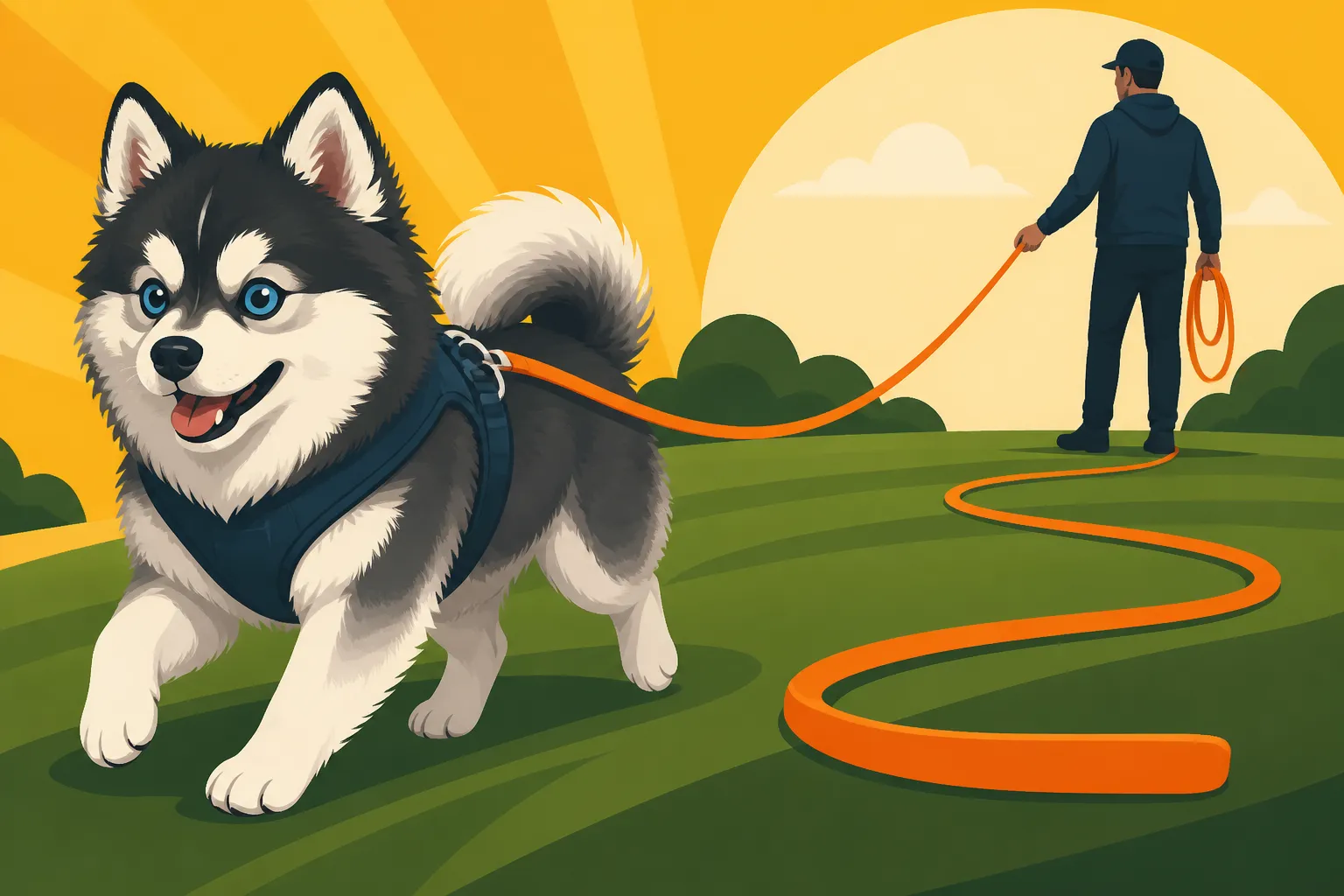
Imagine watching your Pomsky trot twenty, thirty, or even forty feet ahead of you, nose to the ground, tail wagging, truly immersed in the rich tapestry of scents and sounds a new environment offers. They're exploring, making choices, and feeling a sense of autonomy that a standard leash just can't provide. For a breed known for its spirited personality, this increased range of motion is incredibly enriching. It taps into their natural instincts to roam and investigate, inherited from their Husky lineage, without you having to constantly worry about them bolting.
This isn't just about giving your dog more space; it's about giving them mental and physical stimulation that a short leash simply can't deliver. The freedom to explore more widely, to choose their path (within limits), and to feel that stretch of independence can dramatically reduce frustration and pent-up energy in your Pomsky. It transforms a mundane walk into an adventure, leading to a happier, more settled dog at home. And for you, it brings the peace of mind of knowing they're safely connected, a vital component when dealing with The Pomsky Escape Artist in a Twenty Pound Body.
Essential for Training a Reliable Recall
One of the biggest hurdles for any Pomsky owner is achieving that coveted, consistent recall. They are smart, yes, but often too smart for their own good, and their instinct to chase or investigate can easily override your pleas. A fifty-foot line is arguably the most effective tool in your recall training arsenal because it simulates the off-leash experience while providing an essential safety net. It allows your Pomsky to be far enough away that coming back to you feels like a conscious choice, rather than an automatic response to being physically guided.
When you call your Pomsky and they start to ignore you, the long line allows you to gently guide them back, preventing them from practicing the undesirable behavior of not coming. Every time you reel them in, praise them lavishly, and give them a high-value reward, you're building a strong positive association with the "come" command. This consistent, controlled practice, where success is guaranteed, is fundamental to establishing Recall on a Pomsky Bred From a Dog That Runs. It teaches them that returning to you isn't just an obligation, but a highly rewarding experience, which is the cornerstone of truly reliable recall.
Choosing the Right Fifty-Foot Line and Gear
Before you head out with visions of your Pomsky frolicking freely, it’s crucial to understand that not just any old rope will do. The wrong gear can lead to discomfort for your dog, frustration for you, and even potential injury. Selecting the right long line and accompanying equipment is the foundation for a safe, enjoyable, and effective training experience. You want something durable, easy to handle, and above all, safe for your precious Pomsky.
Material, Thickness, and Hardware Considerations
When it comes to the long line itself, you'll generally find two main material types: nylon and biothane. Nylon lines are often lighter and more readily available. They can be a good starting point, but they have drawbacks; nylon absorbs water and odors, can get tangled easily, and if your Pomsky makes a sudden dash, it can give you a nasty rope burn. Biothane, on the other hand, is a fantastic synthetic material that looks and feels like leather but has superior performance. It's waterproof, odor-proof, incredibly durable, easy to clean (a quick wipe-down!), and less prone to tangling. Many experienced dog owners swear by biothane for long lines, despite it often being a bit pricier.
The thickness of the line matters too. You don't want something so thin it's hard to hold or cuts into your hands, nor something so thick and heavy that it becomes a burden for your relatively small Pomsky to drag. Aim for a thickness that feels secure in your grip but isn't excessive. As for the hardware, ensure the clip is robust and made of a durable metal, with a swivel mechanism. A swivel snap prevents the line from twisting and tangling as your dog moves. Always double-check reviews, perhaps on a platform like Amazon, to ensure the quality and durability of the snaps and other components. While a 50-foot line is excellent for wide-open spaces, consider also a 20 or 30-foot line for areas with more obstacles, giving you flexibility.
Harness vs. Collar: Prioritizing Safety
This is a non-negotiable point: you must always attach a long line to a well-fitting harness, never directly to your Pomsky's collar. Pulling on a collar, especially with the force a Pomsky can generate when they hit the end of a long line at speed, can cause serious injury to their neck and trachea. Given their propensity for a "honking cough" or The Collapsing Trachea a Pomsky Gets From the Pomeranian, protecting their delicate throat is paramount.
A good, Y-front or H-style harness distributes pressure across their chest and shoulders, away from their throat, if they suddenly lunge or reach the end of the line. Make sure the harness fits snugly but doesn't restrict movement, and pay close attention to ensure your clever Pomsky can't back out of it. Some Pomskies are masters at slipping out of ill-fitting harnesses or collars, so a secure fit is crucial. Whether a Pomsky Slips a Collar is a real concern, and a good harness minimizes this risk. Remember, the goal is freedom and safety, not an emergency trip to the vet.
Optional but Recommended Accessories
While the long line and harness are your primary tools, a few other items can significantly enhance your experience and safety:
- Gloves: Especially when starting out or if your Pomsky is particularly enthusiastic, a good pair of gloves (gardening gloves or lightweight work gloves work well) can save your hands from painful rope burns, particularly with nylon lines.
- Waist Belt: Some owners prefer attaching the long line to a waist belt, which allows for hands-free handling. This can be great for hands-on training or carrying other gear, but be extremely cautious. A sudden pull from your Pomsky can throw you off balance or cause back strain. It's generally best to maintain a hand on the line as well, even with a belt, until you're very confident in your Pomsky's behavior and your ability to brace for impact.
- Treat Pouch and High-Value Treats: Absolutely essential for recall training. Your Pomsky needs to be highly motivated to come back, especially when competing with fascinating outdoor distractions. Think boiled chicken, cheese, or specialized training treats that your dog absolutely adores. A treat pouch keeps them easily accessible for immediate rewards.
- A good pair of walking shoes: You'll be doing a lot more walking, and sometimes a bit of scrambling!
Safe and Effective Handling Techniques
A fifty-foot line is a powerful tool, but like any tool, it requires proper technique to be safe and effective. It’s not just about letting your dog run wild; it’s about controlled freedom and intentional training. Mishandling can lead to injuries for both you and your Pomsky, or worse, reinforce undesirable behaviors. Let's talk about how to manage that long line like a pro.
The Art of Line Management
The first rule of long-line handling is perhaps the most important: never, ever wrap the line around your hand, wrist, or any part of your body. If your Pomsky suddenly bolts, the line can tighten with immense force, causing severe burns or even broken bones. Instead, learn to manage the excess line by coiling it loosely in one hand, feeding it out as your dog moves further away and taking it up as they come closer. Think of it like handling a horse's lead rope or a boat's anchor line – control without entanglement.
Be hyper-aware of your surroundings. Before letting your Pomsky venture far, scan for trees, poles, picnic tables, or other obstacles that the line could snag on. You don't want your dog hitting the end of the line unexpectedly because it got caught, as this can cause a jarring jolt. When your Pomsky is close, you can allow a shorter section of the line to drag behind them, giving them a bit of freedom while still allowing you to step on it if needed. However, when they're ranging further out, you'll need to actively hold and manage the full length, ready to adjust slack or apply gentle tension. The key is to keep the line relatively loose most of the time, allowing your dog to explore, but always ready to engage if needed.
Introducing the Long Line to Your Pomsky
Your first few sessions with the long line should be all about positive experiences and exploration, not intensive training. Start in a safe, open, and low-distraction environment – perhaps a large, empty park, a quiet beach during off-peak hours, or a securely fenced field. The goal is for your Pomsky to associate the long line with fun and freedom, not pressure.
Let them simply explore at their own pace. Allow them to sniff, trot, and move away from you. This helps them understand the new boundaries and enjoy the expanded space. Keep a close eye on the line, letting it play out and reeling it in as needed. Resist the urge to constantly call them or give commands. This initial phase is about building comfort and confidence with the new equipment and the feeling of increased independence. Once they're relaxed and enjoying themselves, you can slowly start weaving in very light recall practice, but always keep it positive and rewarding.
Practicing Recall with the Long Line
This is where the magic happens. Once your Pomsky is comfortable dragging or ranging on the long line, you can begin to systematically build their recall. Choose moments when your dog is a moderate distance away, but not completely engrossed in a distraction. Use your Pomsky's name followed by your chosen recall command (e.g., "Buddy, come!"). As you say it, gently and smoothly reel in the line while taking a few steps backward to encourage them towards you.
The instant they turn towards you or start moving in your direction, offer enthusiastic praise ("Yes! Good boy/girl!") and immediately reward them with a high-value treat as soon as they reach you. Make coming back the best decision they could possibly make. Repeat this many times in different locations and with gradually increasing distractions. The consistency is crucial: every single time you use your recall command, make sure your Pomsky does come back, even if you have to use the line to ensure it. You don't want them learning that they can ignore you. Organizations like BAXTER & Bella offer excellent online resources for structured, positive reinforcement training methods that can guide you through these steps effectively. You can also work on a "check-in" command, teaching them to periodically look back at you without being called, reinforcing that connection. Teaching a Pomsky to Check In on a Walk is a wonderful habit to cultivate.
Common Challenges and Troubleshooting
Even with the best intentions and the right gear, working a Pomsky on a fifty-foot line isn't always smooth sailing. These intelligent, sometimes stubborn, and highly energetic dogs can present their own unique set of challenges. It's important to anticipate these hurdles and have strategies ready to overcome them, ensuring both your safety and your Pomsky's continued enjoyment and learning.
Tangles and Snags
One of the most common frustrations with long lines, especially in areas with vegetation, is tangling. Your Pomsky, in their enthusiastic exploration, might weave around trees, bushes, or even between your legs, quickly turning your fifty-foot line into a tangled mess. This not only stops their momentum but can also create an unsafe situation.
To prevent this, spatial awareness is your best friend. Constantly observe your Pomsky's path and try to anticipate potential snag points. If you see them heading for a cluster of trees, gently guide them away or reel them in a bit before they get too entwined. With practice, you'll develop a rhythm of paying out and taking up slack, guiding the line to avoid obstacles. If a tangle does happen, resist the urge to yank. Calmly walk over to your Pomsky and untangle the line. This might mean pausing your walk for a moment, but it’s far safer and less frustrating than trying to force it. Starting in wide-open, obstacle-free spaces will minimize this issue initially, allowing both you and your Pomsky to get comfortable with the length.
The Pomsky That Ignores the Line
Pomskies are masters of selective hearing, especially when a tantalizing scent or a squirrel darting across a field calls to them. There will be times when your Pomsky, feeling the freedom of the long line, might act as though it doesn't even exist, stubbornly refusing to acknowledge your presence or your recall command. This is a critical moment for your training.
First, ensure your rewards are truly high-value. Is your praise enthusiastic enough? Is that kibble exciting enough to compete with the thrill of the chase? For a Pomsky, Whether Food Beats Freedom for a Pomsky often depends on the quality of the food! Don't be afraid to pull out the "big guns" – bits of hot dog, cheese, or boiled chicken – especially in the early stages of recall training. If your Pomsky ignores your call and continues to move away, do not chase them. Instead, calmly but firmly reel in the line. Once they are close, praise them gently and reward them, even if you had to physically guide them back. The point is to never let them "succeed" at ignoring your command. Consistency teaches them that your voice, backed by the line, means business, and coming back is always rewarding. If you find this happens frequently, you might need to revert to less distracting environments for a while.
Other Dogs and Distractions
The real world is full of distractions, and eventually, you'll want to practice your long-line skills in environments where other dogs, people, or wildlife are present. However, introducing these elements too soon can set back your training. Start with minimal distractions and gradually increase the complexity of your environment.
When another dog or person approaches, use the long line to manage the interaction safely. You can shorten the line to keep your Pomsky close, ensuring a controlled greeting if appropriate, or guiding them away if they are overly excited or reactive. The long line gives you the ability to prevent unwanted behaviors like jumping or pulling towards another dog, allowing you to practice calm leash manners even from a distance. For high-prey-drive Pomskies, squirrels or birds can be irresistible. The long line allows you to prevent the full chase, interrupting the behavior, and then redirecting your dog's attention back to you with a "leave it" command and a valuable reward. This controlled exposure is key to teaching your Pomsky how to behave politely and safely in a world full of interesting (and sometimes challenging) stimuli. Remember, the goal is always to build a Pomsky who makes good choices, even when presented with temptation, and the long line helps you guide them towards those good choices.
| Feature / Consideration | Pros for Pomsky Owners | Cons for Pomsky Owners |
|---|---|---|
| 50-Foot Long Line | Great freedom, excellent for recall training, safe alternative to off-leash | Can tangle easily, requires good handling skills, not suitable for all environments |
| Biothane Material | Easy to clean, waterproof, durable, good grip, less tangling | Higher upfront cost than nylon, can be heavier |
| Nylon Material | Lighter, often more affordable, good range of colors | Absorbs water/odors, can cause rope burn, more prone to tangling |
| Harness Attachment | Protects neck/trachea, distributes pressure, prevents slipping | Must be well-fitting, some dogs dislike harness application |
| Collar Attachment | (Not Recommended) | High risk of neck/tracheal injury, Pomskies can slip collars easily |
| Gloves | Prevents rope burn, improves grip | Can be cumbersome, adds extra gear |
| High-Value Treats | Essential for motivation and positive reinforcement | Can add calories, need to be fresh/appealing |
Disclaimer
This article is for general informational purposes only and does not constitute professional advice. Laws, prices and regulations vary by location and change over time. Consult a qualified professional for guidance on your specific situation.