Whether a Pomsky Is Reactive on the Leash
It’s a familiar and often disheartening scenario for many Pomsky owners: you head out for a walk, hoping for some peaceful bonding time with your beloved companion, only to have it dissolve into a chaotic ballet of barking, lunging, and pulling at the sight of another dog, a person, or even a leaf blowing across the path. This "leash reactivity" can leave you feeling frustrated, embarrassed, and even isolated, wondering if you'll ever enjoy a simple stroll again. But you’re not alone, and this guide is dedicated to helping you understand why your Pomsky might be acting this way on leash and, more importantly, what concrete steps you can take to manage and improve the situation.
Understanding Leash Reactivity in Pomskies
First, let's take a deep breath and understand what we're talking about. Leash reactivity isn't necessarily aggression, though it can look and sound quite intense. It's typically an over-the-top response to certain stimuli when your dog is on a leash. The leash, while a necessary safety tool, can paradoxically make dogs feel vulnerable or frustrated, leading to these dramatic displays.
What Leash Reactivity Looks Like
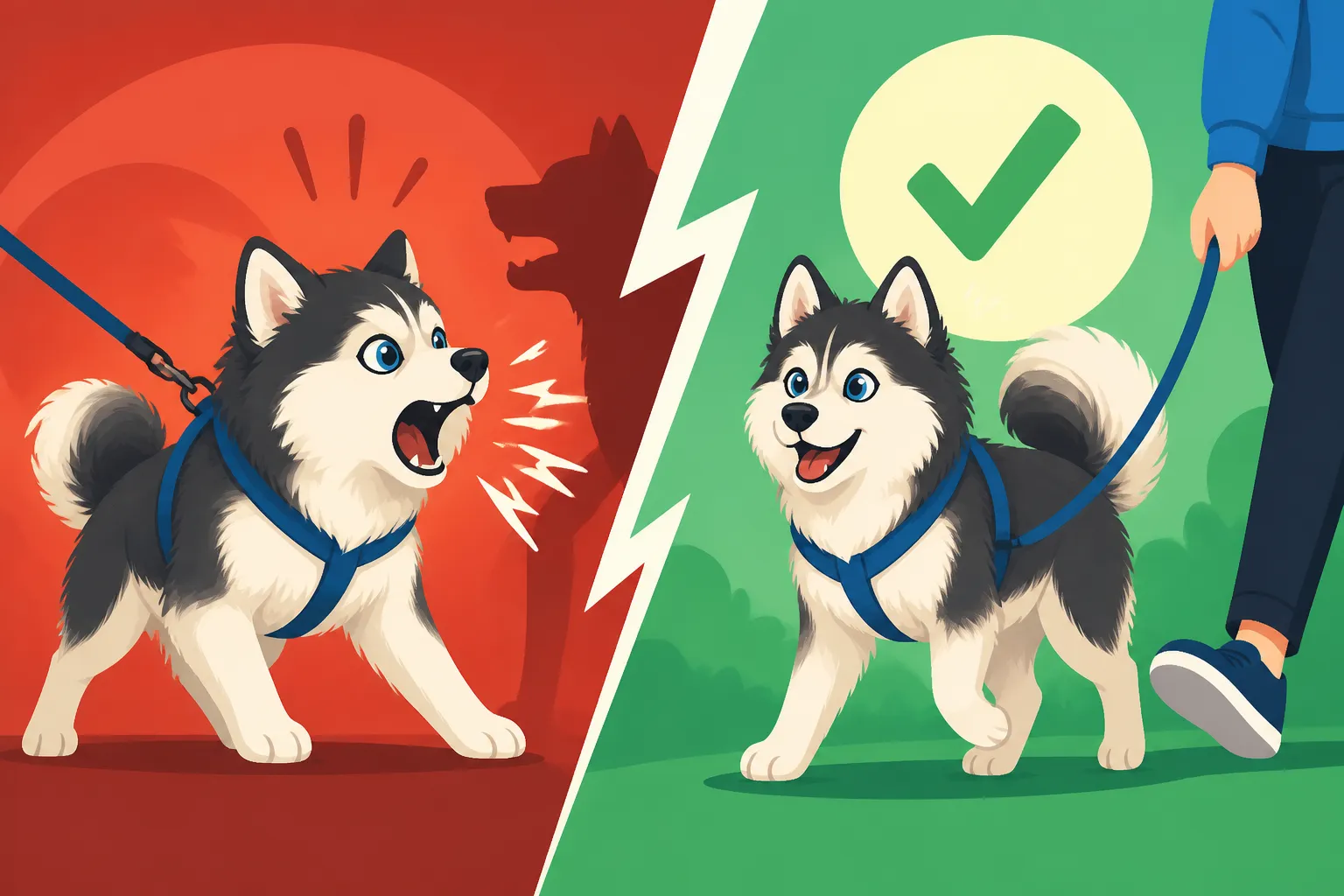
When a Pomsky is reactive on the leash, their behavior can manifest in several ways. You might see a sudden stiffening of their body, ears perked or pinned back, a low growl rumbling in their chest, or perhaps a sharp, frantic series of barks. Often, this is accompanied by lunging towards the trigger, pulling so hard on the leash that you feel like your arm is about to be dislocated, and sometimes even hackles raised along their spine. Some Pomskies might whine incessantly or try to retreat and hide if the trigger gets too close.
It’s an explosion of energy and noise that can be startling, especially given the Pomsky's sometimes smaller stature. Imagine trying to explain to a passerby that your adorable, fluffy companion isn't trying to attack them, but rather, is just really stressed out. It's a tough sell when your dog is putting on a Broadway show of displeasure or fear. The key is to remember these are often fear-based or frustration-based behaviors, not necessarily a desire to harm.
Why Pomskies Can Be Prone to Reactivity
Pomskies inherit traits from two very different but equally strong-willed breeds: the Siberian Husky and the Pomeranian. Both parent breeds have characteristics that can contribute to leash reactivity. Huskies are known for their independence, their sometimes selective hearing, and their strong prey drive, which can lead to intense focus on moving objects or small animals. They are also incredibly vocal, often "talking" or howling rather than barking, which can escalate into reactive vocalizations when stressed. You might find your Pomsky has quite the range of sounds, echoing Why a Pomsky Talks Instead of Barking to communicate their discomfort.
Pomeranians, on the other hand, can be suspicious of strangers, both human and canine, and are not shy about voicing their concerns. Their small size can make them feel more vulnerable, leading to a "small dog syndrome" where they feel the need to puff themselves up and make a big show. When you combine these traits – a Husky's vocal prowess and drive with a Pomeranian's potential for suspicion – you can see why a Pomsky might be predisposed to reacting dramatically when encountering triggers on a leash. Add to this a lack of early, positive socialization, or simply having a sensitive personality, and the stage is set for reactivity. The genetic lottery plays a role too; sometimes you just get a dog who feels the need to be vocal and dramatic.
Differentiating Reactivity from Aggression
It’s crucial to understand that leash reactivity is not the same as outright aggression, though the behaviors can often look similar to the untrained eye. Reactivity is typically an overreaction to a perceived threat or an unfulfilled desire. Your Pomsky might bark and lunge because they are scared and want the other dog to go away, or because they are frustrated that they can't get to the other dog to play. It's a poorly managed emotional response.
True aggression, by contrast, is a deliberate intent to cause harm. While a reactive dog might snap or growl if cornered or pushed past their limit, their primary goal is usually to create distance or dissipate their frustration. An aggressive dog’s body language will often be more predatory, confident, and direct in its threat. With reactive dogs, there's usually a visible element of fear, anxiety, or internal conflict present in their body language, like tail tucked, whale eye, or frantic, rather than purposeful, movements. Understanding this distinction is vital, as it guides the training and management strategies you’ll employ. Most reactive Pomskies aren't bad dogs; they're simply overwhelmed dogs.
Common Triggers for Pomsky Leash Reactivity
Identifying your Pomsky's specific triggers is the first detective work you'll need to do. It's rarely just "everything." Often, there are specific situations or types of stimuli that push your Pomsky past their emotional threshold.
Other Dogs and People
This is by far the most common trigger for leash-reactive dogs, and Pomskies are no exception. For some Pomskies, it's any dog, regardless of size or breed. For others, it might be only large dogs, or dogs that are off-leash, or perhaps dogs that bark first. They might bark and lunge because they're genuinely fearful and want the other dog to disappear, or they might be what we call "frustrated greeters"—they desperately want to play but being restrained by the leash makes them erupt in a tantrum. The internal struggle for a Pomsky with a strong desire to interact, combined with the barrier of the leash, can be immense.
Similarly, people can be triggers. This might be strangers approaching too quickly, children on scooters, or even just someone wearing a hat. Your Pomsky might be wary due to their Pomeranian heritage, which can instill a degree of suspicion towards new faces. If they've had a negative experience in the past, or haven't been adequately socialized to a variety of people, even a friendly wave can be misinterpreted as a threat. Remember the saying, "perception is reality" for your dog.
Moving Objects and Unfamiliar Environments
Beyond other dogs and people, many Pomskies find themselves triggered by anything that moves unpredictably or quickly. This could include bicycles whizzing by, skateboards rattling down the sidewalk, joggers, or even cars speeding past. The Husky's natural The Prey Drive a Pomsky Gets From the Husky can make them fixate on these fast-moving objects, leading to an excited, frustrated, or fearful reaction.
Unfamiliar environments can also be a minefield of triggers. A new park with different smells, sounds, and visual stimuli can be overwhelming. Construction sites, busy street corners, or areas with a lot of echoes can push a sensitive Pomsky over their threshold. Imagine walking into a noisy, crowded party when you're already a bit anxious; that's what a new, stimulating environment can feel like to a reactive dog. It’s important to give your Pomsky time to adjust and feel safe in new places, and sometimes, those bustling city walks just aren't the right fit.
Internal Factors and Frustration
Sometimes, reactivity isn't solely about external triggers. Internal factors play a significant role. A Pomsky that isn't getting enough mental and physical stimulation can become easily overstimulated and frustrated on walks. After all, a bored dog will find something to do, and if that something is reacting to everything, then so be it. Thinking about The Exercise a Pomsky Needs Every Day isn't just about physical fitness, but mental well-being too. A Pomsky with pent-up energy is much more likely to react poorly.
Pain or discomfort can also contribute. An undiagnosed injury, dental pain, or even something as simple as an ill-fitting harness can make your Pomsky more irritable and prone to lashing out. If your Pomsky suddenly develops reactivity, a vet check-up to rule out underlying medical issues is always a good first step. Furthermore, a general state of anxiety or stress in their home life, perhaps due to being left alone for too long – something discussed in How Many Hours a Pomsky Can Be Left – can lower their threshold for reactivity on walks.
Strategies for Managing and Reducing Reactivity
Dealing with leash reactivity is a journey, not a sprint. It requires patience, consistency, and a willingness to adjust your expectations and routines. The good news is that with the right strategies, you can make significant progress and improve your Pomsky’s comfort and your own peace of mind on walks.
Equipment Choices for Better Control
The right equipment can make a world of difference, not just for control, but for your Pomsky's comfort and safety. Standard flat collars can put pressure on your dog's trachea when they pull, which is particularly concerning for breeds potentially prone to The Collapsing Trachea a Pomsky Gets From the Pomeranian. A front-clip harness is often a game-changer. These harnesses clip at the chest, redirecting your dog’s pulling power back towards you, making it much harder for them to lunge with full force. Many owners find them invaluable. We've talked about Why a Pomsky Should Wear a Harness before, and reactivity is a huge reason.
Another option some owners explore are head halters. These give you a lot of control over your dog's head, and where the head goes, the body often follows. However, some dogs initially dislike them, so proper introduction and desensitization are key. For especially strong pullers or for an added layer of safety, consider double-leashing: one leash attached to a front-clip harness and another to a flat collar. This provides redundancy and extra security. You can find a wide variety of these options, from harnesses to longer training leashes, on platforms like Amazon.
Training Techniques for Reactive Pomskies
This is where the real work—and the real breakthroughs—happen. The core of training a reactive Pomsky involves counter-conditioning and desensitization.
- Counter-conditioning: This means changing your dog's emotional response to a trigger from negative (fear, frustration) to positive (happiness, neutrality). The classic method is called "Look At That" (LAT). When your Pomsky sees a trigger (but is still far enough away that they haven't reacted yet), you immediately say "yes!" and give them a high-value treat. The goal is for them to associate the sight of the trigger with something good happening. Over time, they start to look at the trigger and then look back at you expectantly for a treat, rather than reacting.
- Desensitization: This involves gradually exposing your Pomsky to the trigger at a distance where they remain calm and then slowly decreasing that distance over many, many sessions as they become more comfortable. It's about staying under their "threshold" – the point at which they react.
- Engage-Disengage: A variation of LAT, where you reward your Pomsky for looking at the trigger (engage) and then for disengaging their gaze and looking back at you. This teaches them to check in with you.
Consistency is key here, and high-value treats (like boiled chicken, cheese, or hot dogs) are your best friends. These aren't just bribes; they're vital tools for changing your dog's brain association. Resources from online training platforms like BAXTER & Bella can be incredibly helpful, offering structured courses and community support that walk you through these techniques step-by-step. Remember, you're not trying to punish the reactivity away; you're teaching your Pomsky a new, calmer way to feel and respond.
Environmental Management and Avoiding Triggers
While training is crucial, equally important is proactive management of your Pomsky's environment. This means being strategic about when and where you walk. If you know your Pomsky reacts to other dogs, try walking at off-peak hours when fewer dogs are out—early mornings, late evenings, or during typical workday hours. Explore quieter routes or less-frequented parks.
When you do encounter a trigger, be ready with management techniques:
- U-turns: If you see a trigger approaching, turn around and walk in the opposite direction before your Pomsky can react.
- Crossing the street: Put distance between your Pomsky and the trigger by simply crossing to the other side of the road.
- Blocking: If appropriate and safe, step between your Pomsky and the trigger to create a visual block, giving them a moment to regain composure.
The goal in the early stages is to avoid your Pomsky going over threshold as much as possible. Every time they react, the behavior is reinforced, making it harder to break the habit. Think of it as preventing practice sessions for unwanted behaviors while you teach new ones. This might mean adjusting your whole routine, but a calm walk is worth the effort.
When to Seek Professional Help
There's absolutely no shame in admitting you need help, and for many reactive Pomskies, professional guidance is invaluable. If you've tried management and basic training techniques and are still struggling, or if your Pomsky's reactivity is intense, involves aggression, or feels overwhelming, a professional dog trainer or veterinary behaviorist is your next step.
Look for trainers who use positive reinforcement, force-free methods. Avoid anyone who recommends harsh corrections, shock collars, or methods that rely on intimidation, as these can often worsen reactivity and damage your bond with your Pomsky. A certified professional can assess your Pomsky’s specific triggers, body language, and individual needs, and develop a tailored training plan. They can also provide hands-on coaching, which is incredibly beneficial for timing and technique. Sometimes, more complex cases benefit from a veterinary behaviorist who can evaluate if medication might be a helpful adjunct to behavioral modification, especially if anxiety is a major component. Never hesitate to consider Whether a Pomsky Needs a Professional Trainer if you feel out of your depth.
Living with a Reactive Pomsky Long-Term
Having a reactive Pomsky can feel like a heavy burden at times, but it’s entirely possible to have a fulfilling and joyful life together. It changes your perspective, but it can also deepen your bond and understanding of your canine companion.
The Importance of Patience and Consistency
This journey requires a monumental amount of patience. There will be good days and bad days. You’ll have walks where your Pomsky barely bats an eye at a passing dog, and then days where a distant rustle sends them into a frenzy. It’s vital not to get discouraged by setbacks. Every dog progresses at their own pace, and true behavioral change takes time, often months or even years of consistent effort.
Consistency isn't just about showing up every day; it's about everyone in the household being on the same page with the training protocols. If one person allows reactivity and another corrects it, your Pomsky will be confused, and progress will stall. Make sure all family members understand the chosen cues, reward system, and management strategies. This unwavering dedication will eventually pay off.
Celebrating Small Victories
When you're dealing with a big challenge like reactivity, it's easy to focus on the failures. Instead, make a conscious effort to celebrate every tiny victory. Did your Pomsky look at a trigger and then look back at you for a treat, even if they still offered a soft growl? That's a win! Did you manage to do a smooth U-turn before they noticed the squirrel? Victory! Did they only bark three times instead of ten? High fives all around!
These small successes build momentum and help you stay motivated. They also reinforce for your Pomsky that their small efforts are noticed and rewarded, which encourages them to keep trying. Keep a training journal if it helps, noting down triggers, distances, and reactions. This can highlight progress you might otherwise overlook. For broader training goals, remember that patience with basics like Building a Recall a Pomsky Answers can make a huge difference in managing situations.
Building a Stronger Bond
Paradoxically, working through reactivity can actually strengthen the bond you have with your Pomsky. By taking on the role of their advocate, protector, and guide, you teach your Pomsky that they can trust you to handle difficult situations. They learn that they don't have to manage the scary or frustrating world all by themselves.
Training sessions, especially those focused on positive reinforcement, are powerful bonding experiences. They build communication, mutual respect, and confidence for both of you. Your Pomsky learns to look to you for guidance, and you learn to read their subtle cues and anticipate their needs. This deeper understanding can lead to a more harmonious relationship, not just on walks, but in all aspects of your life together. It’s similar to how cooperative care activities like Teaching a Pomsky to Be Brushed build trust—you’re showing them you're on their side, even when things are tough.
Here’s a quick overview of reactivity types and common strategies:
| Reactivity Type | Common Cause | Pomsky Manifestation | Key Management Strategy | Key Training Technique |
|---|---|---|---|---|
| Fear-Based | Perceived threat, negative past experience | Retreating, barking, growling, lunging | Create distance, avoid overwhelming situations | Counter-conditioning (LAT), Desensitization |
| Frustration-Based | Wants to interact but is restrained (barrier) | Barking, lunging, whining, pulling | Structured greetings (if safe), high-value rewards | "Engage-Disengage", Impulse control games |
| Excitement-Based | Over-arousal, overstimulation | Frantic pulling, jumping, excessive vocalizing | Prevent overstimulation, consistent routine | Calm greetings, attention exercises |
| Protective | Guarding owner or territory | Stiff body, growling at approaching stimuli | Build trust in handler, leadership skills | Focus on handler, boundary training |
Disclaimer
This article is for general informational purposes only and does not constitute professional advice. Laws, prices and regulations vary by location and change over time. Consult a qualified professional for guidance on your specific situation.