How Tall a Fence Stops a Pomsky
Oh, the sheer frustration of having a dog who thinks fences are merely suggestions, not solid barriers! If you're wondering how tall a fence needs to be to actually contain your clever, athletic Pomsky, you're not alone. Many Pomsky parents quickly discover their furry friend has a hidden talent for scaling, digging, or otherwise outsmarting traditional containment. This guide is going to walk you through exactly what you need to consider to keep your spirited companion safely in your yard, saving you endless worry and frantic searches.
Understanding the Pomsky's Escape Artist Tendencies
Let's face it, Pomskies are notoriously intelligent and energetic dogs, and these traits, while endearing, often contribute to their Houdini-like abilities. They aren't just trying to be naughty; it's often rooted in their genetic makeup and a profound sense of curiosity. Understanding why they want to escape is the first step to figuring out how to stop them.
The Husky Influence on Houdini Hounds
A huge part of the Pomsky's escape artistry comes straight from their Siberian Husky lineage. Huskies were bred to cover vast distances, to run, and to explore. They have an innate sense of independence and a powerful drive to see what's on the other side of that barrier. Even though your Pomsky might be a fraction of a Husky's size, that primal instinct to roam, to follow a scent, or just to go is often incredibly strong. It's not personal; it's instinct. They're wired to investigate, and a fence is just another challenge to overcome. Many owners relate to the struggle of The Pomsky Escape Artist in a Twenty Pound Body, realizing quickly that size doesn't diminish their drive.
The Pomeranian's Intelligence and Agility
While the Husky provides the wanderlust, the Pomeranian side contributes a surprising amount of cunning and agility. Pomeranians are smart little dogs, and their intelligence combined with their relatively small size means a Pomsky can often squeeze through gaps you wouldn't expect or use their brainpower to figure out how a latch works. They learn quickly, and once they figure out an escape route, they'll exploit it repeatedly. Their athleticism, even in a smaller package, allows them to jump higher than many people anticipate.
Why a Standard Fence Just Won't Do
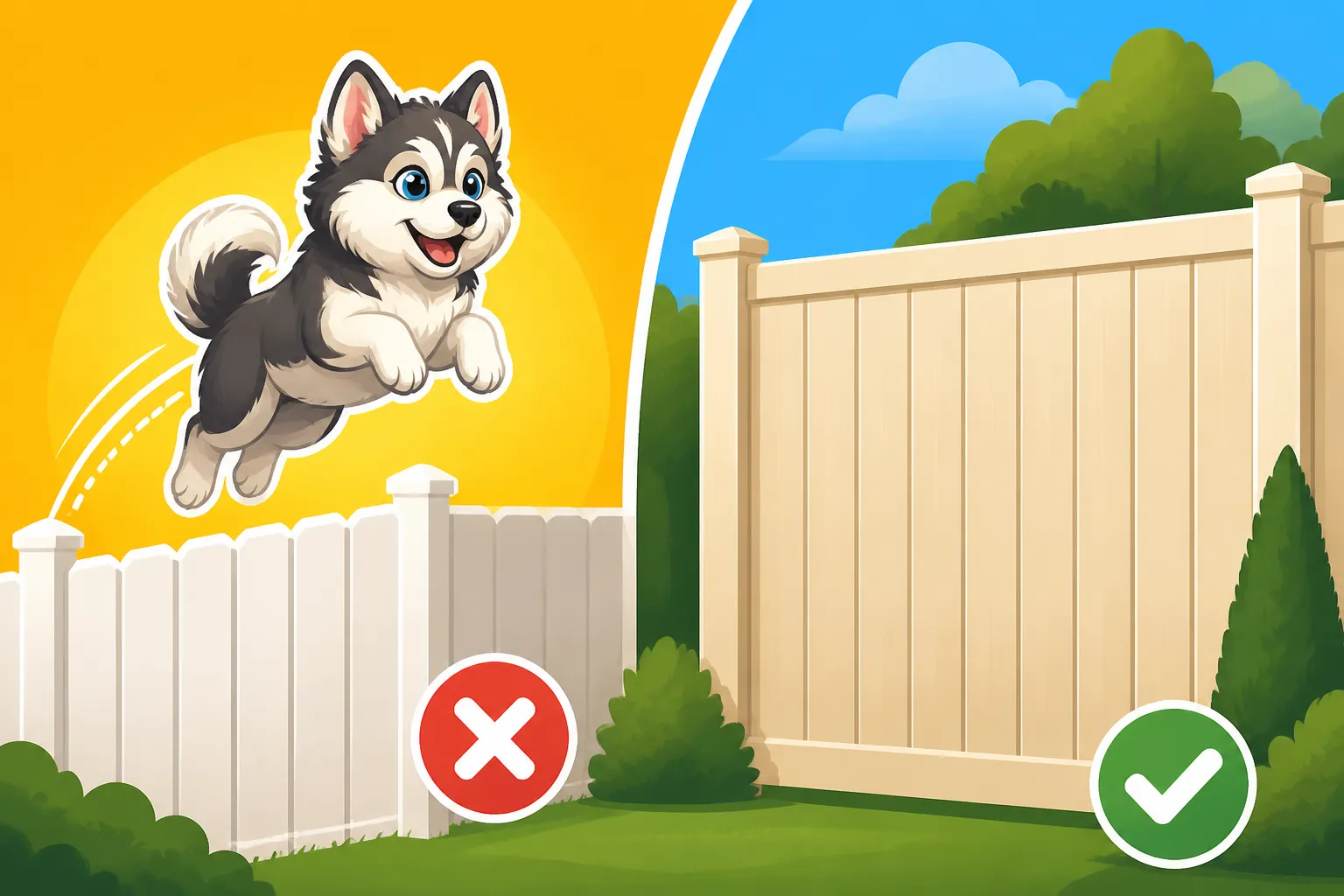
If you've ever had a dog that respects a standard 4-foot fence, prepare for a new reality with a Pomsky. For many Pomskies, a 4-foot fence is less of a barrier and more of a suggestion, or even a launching pad. They can often clear it with a running jump, especially if there's anything nearby to give them leverage. This isn't just about their physical prowess; it's also about their motivation. If there's an interesting smell, a squirrel, or another dog just beyond the fence, their determination to get to it can override everything else. It quickly becomes clear that a "typical" fence isn't going to cut it for these energetic pups.
Minimum Fence Height for a Pomsky
So, what's the magic number? While every dog is an individual, there's a widely accepted minimum that most Pomsky owners find necessary to prevent escapes by jumping.
The 6-Foot Recommendation and Why
For most Pomskies, a 6-foot fence is generally considered the minimum effective height. This height provides a significant visual and physical deterrent that most Pomskies won't attempt to jump. Think about it: a 6-foot fence is often twice the height of the dog, making it a much more formidable obstacle than a 4-foot fence. It takes a serious leap for even the most athletic Pomsky to clear 6 feet, and without any leverage, it's usually beyond their capabilities. Many experienced Pomsky breeders and owners will tell you that anything less than 6 feet is just inviting trouble. This isn't to say no Pomsky could ever clear it, but it dramatically reduces the chances.
Factors Influencing Jumping Ability
It's important to remember that the 6-foot rule is a guideline, and individual factors can influence your Pomsky's jumping prowess:
- Size and Build: A larger, more athletic Pomsky, perhaps one that leans more heavily towards its Husky genes, might be able to jump higher than a smaller, more Pomeranian-like counterpart. A Pomsky closer to 25-30 pounds with strong hindquarters will have more power than a dainty 10-pounder.
- Athleticism and Energy Levels: A Pomsky that's consistently under-exercised or has a naturally higher drive will be more motivated and capable of extreme feats of athleticism. A bored Pomsky is an inventive Pomsky, and all that pent-up energy has to go somewhere!
- Motivation: This is a huge one. If your Pomsky spots a rabbit, a squirrel, or another dog, their adrenaline can give them an incredible boost. The drive to chase or interact can make them push their physical limits.
- Environmental Aids: Look around your fence line. Are there trash cans, firewood piles, patio furniture, or even snow drifts that could give your Pomsky a boost? Anything that shortens the vertical distance to the top of the fence effectively lowers its true height for your dog. A clever Pomsky will absolutely use these to their advantage.
Beyond Height: Addressing Other Escape Routes
Focusing solely on fence height can be a trap because Pomskies are masters of finding other ways out. A tall fence is a great start, but it's only one piece of the puzzle. You need to think like a Pomsky.
The Digging Dilemma
The Husky side of your Pomsky often comes with an inherent love for digging. Huskies dig to hunt, to create cool dens in summer, or just out of sheer boredom. Your Pomsky might share this trait, and if they do, a 6-foot fence above ground won't matter if they can tunnel under it. Many a heartbroken owner has watched their beloved Pomsky disappear under a fence line. To combat this, you need to consider the barrier below ground.
One popular method is to bury wire fencing (often called "L-footers" or "dig guards") along the bottom of your fence, extending it inward into the yard by at least 1-2 feet, and burying it about 6-12 inches deep. This creates an invisible barrier that discourages digging. Another option is to pour a concrete footer along the base of your fence. While more expensive and labor-intensive, it's a nearly impenetrable solution. Even placing large, heavy rocks or paving stones along the inside base of the fence can deter some persistent diggers. You might want to read more about Whether a Pomsky Digs Under a Fence to understand the scope of this challenge.
Climbing and Scaling Surprises
Don't underestimate a Pomsky's ability to climb, especially if your fence type offers any kind of foothold. Chain-link fences are notorious for being climbable, as the gaps provide perfect little ladder rungs. Some wooden fences with horizontal slats can also be scaled. If your fence has cross-bracing on the inside, a nimble Pomsky might use that like a ladder.
To prevent climbing, consider adding "coyote rollers" to the top of your fence. These are PVC pipes or similar free-spinning cylinders attached to the top of the fence that prevent a dog from getting a grip and pulling themselves over. Another option is an inward-sloping "lean-in" or "L-extension" at the top of the fence, which angles back into your yard, making it physically impossible for the dog to get a good purchase to climb over. Even the smallest gaps in fencing can be an invitation for a Pomsky to Whether a Pomsky Climbs Chain Link.
Gate Security and Clever Openers
Your fence is only as strong as its weakest point, and that's often the gate. Pomskies are incredibly smart, and they will test every latch, every handle. A simple thumb latch or a basic hook-and-eye closure often isn't enough. Many stories exist of dogs learning to nose open spring-loaded gates or manipulate simple latches.
Invest in heavy-duty, secure gate hardware. Consider double-latching mechanisms, such as a strong deadbolt in addition to a standard gate latch, or latches that require opposing movements to open. Keyed entry from the outside adds an extra layer of security. Ensure your gate fits snugly within its frame, with no gaps big enough for a curious snout to wedge through. Gates should be as tall and secure as the rest of your fence, extending down to the ground or having buried deterrents if digging is an issue. Never underestimate your Pomsky's ability to figure out Whether a Pomsky Opens Doors and Gates if given enough time and motivation.
Additional Measures for the Determined Pomsky
Sometimes, even with the right fence, you'll need more than just physical barriers. A multi-pronged approach that includes training and enrichment can be the difference between a contained Pomsky and a frequent escapee.
Training for Boundaries and Recall
While a good fence is essential, training provides an invisible layer of security. Teaching your Pomsky strong boundary awareness can be incredibly helpful. Practice "leave it" or "stay" commands near the fence line, rewarding them for choosing to stay inside the boundary even when distractions are present. This helps them understand that the fence is a barrier they should respect, not just a challenge to overcome.
Crucially, work on a bulletproof recall. If, despite your best efforts, your Pomsky does manage an escape, a reliable "come" command can be a literal lifesaver. This takes consistent practice, high-value treats, and patience. Many owners lament how challenging it can be Building a Recall a Pomsky Answers for a breed with such an independent streak. Consider enrolling in positive reinforcement training classes, even if you just focus on recall.
Mental and Physical Enrichment
A bored Pomsky is a destructive Pomsky, and often, an escaping Pomsky. They are intelligent and high-energy dogs who need both physical exercise and mental stimulation to be happy and well-behaved. If they're not getting enough of either, they'll find ways to entertain themselves, and that often involves testing the limits of their enclosure.
Ensure your Pomsky gets adequate daily exercise. This means more than just a quick trot around the block. Think long walks, hikes, fetch sessions, or even structured playdates. Providing them with puzzle toys, snuffle mats, and engaging chew toys can help keep their minds active when they're indoors. Regular training sessions, even short ones, also count as mental enrichment. Never underestimate The Exercise a Pomsky Needs Every Day a Pomsky needs to stay sane and less inclined to escape.
Monitoring and GPS Tracking
For added peace of mind, especially if you have an escape artist in training, consider using a GPS tracker for your Pomsky. These small devices attach to their collar and allow you to track their location in real-time via a smartphone app. While not a substitute for a secure fence, it can be invaluable if your Pomsky manages to get out, significantly increasing your chances of finding them quickly. Brands available on Amazon offer a wide range of options, from simple trackers to more advanced models with activity monitoring. It's truly a game-changer for easing the anxiety of a potential escape, and many owners consider Whether a Pomsky Should Have a GPS Tracker a necessary investment.
Professional Guidance and Reinforcement
If you've tried everything and your Pomsky is still finding ways out, it might be time to call in the cavalry. A professional dog trainer or a veterinary behaviorist can help you identify specific triggers for your Pomsky's escape attempts and develop a tailored training plan. They can offer insights into your dog's specific motivations and suggest solutions you might not have considered. Resources like online platforms or local trainers, such as those associated with programs like BAXTER & Bella, can provide guidance and structure to address these challenging behaviors. Sometimes, an objective expert eye is exactly what you need to understand your dog's unique quirks and prevent a situation where you're constantly worried about What to Do When a Pomsky Bolts.
Remember, building The Fence a Pomsky Actually Needs is a long-term investment in their safety and your peace of mind. It often means going above and beyond what's considered "standard" for other breeds.
| Fence Feature | Effectiveness Against Pomsky Escapes | Additional Considerations |
|---|---|---|
| Height (6ft+) | High (prevents jumping) | Crucial minimum; reduces spontaneous jumps. |
| Dig Guards | High (prevents tunneling) | L-footers, buried wire, concrete footing. |
| Coyote Rollers | High (prevents climbing/scaling) | Free-spinning cylinders on top edge. |
| Lean-In Top | High (prevents climbing) | Inward-sloping top section of fence. |
| Secure Gate | High (prevents opening/pushing) | Double latches, heavy-duty hardware, no gaps. |
| Solid Panels | Moderate (reduces visual triggers) | Less effective against digging/climbing if not reinforced. |
| No Footholds | High (prevents climbing) | Smooth fence surface, no cross-bracing on inner side. |
In conclusion, stopping a Pomsky from escaping requires more than just a tall fence. It's a holistic approach that tackles their innate drive to explore, their intelligence, and their athleticism. By combining a robust physical barrier—starting with a 6-foot fence and addressing digging and climbing—with consistent training, mental enrichment, and smart tools like GPS trackers, you can create a safe and secure environment for your beloved Pomsky. It takes effort, but the peace of mind knowing your furry friend is safely contained is absolutely worth it.
Disclaimer
This article is for general informational purposes only and does not constitute professional advice. Laws, prices and regulations vary by location and change over time. Consult a qualified professional for guidance on your specific situation.