The Colors and Masks a Pomsky Comes In
One of the most exciting parts of bringing a Pomsky into your life is the sheer anticipation of what your puppy will look like! Many people picture a miniature Siberian Husky, complete with the iconic mask and striking blue eyes, but the truth is, the Pomsky's appearance is a wonderfully diverse blend of its parent breeds. This guide will dive deep into the fascinating array of colors and distinctive facial markings you might encounter, helping you understand the unique palette that makes each Pomsky truly one-of-a-kind.
The Core Color Palette of the Pomsky
When you first start looking at Pomsky puppies, you'll quickly realize that while the Siberian Husky influence is strong, the Pomeranian side adds its own delightful twists. The most commonly seen colors are often those familiar from the Husky, but even within these, there's a surprising spectrum of shades and intensities.
Black and White Pomskies
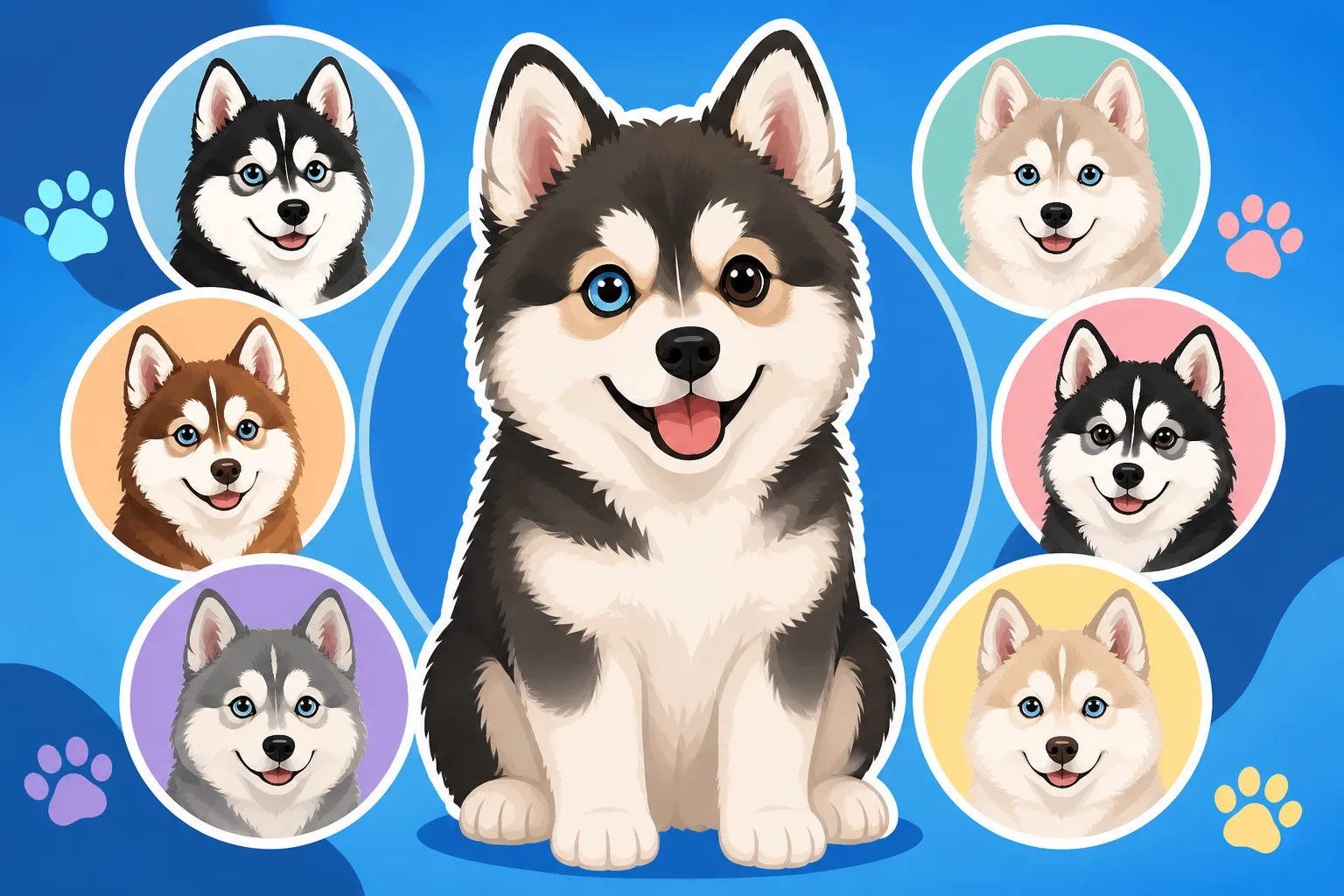
Ah, the classic! Many prospective Pomsky owners dream of a pup with that quintessential black and white Husky look, and for good reason – it's striking and absolutely beautiful. Black and white Pomskies can range from a stark, almost tuxedo-like contrast with crisp black markings against pure white, to a softer, more charcoal gray that might be seen as a diluted black. The black often appears on their backs, heads, and tails, while the white typically graces their chests, bellies, legs, and parts of their faces. You might see a black Pomsky with minimal white, or one with a predominantly white body and black patches. It’s never just "black and white" but a whole conversation in shades and patterns. Often, these dogs have dark eyes, but sometimes, a striking blue eye can appear, creating an even more captivating look.
The intensity of the black can also vary significantly. Some puppies start out with a very deep, rich black that might soften slightly as they mature, especially if they have a thicker undercoat that’s lighter in color. Others might have a more faded, almost smoky black from the start. This variation is part of the genetic lottery from their Husky and Pomeranian ancestry. The amount and placement of the white areas can also differ dramatically, from small "socks" on their paws to large white patches that cover most of their body, leaving only strategic black markings. This classic combination is probably what most people imagine when they hear the word "Pomsky."
Gray and White Pomskies
Beyond black, gray is another incredibly popular and diverse color in the Pomsky world, directly inherited from their Husky lineage. Just like with black, "gray" isn't a single shade. You'll find Pomskies in everything from a pale, almost silver-gray that looks ethereal, to a deep, rich charcoal that borders on black, and even a medium wolf-gray with subtle tan or cream undertones. Often, these gray and white Pomskies have beautiful multi-colored eyes, sometimes a blend of blue and brown, or even just piercing blue eyes, which contrast wonderfully with their coats.
The gray typically covers the same areas as black would – the saddle of their back, head, and tail – while white again fills in the chest, legs, and belly. A wolf-gray Pomsky, for instance, might have guard hairs that are banded with different colors, giving them a grizzled, wilder appearance that is truly stunning. This color variation often carries a more natural, wild aesthetic, reminiscent of their wolf ancestors. You might even find a Pomsky whose gray coat appears to have subtle flecks or shading of cream or tan mixed in, adding another layer of depth to their already intricate coloration. The interaction of their double coat, where the undercoat can be a lighter shade, can also influence the perceived gray.
Red and White Pomskies
Now, this is where things get really interesting and showcase the beautiful range the Pomsky offers! Red and white Pomskies are absolutely captivating and highly sought after by those who want something a little less conventional. The "red" in a Pomsky's coat isn't always what you'd typically think of as a vibrant fire-engine red. It can span a wide array of hues, from a deep, burnished copper or mahogany that is incredibly rich, to a light, almost ginger or strawberry blonde, and even a creamy, warm apricot.
These red tones are often paired with white markings in the usual places, creating a striking contrast. Some red Pomskies will have liver-colored noses and paw pads, which complement their warm coats beautifully. Others might retain black pigmentation for their nose and eye rims, providing an even more unique look. A true red Pomsky with bright blue eyes is a sight to behold, a truly stunning combination that often stops people in their tracks. It’s a color that expresses warmth and vibrancy, a beautiful counterpoint to the more common black or gray variants. Sometimes, the "red" might even appear as a deep orange or a very light fawn, depending on the underlying genetics. What a Red Pomsky Sells For is a topic many prospective owners consider due to the unique appeal of these colors.
Less Common, But Equally Stunning Pomsky Colors
While the black, gray, and red combinations are the most common, the Pomsky's genetic lottery can throw up some truly unique and less frequently seen colors and patterns. These variations often highlight the incredible diversity inherited from both the Siberian Husky and the Pomeranian.
Solid Colors
A Pomsky in a solid color is quite rare and often a surprise! When we think of Pomskies, we usually picture those distinct white markings. However, some Pomskies can be solid black, solid white, or even solid cream. A solid black Pomsky, for instance, will have an all-black coat without any significant white patches, though they might still have a small white blaze on their chest. These dogs often have dark eyes and a very sleek, powerful appearance. They can sometimes be mistaken for other breeds, but their compact Husky-like build usually gives them away.
Solid white Pomskies are equally stunning and possess an almost ethereal quality. It's important to distinguish these from albino dogs, as solid white Pomskies will still have dark pigmentation around their eyes and nose, and often dark eyes (though blue is possible). A solid cream Pomsky offers a softer, warm aesthetic, often with a slightly lighter undercoat that gives them depth. These solid coats are usually a result of specific recessive genes coming together, making them less common but highly distinctive.
Sable and Agouti Patterns
These patterns are a bit more complex and often misunderstood, but they create some of the most beautiful and intricate Pomsky coats. Sable refers to hairs that are banded with different colors, usually a lighter base with black tips. This gives the coat a shaded, often grizzled appearance that changes depending on how the light hits it. You might see a brown sable, where the base color is reddish-brown with black tips, or a cream sable, with cream hairs tipped in black. This banding creates a dynamic, multi-tonal effect that is truly captivating.
Agouti, often confused with sable, is another "wild type" pattern where each individual hair has bands of different colors (e.g., black, tan, cream, and white). This results in a coat that looks very natural and wolf-like, especially around the face and flanks. Whether a Pomsky's Coat Comes Out Pomeranian or Husky often influences the expression of these complex patterns. An agouti Pomsky might have a darker "mask" or shading around its eyes and muzzle, and its overall color can shift from dark to light depending on the blend of banded hairs. These patterns are less uniform than typical bi-colors and add a wonderful depth and natural beauty to the Pomsky's appearance.
Chocolate and Liver Pomskies
Chocolate or liver-colored Pomskies are another delightful, though less common, variant. This color typically manifests as a rich, warm brown that can range from a light milk chocolate to a deep, dark espresso hue. What distinguishes a true chocolate or liver Pomsky is the accompanying pigmentation: their nose, paw pads, and often their eye rims will also be brown or liver-colored, rather than black. This recessive trait creates a completely different overall aesthetic than the standard black-pigmented dogs.
These dogs usually have amber, gold, or even green eyes, which complement their warm coats beautifully. A chocolate and white Pomsky can be particularly striking, with the deep brown contrasting against bright white markings. This color is a testament to the diverse genetic possibilities within the breed, showcasing how traits from both parent breeds can combine in unexpected and gorgeous ways. If you're looking for something unique and warm-toned, a chocolate Pomsky might be just what you're hoping for. Remember, when you're looking for specific colors, a reputable breeder will understand the genetics behind these hues.
The Signature "Masks" and Markings
Beyond the base coat colors, the Pomsky's face is where much of its individual character truly shines, thanks to a captivating array of masks and markings. These facial features are a direct inheritance from their Siberian Husky ancestors and contribute significantly to their distinctive charm.
The Classic Husky Mask
The classic Husky mask is probably what most people envision when they think of a quintessential Pomsky. This striking marking involves dark fur covering the top of the head and around the eyes, often extending down the muzzle, while a white blaze runs up the center of the face, typically between the eyes. This creates the illusion of "goggles" or an eye mask, giving the dog an alert and sometimes mischievous expression. The mask can be incredibly well-defined, with sharp lines of color, or it can be softer and more blended.
What makes this mask so iconic is how it frames the eyes, especially if they are blue, amber, or bi-colored. It truly highlights the eyes as the focal point of the face. The pattern is not just about aesthetics; it’s a genetic trait that is highly sought after. Even within the classic mask, there's variation – some masks might be very broad, covering a larger portion of the face, while others are more delicate. Whether a Pomsky Has the Husky Mask is a common question, and thankfully, many do!
Open and Closed Masks
When we talk about masks, it's not a one-size-fits-all situation. The classic Husky mask can appear in several variations, notably as "open" or "closed" masks. A "closed mask" is characterized by a solid band of dark fur that completely encircles both eyes, often connecting over the bridge of the nose and sweeping up the forehead. This creates a very distinct, almost unbroken dark area around the eyes, with a white blaze running centrally. It gives the Pomsky a very dramatic and often intense look, like a superhero wearing a mask.
An "open mask," on the other hand, is less connected. Here, the dark fur around the eyes might be broken or less extensive, leaving more white or lighter fur in between the eye markings or on the cheeks. The white blaze might be wider, or the dark markings might resemble more of a "tear track" or individual patches around each eye rather than a continuous band. This gives a softer, sometimes more playful expression. Both open and closed masks are beautiful, and the preference often comes down to individual taste. It's truly fascinating to see how the same basic genetic pattern can be expressed in such diverse ways.
Other Facial Markings
Beyond the traditional masks, Pomskies can display a host of other charming facial markings that add to their individuality. A "blaze" is a white stripe that runs up the center of the forehead, often starting at the muzzle and extending between the eyes. This blaze can be narrow or broad, short or long, and can be the sole marking on an otherwise solid-colored face, or it can be part of a larger mask pattern. A crisp, symmetrical blaze is often considered very desirable.
Some Pomskies might have "goggles," where the dark fur creates rings around their eyes without a significant central blaze or connected mask. Others might have "eyebrows" – small patches of lighter or different colored fur just above their eyes, giving them an expressive, questioning look. There can also be "saddle" markings on the head, or distinct patches of color on the cheeks. Even the extent of the white on the muzzle and chin can vary, contributing to the overall facial pattern. These subtle differences ensure that no two Pomskies are exactly alike, even if they share similar core colors. Whether a Pomsky's Mask Fades is a valid concern, as some puppy masks can soften or change slightly as their adult coat comes in.
Understanding How Color and Markings Develop
The journey of a Pomsky's coat color and markings from puppyhood to adulthood is a fascinating one, often full of delightful surprises. It's not uncommon for a pup's initial appearance to evolve, sometimes subtly, sometimes dramatically.
Puppy Coat vs. Adult Coat
When you pick up a tiny Pomsky puppy, its coat might look one way, but don't be surprised if it undergoes some transformations as they mature. Puppy coats are notoriously soft, fluffy, and often don't show the full depth or final shade of their adult fur. For instance, a black and white puppy might have a softer, more muted black that deepens into a rich, true black over time. Similarly, a gray puppy's coat might appear lighter or darker than its eventual adult shade. Whether a Pomsky Puppy's Fluff Predicts the Adult Coat is a common concern for new owners, and while it gives clues, it's not always an exact match.
The patterns and masks can also become more defined or, conversely, soften. A faint blaze might become bolder, or a dark mask might become a bit less intense as the undercoat fills in. It's also possible for "ghost" markings to appear or disappear. For example, a solid-looking puppy might develop subtle brindling or a hidden pattern that wasn't visible in its fluffy puppy fur. This phenomenon is a natural part of canine development, especially in breeds with dense double coats like the Pomsky. The process of The Pomsky That Carries a Husky Coat at Twenty Pounds is a big factor here, as the density and structure of the double coat change.
Genetic Influences
At the heart of every Pomsky's unique coloring are the intricate genetics inherited from its Siberian Husky and Pomeranian parents. Both breeds carry a wide range of color genes, and when they combine, the possibilities are vast. Certain genes are responsible for the base colors like black, red, and brown, while others control the dilution of these colors (creating grays, creams, or sables). There are also genes that dictate the presence and pattern of white markings and masks. For example, the "s" locus gene is largely responsible for white spotting and the extent of white on the body.
The interaction of dominant and recessive genes plays a crucial role. A Pomsky might carry genes for a particular color but not express it if a dominant gene for another color is present. Understanding these basic genetic principles helps explain why a litter from the same parents can produce puppies with such varied appearances, from a classic black and white to a rare solid cream. Responsible breeders often consider the genetic background of their breeding pairs to predict potential color outcomes, though nature always has a way of surprising us.
Does Color Affect Price or Temperament?
This is a question that often comes up, and it's important to address with a dose of realism. Purely from a biological standpoint, a Pomsky's coat color or markings have absolutely no bearing on its temperament, intelligence, or overall health. A red Pomsky is just as likely to be playful and loving as a gray one. However, in the world of designer breeds, demand for certain aesthetic traits can influence pricing. For example, blue eyes or a very specific, well-defined "miniature Husky" mask might be marketed at a premium due to high buyer interest.
It's crucial for prospective owners to prioritize health, temperament, and responsible breeding practices over superficial traits like color. While it's natural to have a preference for a certain look, allowing color to be the sole deciding factor can sometimes lead to overlooking more important aspects of a puppy's well-being and suitability for your home. Focus on finding a reputable breeder who health tests their parent dogs and socializes their puppies, regardless of the shades they come in. While you might see Whether Two Blue Eyes Double a Pomsky's Price, remember that health and temperament should always be paramount.
Grooming and Maintaining a Pomsky's Coat
Regardless of the magnificent colors and markings your Pomsky boasts, maintaining the health and vibrancy of their double coat is a year-round commitment. Their beautiful fur is not just for looks; it serves essential protective functions.
Preserving Coat Color and Health
A Pomsky's double coat is designed to protect them from both heat and cold. The dense undercoat provides insulation, while the coarser guard hairs repel water and dirt. To keep their coat healthy and their colors vibrant, regular grooming is essential. This includes brushing several times a week, or even daily during shedding seasons, to remove dead hair and prevent matting. Mats can not only be uncomfortable but can also dull the coat's appearance and even lead to skin issues. Choosing the right tools, like an undercoat rake and a slicker brush, is crucial. Retailers like Chewy offer a wide selection of brushes and grooming supplies tailored for double-coated breeds, making it easy to find what you need.
Beyond brushing, proper nutrition plays a huge role in coat health. A high-quality diet rich in omega fatty acids can contribute to a shiny, lustrous coat and vibrant color expression. Regular bathing, but not too frequent, with appropriate dog-specific shampoos will help keep their coat clean without stripping natural oils. When bathing, always ensure you dry their double coat thoroughly to the skin to prevent skin irritation or hot spots. Shampoos That Suit a Pomsky's Double Coat are vital to prevent damage or dryness.
Shedding and Color Management
If you're bringing a Pomsky into your home, prepare for shedding! Pomskies inherit the double coat from both parents, and they are known for their "blowouts" twice a year, typically in spring and fall, when they shed their entire undercoat. During these periods, the amount of hair coming off your dog can be astonishing. Even outside of blowouts, they will shed moderately year-round. This shedding can sometimes make their coat appear lighter or less intense during certain times of the year, especially if their undercoat is a different shade than their guard hairs.
Managing shedding is key to maintaining a neat home and a healthy coat. Regular deshedding sessions with an undercoat rake can significantly reduce the amount of loose hair. A high-velocity dryer, often used by professional groomers, can also be a game-changer for blowing out dead undercoat after a bath. Products like deshedding shampoos and conditioners, also widely available at stores like Chewy, can assist in releasing loose hair. While you can't stop the shedding process, you can definitely manage it to keep your Pomsky's beautiful colors and patterns looking their best all year long. Embrace the brush, and you'll keep that stunning coat gleaming! How Much Undercoat Comes Off a Pomsky during a blowout is truly an experience.
| Pomsky Color Category | Common Appearance | Mask Variations | Nose/Pad Pigmentation | Eye Color Tendency |
|---|---|---|---|---|
| Black & White | Crisp black markings on white, range to charcoal | Classic full mask, open mask, minimal facial white | Black | Dark (brown), Blue, Bi-eyed |
| Gray & White | Various grays (silver, wolf, charcoal) on white | Classic full mask, open mask, "goggles" | Black | Blue, Bi-eyed, Dark (brown) |
| Red & White | Warm hues (copper, ginger, apricot) on white | Less defined mask, sometimes subtle shading | Black or Liver | Blue, Amber, Dark (brown) |
| Sable | Banded hairs with dark tips, wolf-like shading | Often darker facial shading, less distinct mask | Black | Dark (brown), Amber |
| Agouti | Multi-banded hairs, wild type, grizzled look | Distinct "dirty" mask, often smoky | Black | Dark (brown), Amber |
| Chocolate & White | Rich brown (milk to espresso) on white | Similar to black/gray masks, but in brown | Liver (brown) | Amber, Green, Blue |
| Solid White | Pure white coat, no markings | None, or very faint "ghost" markings | Black or Liver | Blue, Dark (brown) |
| Solid Black | Entirely black coat, minimal or no white | None, or small white chest patch | Black | Dark (brown) |
| Solid Cream | Uniform creamy tan coat | None, or faint lighter shading | Black or Liver | Dark (brown) |
Disclaimer
This article is for general informational purposes only and does not constitute professional advice. Laws, prices and regulations vary by location and change over time. Consult a qualified professional for guidance on your specific situation.