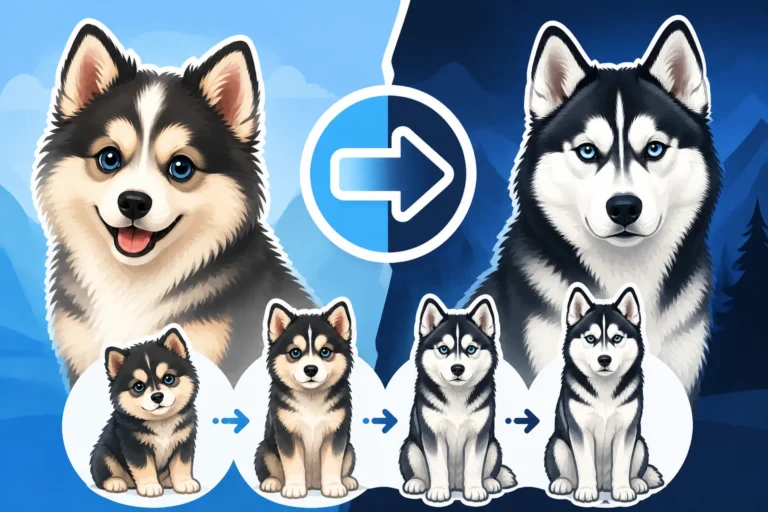
The Age a Pomsky Reaches Full Size
A Pomsky puppy can look nearly grown one month and still gain height, muscle, and weight the next. That makes it hard to know when puppy food, harnesses, or exercise routines should change. This guide explains when Pomskies usually reach adult size, why their growth varies, how to track it sensibly, and which changes are worth discussing with your veterinarian.
When a Pomsky usually reaches full size
Height and body length often settle before weight
There isn’t one birthday when every Pomsky is suddenly fully grown. Many are close to their adult height somewhere around their first birthday, but some continue developing for longer. A Pomsky with a larger frame or a Husky-leaning build may keep growing into the 12-to-18-month range. Smaller dogs may reach much of their adult height earlier.
Height is only one part of the picture. A young dog may stop getting taller but still gain muscle and fill out through the chest and shoulders. That can make a 10-month-old Pomsky look lanky, then noticeably sturdier a few months later, even if the measuring tape barely changes.
It helps to think of “full size” as a gradual transition rather than a switch. A dog may be close to its adult height, still changing shape, and not yet at its settled adult weight—all at the same time. For a wider look at expected adult dimensions, see How Big a Pomsky Gets and What a Pomsky Actually Weighs Full Grown.
A practical growth timeline
The age ranges below are general guideposts, not promises. Pomskies vary considerably, and an individual dog may move through these stages earlier or later.
| Approximate age | What you may notice | What to focus on |
|---|---|---|
| 2 to 6 months | Rapid growth; legs, paws, and body proportions can change quickly | Regular meals, safe activity, and routine veterinary checkups |
| 6 to 12 months | Growth may slow; many dogs approach adult height, but proportions can still look adolescent | Track weight and body condition rather than judging by appearance alone |
| 12 to 18 months | Some Pomskies continue filling out or gaining a little height, especially if larger-framed | Ask your vet whether growth, food, and body condition look appropriate |
| After 18 months | Most dogs are near their adult frame, though weight can still change with activity, diet, or neutering | Maintain a healthy body condition and adjust portions as needed |
A growth chart is most useful when you record measurements consistently. Weigh your Pomsky on the same scale when possible, around the same time of day, and note the date. If your puppy is too wiggly for a household scale, you can weigh yourself while holding the dog and subtract your own weight, though that method is less precise. A veterinary clinic can also help establish a reliable baseline.
A small digital pet scale may be convenient for a puppy that is still easy to lift. If you’re comparing options through a retailer such as Chewy, focus on whether the scale is stable, easy to read, and large enough for your dog to stand on comfortably. The important part is not the brand or a perfect weekly measurement; it’s noticing the overall trend.
Why Pomsky growth is difficult to predict
A mixed breed does not follow a single size schedule
Pomskies come from Pomeranian and Siberian Husky ancestry, but that does not mean every puppy lands halfway between the two breeds in either size or growth rate. A litter can include puppies with different frames, proportions, and adult weights. Even siblings raised in the same home may mature at different speeds.
Generation can add another layer of variation. An F1 Pomsky is a first-generation cross, while later-generation dogs have more complicated combinations of ancestry. Those labels describe breeding history; they do not guarantee a particular adult size or a predictable age of maturity. For a closer look at how much puppy size estimates can tell you, read Whether a Pomsky Puppy's Size Can Be Predicted and Whether Parent Weights Predict a Pomsky's Size.
Parents’ size is still useful context, but it is only one clue. A puppy may take after one parent more strongly, and a breeder’s estimate is still an estimate. Ask for the parents’ actual adult weights, the puppy’s age and current weight, and the growth history of related litters if available. Treat an exact adult-weight promise with caution, especially when the puppy is very young.
Labels such as toy and micro are not a growth guarantee
People often search for a “toy” or “micro” Pomsky because they want a dog that will stay very small. Those words can be used inconsistently, and they do not override genetics or a puppy’s individual development. A tiny puppy is not automatically destined to remain tiny, just as a puppy with oversized paws is not guaranteed to become a large adult.
If a seller gives you a size estimate, ask how it was reached. A useful discussion includes the puppy’s current growth curve and information about both parents—not just a label or a photograph. You can also read Whether a Toy or Micro Pomsky Is Real and Whether a Pomsky Stays Under Twenty Pounds before making plans around a particular adult size.
Size uncertainty matters in everyday ways. A crate, harness, travel carrier, and exercise plan that suit a very small puppy may not fit a larger adolescent. It is sensible to buy adjustable equipment where possible and check the fit as your dog grows. A harness that rubs under the legs or a carrier your dog has outgrown is more than an inconvenience; it can make walks and trips stressful.
How to tell whether your Pomsky is still growing
Track more than the number on the scale
A weekly weight can be useful for a young puppy, but one measurement cannot tell you the whole story. Look at the pattern across several weeks and pair it with changes in height, body length, and body condition. You may find that weight gain slows even while your dog’s body is still maturing.
Body condition is often more helpful than comparing your dog with another Pomsky online. In a dog at a healthy condition, you should generally be able to feel the ribs beneath a light covering, without them being sharply visible. From above, there should be some waist definition; from the side, the abdomen should tuck up rather than hang heavily. Coat volume can make these checks tricky, so use your hands rather than relying on a fluffy silhouette.
Keep a simple record: date, weight, food amount, major changes in activity, and any comments from your veterinarian. If you shop for food through Chewy or another retailer, keeping the packaging or order information can help you remember which formula your puppy was eating and when it changed. That context can be handy if appetite or stool changes during a food transition.
Ask your veterinarian about growth concerns
Bring up growth at routine puppy visits, particularly if your Pomsky’s weight curve changes sharply, your dog seems unusually thin or heavy, or you’re unsure whether the current diet is appropriate. A veterinarian can assess body condition, discuss expected development based on your dog’s frame, and help you decide whether a food change is timely.
It is worth checking in sooner if your puppy stops gaining weight while still growing, loses weight unexpectedly, has persistent digestive trouble, or seems unusually tired. Those signs do not automatically mean something serious is wrong, but they deserve attention rather than an online comparison with another dog. If one leg seems painful, your puppy limps repeatedly, or movement suddenly changes, ask the clinic for advice rather than assuming it is a normal growth phase.
Remember that growth is not always perfectly smooth. A puppy may appear to pause for a while and then gain again. What matters is the overall picture: energy, appetite, movement, body condition, and the trend in measurements. If you are wondering specifically about changes after the first birthday, Whether a Pomsky Grows After a Year explores that question further.
Food, exercise, and equipment as your Pomsky matures
Adjust meals to the dog, not just the calendar
Puppy food supports growth, but there isn’t a universal birthday when every Pomsky should switch to adult food. The right timing depends on the dog’s size, development, diet, and veterinary guidance. If your Pomsky looks close to adult height but is still filling out, don’t make a change simply because a calendar says your puppy has reached a certain age.
Use the feeding guide on the food as a starting point, then check portions against your dog’s body condition and activity. Those guides cannot account for every individual dog. If your Pomsky is gaining too quickly, ask your veterinarian whether the portion or treat routine needs adjusting before cutting food sharply. If your puppy is not gaining as expected, get guidance before adding supplements or switching formulas.
When changing foods, transition gradually unless your veterinarian advises otherwise. If your current food was ordered through Chewy, save the product details so you can compare the formula and feeding directions when considering another option. The goal is a suitable, consistent diet—not chasing a product that promises to make a Pomsky reach a particular size.
Keep activity age-appropriate while the frame develops
Puppies need play and exploration, but a growing dog does not need to be pushed into long, repetitive exercise to “build” an adult body. Let activity develop gradually, with chances to rest. A short walk with sniffing breaks, indoor games, and gentle training can provide useful stimulation without turning every outing into an endurance test.
Pay attention to how your Pomsky moves during and after activity. If your puppy repeatedly sits down, lags, seems sore, or is reluctant to move later, shorten the next outing and discuss the pattern with your veterinarian. Avoid encouraging repeated high jumps from furniture or intense, repetitive running, especially while your dog is still growing. For broader guidance on expected size and day-to-day care, What Nobody Warns a Pomsky Buyer About can help put ownership questions into context.
Check collars, harnesses, beds, and carriers as your dog’s body changes. Equipment that fit a few months ago may become tight across the chest or restrict movement. Chewy may be one place you look when replacing an item, but whichever store you use, measure your Pomsky and follow the manufacturer’s sizing guidance rather than buying based on age alone. A comfortable fit and a steady growth record are more useful than guessing that your dog has reached adult size.
Disclaimer
This article is for general informational purposes only and does not constitute professional advice. Laws, prices and regulations vary by location and change over time. Consult a qualified professional for guidance on your specific situation.