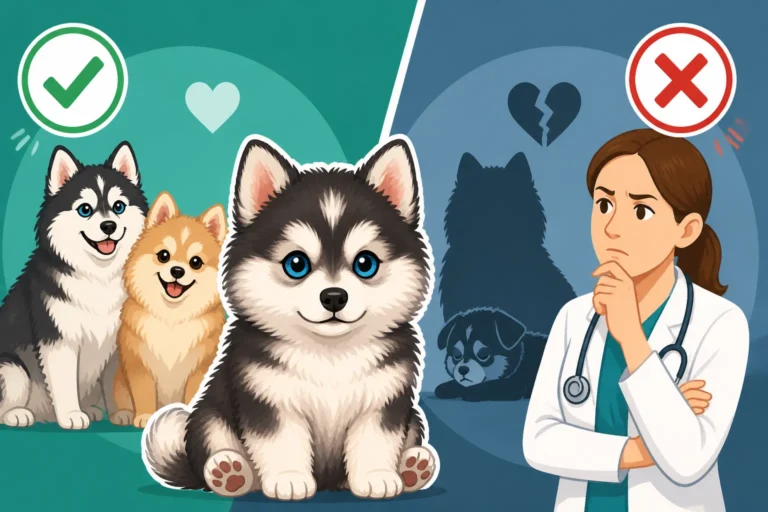
Whether a Pomsky Puppy’s Size Can Be Predicted
A Pomsky puppy’s adult size can’t be predicted from one photo, a pair of oversized paws, or a breeder’s confident estimate. The Pomeranian–Siberian Husky cross can vary widely, even among littermates. This guide explains which clues are useful, what they can and can’t tell you, and how to plan for a dog whose final size remains uncertain.
Why predicting a Pomsky’s adult size is difficult
Pomskies inherit a range of traits, not a guaranteed midpoint
A Pomsky is a cross between two breeds with very different typical sizes. It may seem reasonable to expect every puppy to grow into a neat halfway point, but inheritance doesn’t work like averaging two numbers. A puppy can take more after its smaller Pomeranian parent, more after its larger Husky parent, or land somewhere between them. Even puppies from the same litter may mature into noticeably different-sized dogs.
That variation is why a puppy’s appearance can be misleading. A Pomsky who looks tiny at eight weeks may still inherit a larger frame, while a chunky, fluffy puppy may turn out more compact once the coat and puppy proportions change. Growth also happens in stages. A puppy may seem to shoot up in height, then add weight more gradually as its body matures.
The broad size possibilities are worth understanding before you commit to a puppy. Read What a Pomsky Actually Weighs Full Grown for a wider look at adult size, and remember that any general range describes a population, not a promise about one particular dog.
Generation names don’t guarantee size
Terms such as F1 and multigenerational describe a puppy’s ancestry. They don’t function as a size label. An F1 Pomsky is a first-generation cross, but that does not mean every F1 puppy will be the same size or inherit a perfectly balanced set of traits. You can learn more in What an F1 Pomsky Is.
A breeder may suggest that a later-generation Pomsky will be more predictable. That may be possible when a breeding program has consistent, well-documented dogs, but the generation label alone does not make an individual puppy’s adult weight certain. It matters which dogs were bred, what their own adult sizes were, and how previous relatives developed. Whether a Multigen Pomsky Is More Predictable offers more context on what generation can—and cannot—tell you.
Be cautious with descriptions such as “micro,” “teacup,” or “toy” if they are presented as guarantees. These labels are not a dependable substitute for a documented growth history, and they don’t ensure that a puppy will stay unusually small. A small puppy can also simply be younger, underweight, or growing at a different pace from its littermates. For more on the labels, see Whether a Toy or Micro Pomsky Is Real.
Clues that can help estimate a puppy’s size
Start with both parents’ adult weights and build
The parents are usually more informative than a puppy’s paws or coat. Ask for each parent’s adult weight, height if available, and body condition. A weight taken when a dog is overweight or underweight can distort the picture, so it helps to know whether the parent is in a healthy condition. Also ask whether those measurements are documented or simply remembered.
Look beyond the two parents where possible. Adult sizes among grandparents, aunts, uncles, and older siblings can show whether a line tends to produce similarly sized dogs or a broad mix. A breeder who can discuss the actual growth of previous puppies from related pairings is giving you more useful information than one who offers a precise prediction without explaining its basis.
Even then, parent size is a clue rather than a formula. A puppy’s inheritance is not a simple blend, and a dog can take after an ancestor that is larger or smaller than either parent. For a closer look at the limits of this clue, read Whether Parent Weights Predict a Pomsky's Size.
| Clue | What it may tell you | What it cannot guarantee |
|---|---|---|
| Adult weights of both parents | The broad size range in the immediate family | That a puppy will fall halfway between them |
| Sizes of relatives and earlier litters | Whether the breeding line tends to be consistent or variable | That every puppy from the line will match relatives |
| Puppy’s weight over time | Whether growth is steady and how the puppy compares with its own earlier measurements | A precise adult weight from one measurement |
| Age and body condition | Whether a comparison is meaningful | That two puppies of the same weight will mature alike |
| Paw size or fluffy appearance | A small piece of the puppy’s overall look | Reliable adult height or weight |
Track growth over several weeks, not just once
A single weigh-in is only a snapshot. Regular measurements, taken under similar conditions, are more useful because they show the puppy’s own growth pattern. If you bring home a puppy, record the date, age, weight, and any relevant notes, such as a recent illness or a change in appetite. A simple notebook or phone spreadsheet works well.
Use the same scale when you can, and weigh the puppy in a consistent way. A small puppy may fit on a household or pet scale; for a larger dog, your veterinary clinic can help with accurate measurements. If you’re looking for supplies, Chewy may be one place to check for a pet scale or measuring tape. The important part is not where you buy the tools, but using them consistently and recording the results.
A chart can help you notice whether growth is steady, but it should not be treated as a crystal ball. Online calculators and breed-based growth charts may not be designed for a cross with such variable ancestry. If a chart suggests a dramatic change or the puppy’s growth seems to stall, ask your veterinarian to interpret the measurements in context rather than changing food or feeding amounts based only on a projection.
Don’t use paws, coat, or puppy photos as a measuring tool
Big paws are often treated as a sign that a puppy will become a big dog. They may be one visual clue, but they are not dependable enough to support a confident estimate. Puppies can look temporarily out of proportion as they grow, and paw size alone doesn’t reveal the dog’s eventual frame, body condition, or weight.
Fluff can make the uncertainty worse. A dense puppy coat may create the impression of a larger body, while a coat that lies close to the frame can make a puppy look smaller. Coat texture and length can change as a Pomsky matures, so a photo is particularly poor evidence for estimating adult weight. Whether a Pomsky Puppy's Fluff Predicts the Adult Coat explains why that puppy softness doesn’t necessarily show what the adult coat—or body—will look like.
Photos also hide important details. Camera angle, distance, posture, and the size of objects nearby can make a puppy appear larger or smaller. If a breeder shares pictures, ask for the puppy’s age and current weight alongside them. That information still won’t give you a guaranteed adult size, but it is more useful than comparing photos of puppies taken at different ages.
How to use a size estimate when choosing a puppy
Treat a breeder’s estimate as a range, not a promise
A careful breeder should be comfortable talking about uncertainty. Ask how they estimated adult size, what the parents and close relatives weigh, and whether they can share growth records from older puppies in the same line. A thoughtful answer might describe a likely range and explain the evidence behind it. A very exact prediction deserves follow-up questions, especially if it is based mainly on a puppy’s current appearance.
Ask what happens if the dog grows larger than expected. The answer can help you understand whether the breeder is focused on matching puppies to suitable homes or selling a particular size image. A responsible conversation should make room for the possibility that the puppy may not stay within a buyer’s preferred weight limit.
It is also reasonable to ask how the breeder tracks puppy growth and whether a veterinarian has checked the litter. If the breeder has little information about parentage, health screening, or the adults’ sizes, don’t let a confident size claim fill those gaps. Whether an Untested Pomsky Litter Is Worth Buying can help you think through what unanswered questions mean when evaluating a litter.
Plan for the dog you can care for, not the smallest possible outcome
If your home, budget, or daily routine only works with a very small dog, a Pomsky’s uncertainty deserves serious consideration. A puppy marketed as small may grow beyond the size you pictured. That can affect practical choices such as carrier fit, harness size, travel arrangements, and how easily the dog can be lifted. It can also change how much room the dog needs to move comfortably, even if the home itself is suitable.
Choose equipment that can accommodate growth where possible. An adjustable harness can be easier to manage than buying several fixed sizes as the puppy develops, though it still needs to fit securely at every stage. If you compare harness options through Chewy or another retailer, check the product’s sizing guidance against the puppy’s actual measurements rather than choosing based on the breeder’s adult-size estimate.
For a crate, bed, or travel setup, think about function and safety as well as the puppy’s current dimensions. A crate should allow the dog to stand, turn around, and lie down comfortably, but an oversized crate may not be the best solution during early house training. Chewy can be a convenient place to browse pet supplies, but product descriptions won’t resolve the underlying uncertainty: your puppy may outgrow an item sooner than expected. Keep receipts and review return policies before buying several pieces of equipment in advance.
Make feeding and health decisions with your veterinarian
Size estimates should not be used to restrict a puppy’s food in an effort to keep the dog small. A growing puppy needs an appropriate diet and enough food to support healthy development. Follow the feeding guidance for the puppy’s food as a starting point, then ask your veterinarian to adjust the plan based on age, activity, body condition, and growth.
A healthy puppy should not be judged by weight alone. Your veterinarian can assess body condition and growth together, and can tell you whether the puppy’s progress looks appropriate. If the puppy is gaining too quickly, losing weight, eating poorly, or not growing as expected, the right response is a veterinary conversation—not trying to manipulate the dog’s adult size through feeding changes.
It’s normal for owners to worry when a puppy seems smaller or larger than expected. Keep a record of meals, weight, and changes in energy or appetite, and bring it to appointments. That history can make it easier to distinguish ordinary variation from a concern that needs attention. The goal is a healthy adult dog, not hitting a predicted number on a chart.
What to do when your Pomsky grows differently than expected
Revisit the estimate as the puppy matures
A size estimate is most useful when it is updated as new information arrives. Recheck the puppy’s weight periodically, note how its body is changing, and compare its development with its own earlier measurements. Don’t overinterpret normal week-to-week fluctuations, particularly if the puppy has just had a growth spurt or is recovering from a disruption in routine.
As your puppy matures, the shape of the body may change as well as the number on the scale. A lanky adolescent can look quite different after filling out, and a thick coat can make it harder to see the underlying frame. Keep your veterinarian involved in interpreting these changes, especially if you have concerns about body condition or mobility.
If the adult dog ends up outside the breeder’s estimate, that doesn’t automatically mean something is wrong. Mixed-breed size is difficult to predict precisely. The practical question is whether the dog is healthy and whether your household can meet its needs at its actual size. If you are still comparing possible adult weights, What a Pomsky Actually Weighs Full Grown is a helpful companion topic.
Separate healthy growth from the pressure to buy “small”
A promise that a Pomsky will remain exceptionally small should not be treated as proof of careful breeding or sound health. The smallest puppy in a litter is not automatically the healthiest, and selecting for extreme smallness can raise concerns if the dogs’ health and welfare are not the priority. Whether the Smallest Pomskies Are Healthy explores why “smallest” is not the same as “best.”
Before choosing a puppy, consider whether you would still be happy with the dog if it grew larger than the estimate. If the honest answer is no, pause and think about whether another breed or an adult dog with a known size would suit you better. That isn’t a failure; it’s a way to avoid placing unrealistic expectations on a puppy.
The most responsible prediction is a cautious one: parent size, family history, and steady growth can help you form an informed expectation, but none can guarantee an exact adult weight. Make room for that uncertainty in your plans, and choose based on the dog you can care for—not only the size you hope to get.
Disclaimer
This article is for general informational purposes only and does not constitute professional advice. Laws, prices and regulations vary by location and change over time. Consult a qualified professional for guidance on your specific situation.