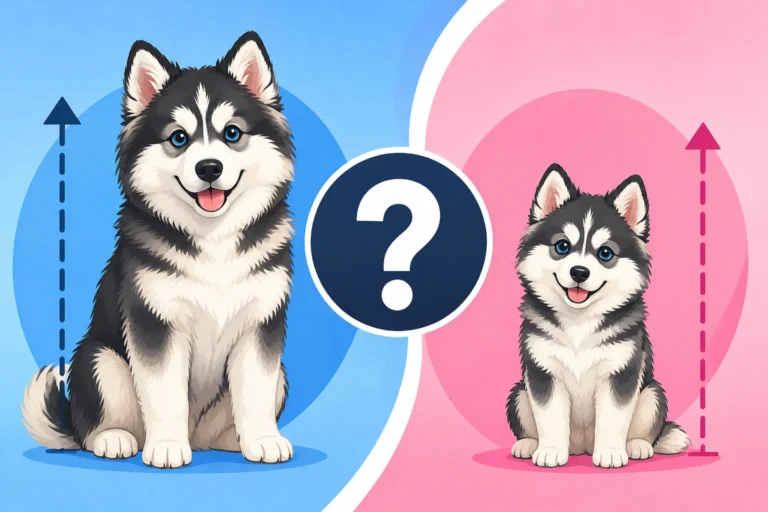
Whether Parent Weights Predict a Pomsky’s Size
A Pomsky puppy’s parents can offer useful clues about adult size, but their weights cannot guarantee what your dog will weigh. That uncertainty can be frustrating when you are choosing a puppy, planning for an apartment, or budgeting for food and equipment. This guide explains what parent size can tell you, what it cannot, and how to make a more realistic estimate.
How much do a Pomsky’s parents predict adult size
Parent weights are clues, not a size guarantee
A Pomsky’s adult size is influenced by inherited traits from both parents, so the size of the mother and father matters. If both are similar in height and weight, that may offer a more useful clue than a pairing with a wide size gap. But a puppy does not simply grow into the average of its parents. It inherits a mix of traits, and littermates can end up noticeably different from one another.
That is why a breeder’s estimate should be treated as a range rather than a promise. A puppy from two relatively small parents could grow larger than expected if it inherits a bigger build from earlier generations. A puppy from a larger parent could still be comparatively small. Parent weights are part of the picture, but they do not tell you exactly which combination of traits a particular puppy will inherit.
It helps to look beyond the parents’ numbers. Ask how much adult relatives from previous litters weigh, and whether the breeder has records for grandparents or other close relatives. A history of similarly sized adult dogs may provide more context than a single pair of parent weights. For a broader overview of adult size ranges, see What a Pomsky Actually Weighs Full Grown and How Big a Pomsky Gets.
Why parent size can be especially hard to interpret
Pomskies vary in their ancestry and generation. An F1 Pomsky is a first-generation cross between a Pomeranian and a Siberian Husky, while later generations may have different combinations of Pomsky and parent-breed ancestry. That variation can affect how predictable size appears from one litter to another. If you are unfamiliar with generation labels, What F1 Means on a Pomsky explains what the term describes; it does not, by itself, promise a particular adult size.
A breeder may also have dogs from different lines whose mature builds vary. Two dogs with similar weights might not have the same proportions: one could be short-legged and compact, while the other is taller and more lightly built. Weight alone does not capture height, bone structure, body length, or muscle. Those differences can matter when you are trying to judge whether a dog will fit comfortably in a carrier, on a lap, or in a small home.
A useful question is not only “How much do the parents weigh?” but also “How do the adult dogs from this line tend to develop?” Ask for the parents’ approximate adult heights and weights, the ages at which those measurements were taken, and details about adult offspring if the breeder has them. You can also read about Why Pomsky Breeders Prefer F2 and Beyond and Whether a Multigen Pomsky Is More Predictable to understand why generation and family background are part of the discussion.
What makes a puppy grow larger or smaller than expected
Inherited traits and family history
A puppy receives genes from both parents, but siblings do not inherit identical sets of genes. One puppy may take after the smaller parent in frame and the larger parent in another trait; a littermate can inherit a different mix. This is one reason two puppies from the same litter may not reach the same adult weight, even when they are raised in the same home.
Family history can help put an estimate into perspective, but it still cannot remove uncertainty. A breeder who has raised several generations may be able to describe a pattern in their lines, yet an individual puppy can fall outside that pattern. If the breeder has adult offspring from previous litters, ask about the full range of their sizes rather than only the smallest or most striking example.
Be cautious when a seller emphasizes tiny parents as proof that a puppy will stay tiny. Small parent dogs may increase the chance of a smaller puppy, but they do not establish a firm upper limit. Labels such as “micro,” “mini,” or “toy” are not substitutes for documented family history or a clear explanation of what size range the breeder has actually observed. For related questions, see Whether a Toy or Micro Pomsky Is Real and Whether the Smallest Pomskies Are Healthy.
Growth, nutrition, and body condition
A puppy’s weight changes quickly as it grows, and an early measurement cannot reliably settle its adult size. Growth rates vary. Some puppies may look as if they are growing rapidly for a while and then slow, while others fill out gradually. A single weigh-in is less informative than a series of measurements taken over time and interpreted alongside the dog’s age, frame, and general health.
Food matters for healthy development, but feeding extra does not safely make a puppy grow into a particular size. Overfeeding can lead to excess body fat and put unnecessary stress on developing joints. Underfeeding can also interfere with health and growth. Ask your veterinarian to help you choose an appropriate diet and feeding amount for your puppy’s age, expected adult build, and body condition.
It can be useful to weigh your puppy regularly using the same scale and note the date and age alongside each measurement. A small household or pet scale may help with consistency; retailers such as Chewy can be one place to compare available pet-care equipment, but check that any scale is appropriate for your puppy’s size. These measurements help track development—they are not a formula for calculating a guaranteed adult weight.
How to make a more realistic adult size estimate
Ask the breeder specific, verifiable questions
Before choosing a puppy, ask the breeder for the adult weights and heights of both parents and whether those figures were measured or estimated. Then ask about adult relatives and puppies from previous litters. If a breeder has only young offspring to discuss, say so plainly: those puppies may not yet be old enough to provide a useful picture of mature size.
Request the breeder’s expected size range and ask what evidence supports it. A careful breeder should be comfortable explaining uncertainty, including the possibility that a puppy could end up outside the estimate. Be wary of a guarantee based only on the parents’ weights or a puppy’s appearance at a few weeks old. Whether a Pomsky Breeder Can Guarantee Adult Size and What Happens If a Pomsky Doubles the Estimate cover the expectations and practical concerns that can come up when a dog grows beyond an estimate.
It is also reasonable to ask how the breeder describes adult size in their contract and what happens if the dog grows larger than anticipated. Read the wording rather than relying on a verbal assurance. If you are still assessing a breeder, The Health Tests a Pomsky Breeder Should Show offers another set of questions to consider alongside size and family history.
Track growth without trying to predict every pound
Once your puppy is home, keep a simple record of weight and age. Your vet can assess whether growth appears appropriate for your individual dog, especially if there are concerns about appetite, body condition, or an unexpected change in weight. Measurements are most useful when they are consistent and considered over time, rather than treated as proof that a particular adult size is inevitable.
For a home estimate, compare several pieces of information: the puppy’s current age and weight, the parents’ adult builds, the range seen in close relatives, and the puppy’s body condition. None of these inputs produces a certain answer, but together they help you plan more sensibly. A puppy growing steadily and remaining lean is different from one who is gaining excess body fat; the scale alone cannot tell you which is happening.
This practical approach is especially helpful when choosing equipment. Rather than buying everything based on the smallest adult estimate, select adjustable items where possible and check product measurements before ordering. Chewy may be useful for browsing items such as adjustable harnesses or different bed sizes, but compare the listed dimensions with your puppy’s actual measurements. The goal is to accommodate the dog you have as it grows, not to force it to match a prediction.
| Information to check | What it can tell you | What it cannot guarantee |
|---|---|---|
| Both parents’ adult weights | A starting point for the family’s size range | The puppy’s exact adult weight |
| Parents’ height and build | Whether the dogs are compact, tall, or heavier framed | How the puppy’s proportions will develop |
| Adult relatives and previous offspring | Whether a size pattern appears across the family | That every puppy in a new litter will follow it |
| Puppy’s weight over time | Whether growth is changing steadily | A precise final weight from one measurement |
| Generation and ancestry | Context about the puppy’s background | A fixed size based on a generation label |
| Veterinarian’s assessment | Guidance on healthy growth and body condition | A guarantee of adult size |
Planning for a Pomsky when the adult size is uncertain
Plan for a range rather than the smallest estimate
If your housing, travel plans, or daily routine depend on a dog staying below a particular size, be conservative. A small puppy can grow into a sturdier dog than expected, and a size estimate should not be treated as a dependable promise. Think through the practical upper end of the range the breeder describes: would the dog still fit your home, travel setup, and budget if it became larger than the idealized estimate?
This matters for more than food portions. Adult size can affect harness fit, carrier dimensions, vehicle restraints, and whether a dog can comfortably be lifted. A larger-than-expected Pomsky is still the same companion, but it may call for different equipment and more planning. Choosing adjustable gear and checking measurements before buying can prevent the frustrating cycle of replacing items that no longer fit.
Keep the uncertainty in perspective, too. The point is not to assume that every Pomsky will grow large, but to avoid making a long-term decision based on the most appealing possibility alone. If a seller’s estimate sounds unusually exact, ask how it was reached and what the breeder considers a realistic range.
Separate size expectations from health and care needs
A particular weight does not determine whether a Pomsky is healthy or easy to care for. Body condition, movement, energy, and veterinary findings all matter. A naturally small dog should not be pushed to stay smaller through restricted feeding, and a naturally larger dog should not be treated as overweight solely because it exceeds an advertised estimate. Your veterinarian can help distinguish an appropriate build from excess weight.
Size also does not erase the care needs that come with the breed mix. A Pomsky may have a substantial coat, an active temperament, and a need for thoughtful training regardless of whether it is at the smaller or larger end of its family’s range. If size is the deciding factor in your search, consider whether you can accommodate some variation before you commit.
If the uncertainty itself feels difficult, it may be worth taking more time to compare breeders and ask for adult-family information. A transparent estimate is more useful than a confident promise that cannot be supported. Chewy can be one option for checking equipment dimensions as your puppy grows, but the most reliable guidance about healthy growth comes from your vet and the dog’s own measurements.
Disclaimer
This article is for general informational purposes only and does not constitute professional advice. Laws, prices and regulations vary by location and change over time. Consult a qualified professional for guidance on your specific situation.