Whether a Male Pomsky Outgrows a Female
A male Pomsky may grow larger than a female, but sex alone is a poor way to predict an individual dog’s adult size. Pomskies can vary widely because they inherit different combinations of traits from their Pomeranian and Siberian Husky parents. This guide explains what sex can tell you, what matters more, and how to track your puppy’s growth without getting caught up in unreliable size promises.
Do male Pomskies usually grow larger than females
The usual difference is modest, not a guarantee
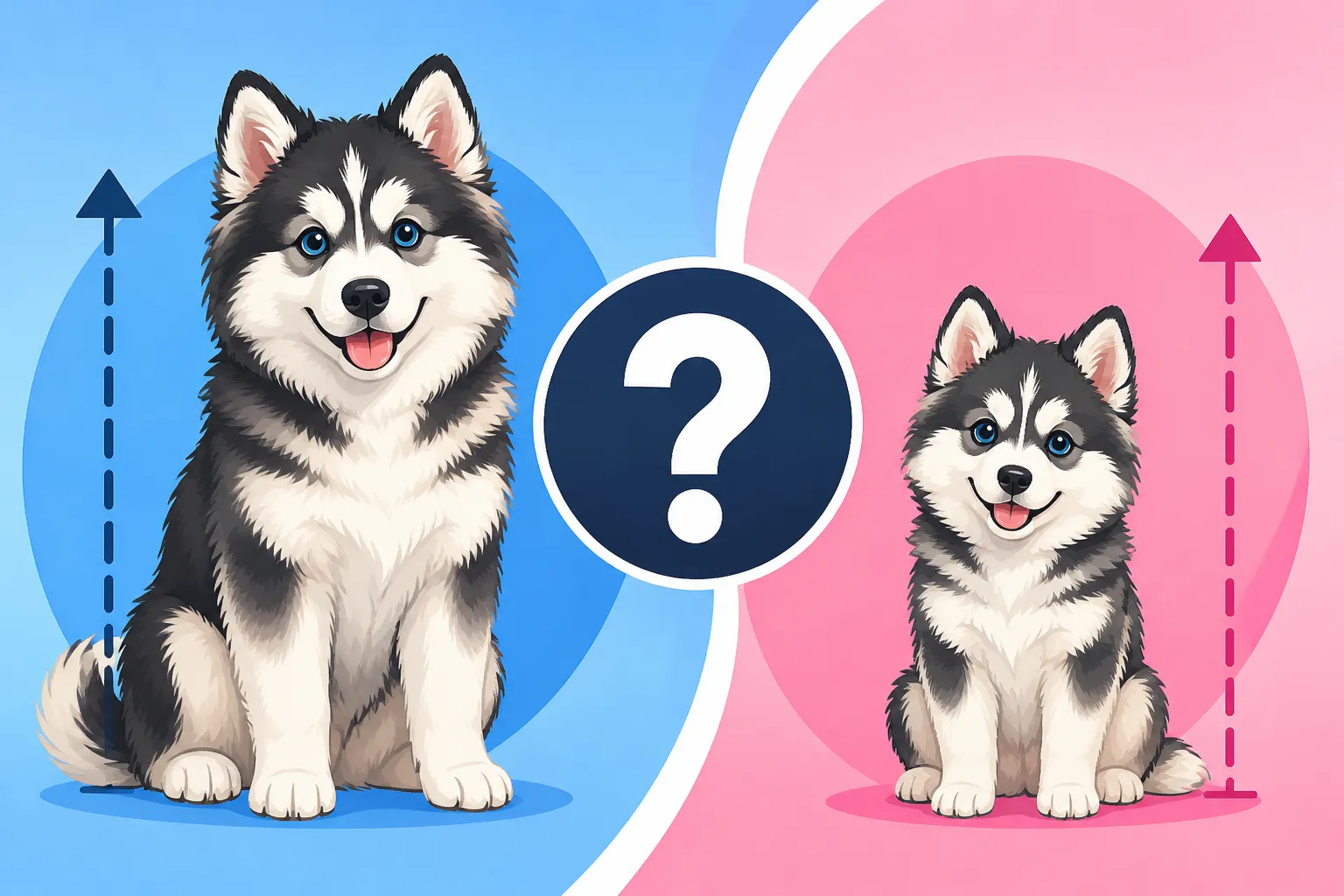
In many dog breeds, males tend to be somewhat larger or heavier than females on average. That pattern can occur in Pomskies, too, but it does not mean every male will outgrow every female. A small male and a larger female from the same litter can easily end up the other way around.
Sex is just one part of a dog’s inherited build. A male Pomsky may take after a smaller Pomeranian grandparent, while his female littermate inherits more of the larger Husky side. Their adult weights can also differ because of individual variation in bone structure, muscle, appetite, activity, and overall development.
This is why a breeder’s simple estimate based on “male” or “female” should be treated as a rough clue rather than a forecast. If you’re trying to understand the range, start with How Big a Pomsky Gets and What a Pomsky Actually Weighs Full Grown. Those topics help put sex differences in perspective.
A bigger dog is not automatically a healthier dog
It can be tempting to view a larger male puppy as the “stronger” one or a smaller female as the “easier” choice. Size alone doesn’t tell you whether a Pomsky is healthy, well proportioned, or likely to have a particular temperament. A puppy’s overall condition, movement, behavior, veterinary care, and family health history matter much more than whether the puppy is the largest or smallest in the litter.
There is also a difference between being naturally small and being underweight. A petite Pomsky who is active, developing steadily, and maintaining a healthy body condition may simply be small. A puppy who is losing weight, unusually tired, eating poorly, or failing to grow as expected needs attention from a veterinarian, regardless of sex.
If your puppy seems to be growing slowly, compare their progress with their own earlier measurements rather than with a male or female littermate. A vet can assess whether the puppy’s body condition and development are appropriate for that individual dog.
What affects a Pomsky’s adult size more than sex
Parent size and family traits
A Pomsky’s parents can offer useful context, but their weights do not provide a precise formula for the puppy’s eventual size. Puppies inherit a mix of genes from both parents and sometimes show traits that are less obvious in the parents themselves. Even puppies from the same litter may vary in frame, height, and weight.
Parent weights are best used as one piece of a broader picture. Ask about the sizes of previous puppies from the same parents or close relatives, and consider whether the breeder’s estimate is based on a pattern across multiple litters or just a guess. For more on what parent size can and can’t tell you, see Whether Parent Weights Predict a Pomsky's Size.
A puppy with a Husky-sized parent may still be smaller than expected, while one with a more compact-looking parent may grow into a sturdier dog. The range is one reason it’s wise not to choose a Pomsky solely because someone promises a particular adult weight. Whether a Pomsky Puppy's Size Can Be Predicted explains why early predictions can be uncertain.
Generation and genetic variation
A Pomsky’s generation can help describe its ancestry, but it does not guarantee an exact adult size. Generations and breeding choices influence which traits may appear, yet individual puppies can still inherit different combinations. A label such as F1 or multigenerational is not a substitute for looking at the puppy’s family background, growth, and health.
Ask the breeder to explain the puppy’s parentage clearly and to show the information behind any adult-size estimate. A responsible answer may include a range and acknowledge uncertainty. Be wary of claims that sex, a single puppy weight, or a generation label makes adult size certain.
| Clue | What it may tell you | What it cannot guarantee |
|---|---|---|
| Puppy’s sex | Males may be somewhat larger on average | That a particular male will outgrow a particular female |
| Parent weights | A rough sense of the family’s size range | The puppy’s exact adult weight |
| Littermate size | How puppies in that litter compare at that moment | Their final adult ranking |
| Generation | A description of ancestry and breeding history | A fixed size or predictable build |
| Growth over time | Whether the puppy is following a steady pattern | A precise adult weight from one measurement |
For a closer look at how ancestry relates to size, read Whether Generation Changes a Pomsky's Size. It’s more useful to think in terms of overlapping possibilities than a neat male-versus-female rule.
How to follow your Pomsky puppy’s growth
Record weight and body condition consistently
A single weigh-in is a snapshot, not a forecast. Weigh your puppy regularly using the same scale where possible, and keep the date and measurement in a simple notebook or phone note. If your puppy is small enough, a household scale can work: weigh yourself, then weigh yourself holding the puppy, and subtract the first number. For a wiggly puppy or an unclear reading, ask your veterinary clinic to help.
Alongside weight, watch body condition. You should be able to feel the ribs with light pressure, though they should not be sharply visible in a well-nourished dog. From above, many dogs have a visible waist behind the ribs; from the side, the abdomen typically tucks upward rather than hanging straight down. Your vet can show you how to assess this for your Pomsky’s frame.
If you use a feeding guide on a food package, treat it as a starting point, not an exact prescription. The amount a puppy needs depends on age, activity, body condition, and the particular food. If you purchase food through Chewy, check the feeding directions on the specific product packaging and discuss portions with your veterinarian, especially if your puppy is growing quickly or slowly.
Compare the trend, not the puppy with a sibling
A littermate may be heavier this week and lighter later. Growth can come in uneven spurts, so comparing two puppies on one particular day can create needless worry. Instead, look at each puppy’s pattern over time and whether their energy, appetite, stool, and body condition seem normal.
If you have two Pomskies, give each dog an individual record. Shared meals can make it harder to notice who is eating more, and one dog may quietly finish the other’s food. Separate feeding can help you track appetite and portions more accurately. Chewy’s product information can help you check how a particular food is intended to be measured, but your vet is the better person to advise whether the portion suits your dog’s growth and condition.
Do not try to make a puppy grow faster by increasing food without guidance. Extra calories can lead to excess body fat rather than healthy development. If you are concerned about weight gain, a sudden change in appetite, or a puppy who seems to fall off their own growth pattern, share your records with your vet. If you’re comparing your puppy with a predicted adult-size category, Whether a Pomsky Stays Under Twenty Pounds and Whether a Pomsky Can Reach Thirty Five Pounds explain why broad labels don’t capture every dog.
When a Pomsky is likely to reach adult size
Growth slows at different times for different dogs
Pomskies do not all finish growing on the same schedule. A puppy may reach much of its adult height before its body has filled out, while another may mature at a different pace. Smaller dogs often finish growing sooner than larger dogs in a general sense, but a mixed breed’s size and family traits make exact timelines difficult to promise.
Your vet can help distinguish ordinary variation from a concern by considering your puppy’s age, weight history, body condition, and physical development together. If you’re unsure whether your Pomsky is still growing, ask about the dog’s growth plates and the appropriate timing for any health or reproductive decisions. Avoid relying on a single internet chart as a diagnosis.
For more on the growth timeline, see The Age a Pomsky Reaches Full Size. The important thing is not to force a puppy into an expected adult weight, but to support steady, healthy development.
Use sensible expectations when choosing a puppy
If you are deciding between a male and female puppy, choose based on the individual dog’s needs and your household rather than assuming one sex will be reliably smaller. Ask about each puppy’s health, temperament, socialization, and family background. If adult size is important because of housing, travel, or handling, discuss the uncertainty openly with the breeder before making a commitment.
A practical conversation might sound like this: “What are the adult weights of both parents? How have puppies from earlier litters grown? What range would you consider realistic, and what makes you uncertain?” A breeder who answers thoughtfully and avoids guarantees is giving you more useful information than one who promises a precise weight from sex or appearance alone.
When you bring your puppy home, plan for a range of outcomes. Choose a carrier, harness, bed, and feeding setup that can accommodate a growing dog, and revisit fit as the puppy develops. Chewy can be one place to compare sizes when replacing equipment, but measure your dog rather than buying based on a projected adult weight. That small habit can prevent the familiar frustration of a harness that seemed “about right” when ordered but no longer fits a few weeks later.
In the end, male Pomskies may be larger on average, but there is no dependable rule that a male puppy will outgrow a female. Family traits, individual inheritance, and healthy development offer a more meaningful picture than sex alone. Track your Pomsky’s growth, keep expectations flexible, and bring concerns to your veterinarian rather than trying to judge your puppy against a littermate or a promised number.
Disclaimer
This article is for general informational purposes only and does not constitute professional advice. Laws, prices and regulations vary by location and change over time. Consult a qualified professional for guidance on your specific situation.