Whether Generation Changes a Pomsky’s Size
One of the biggest questions on every prospective Pomsky parent's mind, right after "How cute will they be?" is often "How big will they get?" It's a valid concern, especially when you're dreaming of a compact, Husky-esque companion, but the reality can sometimes feel like a lottery. Many believe that the generation of a Pomsky – whether they're an F1, F2, or even a multi-generational pup – holds the key to predicting their adult size, yet this isn't always the straightforward answer we hope for. This guide will delve into what these generations truly mean for a Pomsky's eventual stature, helping you set realistic expectations and understand the fascinating genetics at play.
Understanding Pomsky Generations
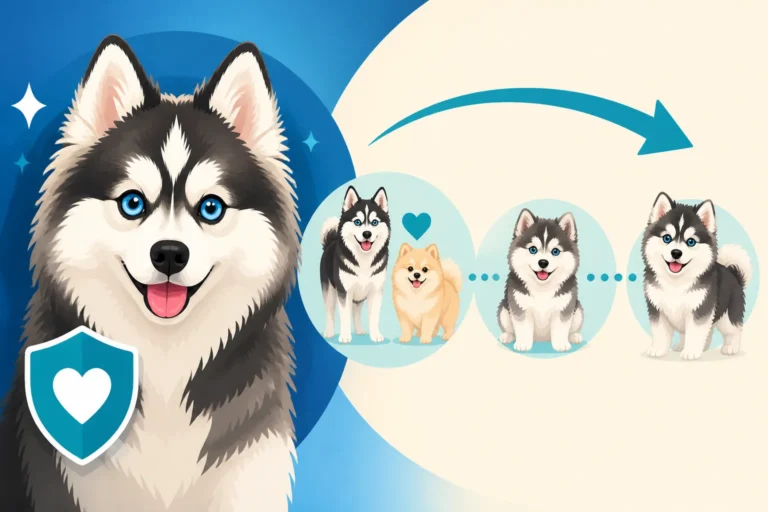
Before we can even begin to talk about size, we need to clarify what we mean by "generation" in the world of Pomskies. Unlike purebred dogs with established pedigrees, Pomskies are a relatively new hybrid, a crossbreed that's still finding its consistent footing. The generational labels are essentially a way to track how far removed a particular Pomsky is from its original Siberian Husky and Pomeranian parents. It’s a bit like tracking family trees, but with a lot more variability in the early branches.
F1 Pomskies: The First Cross
An F1 Pomsky stands for "First Filial Generation." This means they are the direct offspring of a purebred Siberian Husky mother and a purebred Pomeranian father. This is the very first step in creating a Pomsky, and because of the direct parental input from two distinctly different breeds, F1 Pomskies are often the most unpredictable in terms of appearance and size. Think about it: you're taking genes from a large working dog and a tiny companion dog, mixing them for the first time. There's no way to definitively say which parent's genes for size will be more dominant in any given puppy from that litter. You might have one pup that leans heavily towards the Husky in size and another that favors the Pomeranian, all from the same parents. It's truly a genetic crapshoot, and it's why What an F1 Pomsky Is is such a fundamental concept.
The range in size for F1 Pomskies can be quite astounding, from a petite 10-pound companion to a robust 35-pound active dog. This isn't just theory; it plays out in real life with littermates often showcasing stark differences. One puppy might inherit the long legs and leaner build of a Husky, while its sibling might get the compact, stockier frame of a Pomeranian, just scaled up a bit. This variability is both the charm and the challenge of the F1 generation.
F2 Pomskies: Breeding Pomsky to Pomsky
When you breed two F1 Pomskies together, their offspring are considered F2 Pomskies. This is where many people assume the size prediction becomes easier, reasoning that you're now breeding "Pomsky to Pomsky," so the traits should stabilize. While there's a kernel of truth in the idea of working towards more consistent traits, the reality regarding size is often more complex than people expect. You see, even if both F1 parents are roughly the same size, their underlying genetic makeup still carries that wide spectrum of Husky and Pomeranian genes. When those F1 parents pass on their genes, they're essentially reshuffling that same deck of cards.
So, an F2 litter can still present a significant range in size, perhaps slightly less dramatic than F1, but certainly not a guarantee of a specific weight or height. Just because both parents are F1 Pomskies doesn't mean they'll produce carbon copies of themselves. They might still throw back to the larger Husky or smaller Pomeranian genes that were present in their own F1 lineage. If you're looking for stability, What an F2 Pomsky Is explains why it's a step, but not a final destination.
Multigenerational Pomskies: Beyond F2
"Multigenerational" or "Multi-gen" Pomskies are those bred beyond the F2 generation, meaning F2 to F2, F2 to F1, or F3 to F3, and so on. The goal with multi-gen breeding is often to achieve greater consistency in desired traits, including size, temperament, and appearance. Breeders working with multi-gen lines are typically trying to selectively breed Pomskies that more reliably produce puppies fitting a specific "type" or size range. This involves careful selection of breeding pairs over several generations, looking for those individuals who consistently produce offspring within a tighter size bracket.
Does this mean multi-gen Pomskies have a more predictable size? In theory, yes, to a degree. Over multiple generations of careful selection, a breeder can start to narrow down the size range of their puppies. However, it's never an absolute guarantee. Even in multi-gen lines, you can get throwbacks or puppies that surprise you with their final size. It's a long, arduous process for breeders to achieve true consistency, and it requires a deep understanding of genetics and a commitment to health testing. Whether a Multigen Pomsky Is More Predictable tackles this aspiration versus reality head-on.
The Myth of Predictable Size by Generation
It's a common misconception that simply knowing the generation of a Pomsky will give you a clear-cut answer about its adult size. The truth is far more nuanced, and anyone telling you that an F2 will always be X pounds smaller than an F1, or that a multi-gen is guaranteed to be a specific size, might be oversimplifying complex genetics.
Genetic Lottery in Early Generations
Imagine a deck of cards where half the cards are "Husky" traits (large size, thick coat, blue eyes) and the other half are "Pomeranian" traits (small size, fluffy coat, foxy face). When you breed an F1 Pomsky, you're essentially shuffling and dealing a hand from that mixed deck. Each puppy gets a unique combination. One pup might get a strong hand of Husky size genes, while another in the same litter draws more Pomeranian size genes. This is why you see such dramatic size differences within the same F1 litter. There's no control over which genetic hand each puppy is dealt, making early generation size extremely much like a lottery.
This genetic variability means that two F1 Pomskies from the same litter, both around 20 pounds, could potentially produce F2 puppies that range from 15 to 30 pounds. It's not just about the parents' phenotype (what they look like and weigh), but their genotype (the underlying genetic code they carry). They might carry recessive genes for larger or smaller sizes from their purebred grandparents that can express themselves in later generations.
The Influence of Parentage
While the generational label offers some context, the individual parent dogs' sizes remain a more significant predictor than the F-number itself. If you have an F1 Pomsky whose Husky mother was on the smaller side and the Pomeranian father was larger for his breed, their offspring might lean towards a mid-range size. Conversely, an F1 from a larger Husky and a smaller Pomeranian could have puppies that are quite varied.
The most valuable information a reputable breeder can provide you isn't just the generation, but the specific weights and heights of the parent dogs involved in your puppy's lineage. Beyond that, knowing the size of grandparents can also offer clues, especially in F2 and multi-gen litters where those ancestral genes can still pop up. This detailed family history gives a much clearer picture than a simple F-number.
When Size Prediction Becomes Slightly More Reliable
It's only after multiple generations of careful, selective breeding, where breeders are consistently choosing Pomskies within a very specific size range to be parents, that size prediction starts to become somewhat more reliable. This is the goal of multi-generational breeding—to "set" the type, including size. However, even then, nature can surprise you. It's not like manufacturing a product; it's living genetics.
A breeder committed to producing, say, Pomskies under 20 pounds will spend years selectively breeding the smaller individuals from each litter. They'll also carefully track the adult size of all the puppies they produce. Over time, their multi-gen lines might produce a more consistent size range. But this is a testament to diligent breeding practices, not an inherent quality of the F-number itself. It’s an ongoing process of refinement, not a fixed state.
Factors Truly Influencing a Pomsky's Adult Size
So, if generation isn't the be-all and end-all for predicting size, what truly dictates how big your Pomsky will get? It comes down to a blend of genetics, individual puppy variation, and even some environmental factors during growth.
Size of the Parent Dogs
This is, hands down, the most crucial factor. A Pomsky puppy is a direct blend of its two parents. Therefore, the size of the Siberian Husky dam and the Pomeranian sire (for an F1), or the two Pomsky parents (for F2 and multi-gen), will give you the best indicator.
For instance, if you have an F1 Pomsky puppy whose Husky mother weighed around 40 pounds and the Pomeranian father weighed 8 pounds, that puppy's adult weight will likely fall somewhere in between, or possibly slightly above or below that range depending on which parent's growth genes it inherited more strongly. Generally, the larger the parents, the larger the offspring can be, and the smaller the parents, the smaller the offspring. This might seem obvious, but it's often overlooked in favor of focusing on the generational label. Whether Parent Weights Predict a Pomsky's Size delves into this in more detail. It's important to ask breeders for the weight and height of both parents, and ideally, their hip and elbow scores, too.
Genetics Beyond Generation Labels
Beyond the immediate parentage, the specific genetic cocktail each puppy inherits is paramount. Genes aren't just a simple mix; they interact in complex ways. Some genes are dominant, some recessive, and some have polygenic inheritance, meaning multiple genes contribute to a single trait like size. This means even if both parents are a specific size, they carry a wider genetic blueprint from their ancestors that can manifest in their offspring.
A Pomsky puppy might inherit a set of growth genes that cause it to grow significantly larger than both its F1 Pomsky parents, reflecting a throwback to a larger Husky grandparent. Conversely, another puppy in the same litter might inherit genes that keep it quite small, echoing a petite Pomeranian ancestor. These genetic throwbacks are perfectly normal in hybrid breeds and contribute to the wide variation we see. This is why How Big a Pomsky Gets can have such a broad answer.
Sex and Individual Puppy Variation
Just like in many other breeds, male Pomskies tend to be slightly larger and heavier than female Pomskies. This is a common biological difference across canine species. However, even within the same litter of male puppies, you can see individual variation in growth rates and final adult size. Some puppies are simply genetically predisposed to be larger or smaller than their littermates, irrespective of their sex.
The growth trajectory of each puppy is unique. Some might have a growth spurt early on and then slow down, while others might grow steadily. Nutrition during puppyhood, while important for healthy development, generally doesn't dramatically alter a dog's genetically predetermined adult size. A puppy fed well will reach its genetic potential, whereas one fed poorly might be stunted, but proper feeding won't make a genetically small Pomsky grow into a giant. The overall picture is really that Whether a Pomsky Puppy's Size Can Be Predicted is still largely an educated guess.
Setting Realistic Size Expectations
It's easy to fall in love with pictures of tiny, fluffy Pomskies that look like miniature Huskies, but the reality often requires a broader perspective. Setting realistic expectations from the outset is crucial for a happy ownership experience.
The Unpredictable Nature of a Mixed Breed
The Pomsky, being a designer hybrid, inherently carries a degree of unpredictability that purebred dogs, with their centuries of selective breeding for consistent traits, do not. While breeders are working hard to establish consistency, especially in multi-generational lines, it's vital to remember that each Pomsky is a unique blend. The "miniature Husky" look that many desire is one end of a very wide spectrum. You might get a dog that looks more like a small Husky, one that looks like a large Pomeranian, or something wonderfully in between. The key is to embrace this charming variability rather than chasing an exact ideal.
Don't be surprised if your Pomsky ends up larger or smaller than you initially imagined. It's part of the adventure of owning such a dynamic crossbreed. Many owners have been surprised by What Happens When a Pomsky Grows Bigger Than Sold, and it's something to prepare for.
What Reputable Breeders Can Tell You
A truly reputable Pomsky breeder will be upfront and honest about the potential size range of their puppies. They won't guarantee an exact weight but will instead provide an educated estimate based on several factors:
- Parental Weights: They should be able to tell you the precise weights and heights of both the mother and father of the litter.
- Previous Litter Data: If they have bred the same pair before, or similar lines, they can share data on the adult sizes of those past puppies.
- Puppy Growth Charts: Some breeders might use growth charts to give a general projection, but they will stress that these are estimates.
- Transparency: They will openly discuss the variability inherent in Pomsky breeding and manage your expectations rather than making false promises.
Always ask to see the parents if possible, or at least photos and videos with their weights clearly stated. A breeder who avoids discussing size or makes unrealistic guarantees should be a red flag. When buying from a good breeder, you'll be well-informed and less likely to be surprised.
Preparing for a Pomsky of Any Size
Given the inherent variability, the best approach is to prepare your home and lifestyle for a Pomsky that could fall anywhere within the typical size range of the breed (which generally means anywhere from 10 to 35 pounds). This means:
- Space: Ensure your living situation (apartment or house) can comfortably accommodate a medium-sized dog, just in case your "mini" Husky grows larger than anticipated.
- Food & Supplies: Factor in the cost of food and supplies for a potentially larger dog. Larger dogs eat more, and their accessories (beds, crates, harnesses) can also cost more. Brands like Chewy offer a wide range of sizes for dog essentials, making it easier to adjust as your puppy grows.
- Exercise: A larger Pomsky will likely need more exercise than a smaller one. Be ready for The Exercise a Pomsky Needs Every Day regardless of their eventual size, but understand that a 30-pound Pomsky might need more vigorous activity than a 15-pound one.
- Training: All Pomskies benefit from consistent training and socialization. Their size doesn't change their inherent Husky intelligence and Pomeranian sass!
Being mentally prepared for this range will ensure that you love and accept your Pomsky, whatever their final dimensions may be.
The Impact of an Unexpected Size
While many people dream of a miniature Husky, the reality is that Pomskies vary greatly in size, and sometimes, a puppy grows up to be much larger or smaller than anticipated. This can have significant implications for daily life, health, and even the emotional bond with your dog. It's crucial to understand these potential impacts.
Lifestyle Adjustments for a Larger Pomsky
If your Pomsky grows to be on the larger end of the spectrum (say, 25-35 pounds or more), you might find yourself needing to make certain lifestyle adjustments that you hadn't initially planned for when imagining a smaller dog.
- Living Space: A bigger dog simply needs more room. An apartment that felt spacious for a 15-pound Pomsky might feel a bit cramped with a 35-pound energetic one, especially if they like to sprawl. You might need a larger dog bed, a bigger crate, and more open floor space for them to play.
- Exercise Needs: Larger dogs often have higher energy levels and require more physical activity to stay happy and healthy. This could mean longer walks, more vigorous play sessions, or even engaging in dog sports. If you live in an urban environment, finding appropriate spaces for a larger, more active Pomsky might require more planning. The Exercise a Pomsky Needs Every Day becomes even more critical for a bigger dog.
- Cost of Care: From bigger bags of food (check Chewy for bulk options!) to larger doses of preventatives, the cost of caring for a bigger dog generally increases. Vet visits, grooming services (especially if they have a dense coat), and even toys might be more expensive for a larger Pomsky. This is part of The Full Cost of Fourteen Years With a Pomsky that many owners underestimate.
- Travel: A larger Pomsky might not be able to fly in the cabin with you, requiring cargo travel instead, which is a big consideration for some families. Car travel might also necessitate a larger crate or a more robust car harness.
Health Considerations Related to Size
While Pomskies are generally healthy dogs, their size can play a role in certain health considerations, especially when they lean heavily towards one parent breed's physique.
- Joint Health: Larger, more athletic Pomskies might be more susceptible to conditions like Hip Dysplasia in a Twenty Pound Pomsky or Slipping Kneecaps in a Pomsky (patellar luxation), especially if they have an active lifestyle. These are conditions seen in both Huskies (hip dysplasia) and Pomeranians (patellar luxation), so a Pomsky can inherit a predisposition to either. Maintaining a healthy weight is paramount for joint health, regardless of size.
- Tracheal Issues: On the other hand, smaller Pomskies who take more after their Pomeranian side might be more prone to The Collapsing Trachea a Pomsky Gets From the Pomeranian. This is less common in larger dogs, but still a concern within the breed.
- Dental Crowding: No matter the size, if a Pomsky inherits a smaller Pomeranian jaw with Husky-sized teeth, dental crowding can be an issue. However, in a generally larger Pomsky, this might be slightly less pronounced than in a very small one. Dental Crowding in a Pomsky's Small Mouth is a good read on this topic.
- Overheating: All Pomskies, with their double coats, need careful management in warm weather. However, a larger Pomsky might have a harder time dissipating heat simply due to their greater body mass, requiring extra vigilance to prevent overheating.
It's important to discuss potential size-related health concerns with your veterinarian, who can offer tailored advice for your individual dog.
The Emotional Aspect of Size Discrepancies
Perhaps one of the most significant impacts of an unexpected Pomsky size is the emotional one. Many prospective owners are captivated by the idea of a very specific "miniature Husky" look and size. When their puppy grows up to be a larger, more Pomeranian-looking dog, or a smaller dog than they envisioned, it can sometimes lead to disappointment or a feeling that they didn't get what they "ordered."
This disconnect between expectation and reality is a significant reason why some Pomskies unfortunately end up in shelters or rescues. Why Pomskies Are Surrendered often includes reasons related to size and the associated lifestyle demands. It highlights the importance of going into Pomsky ownership with an open mind and a willingness to love the dog for who they are, regardless of their final size or appearance. Embrace the individual personality and charm of your Pomsky, recognizing that their unique blend of traits is what makes them special. After all, a loving companion is a loving companion, no matter how much they weigh or how tall they stand.
Conclusion
The generation of a Pomsky, whether F1, F2, or multi-generational, does not offer a definitive crystal ball into their adult size. While multi-generational breeding aims for greater consistency, especially in skilled hands, the early generations remain wonderfully, frustratingly unpredictable. The genetic lottery ensures that each puppy is a unique individual, carrying a blend of traits from its Husky and Pomeranian ancestors.
What truly dictates a Pomsky's size are the genetics passed down from its immediate parents and further back in its lineage, alongside individual variation and sex. A reputable breeder will prioritize transparency, providing information on parent sizes and previous litters, rather than making sweeping guarantees based solely on the generational label.
Ultimately, prospective Pomsky owners must be prepared for a range of possibilities. Embracing the inherent unpredictability of this captivating hybrid, and preparing for a dog that could be anywhere from a compact companion to a robust medium-sized canine, is key to a fulfilling relationship. Love your Pomsky for the unique individual they are, and you'll find joy in whatever size package they come in.
Disclaimer
This article is for general informational purposes only and does not constitute professional advice. Laws, prices and regulations vary by location and change over time. Consult a qualified professional for guidance on your specific situation.