Whether a Pomsky’s Tail Curls Over Its Back
A Pomsky’s tail often curves over its back, but it is not a reliable rule for every dog. Some carry a fluffy plume in a clear arch, while others have a looser curve or let the tail hang when relaxed. This guide explains what influences tail shape, how to tell normal variation from a possible problem, and what to watch as a Pomsky grows.
Do Pomskies usually have tails that curl over their backs
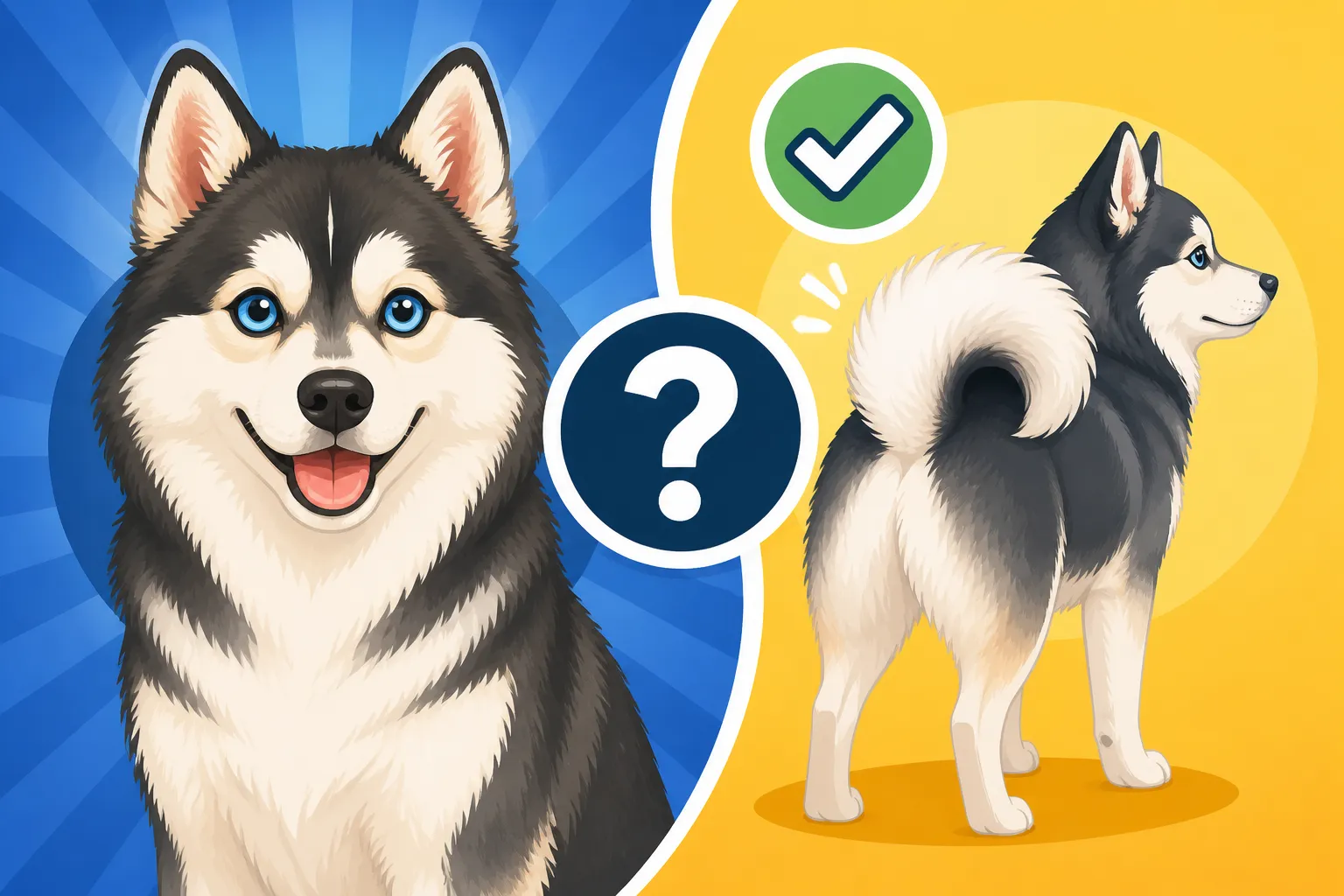
Many Pomskies do carry the tail over the back, reflecting traits that can appear in both parent breeds. Pomeranians are known for a high-set, plumed tail that arches over the back, while Siberian Huskies often carry a bushy tail in a curve when alert or moving. A Pomsky may inherit a look closer to either parent, or land somewhere between them.
That does not mean every Pomsky has a tight curl. Some have a broad, loose arc; some carry the tail to one side; and some let it hang naturally when they are resting. A relaxed dog’s tail can look quite different from the same dog’s tail during play or when greeting someone at the door.
What “curling over the back” can look like
The phrase describes tail carriage, not necessarily a permanently curled tail. A Pomsky may hold the tail in an arch above its back, with the plume resting across the rump. Another dog may carry it higher during an exciting walk but lower while sniffing around the yard. Both can be normal.
A thick coat can also change the impression. Long feathering may spread out like a fan and make a gentle curve look more dramatic. Conversely, a shorter-coated Pomsky may have a similar tail shape that is simply easier to see. If you are comparing puppy photos, keep in mind that coat length, camera angle, and the dog’s mood all affect what you notice.
A curled or arched tail is not the same as a tightly kinked tail. A naturally curved tail tends to move freely and look comfortable. If the tail seems rigid, painful, unusually crooked, or suddenly different from its usual position, that is a reason to contact a veterinarian rather than trying to judge its shape from appearance alone.
Why some Pomskies have looser or lower tail carriage
Pomskies are a cross, and their appearance can vary even among littermates. The parent breeds offer clues, but they do not let anyone predict every physical feature with certainty. A puppy with a tail that hangs more often may still develop a pronounced plume and carry it over the back at other times. Another puppy may retain a lower, more relaxed carriage as an adult.
Generation alone is not a guarantee of a particular tail. An F1 Pomsky has one Pomeranian parent and one Siberian Husky parent, but that combination does not produce a perfectly predictable blend of visible traits. For a closer look at what the generation label means, see What an F1 Pomsky Is. The broader point is that a label or family tree cannot promise a specific tail curl.
Even puppies from the same litter can differ in coat, build, and expression. If two pups look strikingly different, that does not automatically mean one is a different mix. Whether Two Pomsky Littermates Look Alike explores why siblings can have distinct appearances.
What influences a Pomsky’s tail shape
A Pomsky’s tail is shaped by more than a simple “Pomeranian trait” or “Husky trait.” Genetics, body structure, coat, age, and the dog’s state of mind all affect how the tail looks and how it is carried. Looking at the whole dog is more useful than treating the tail as a standalone clue.
Inherited traits from both parent breeds
Pomeranians often have a high-set, plumed tail carried over the back. Siberian Huskies are known for a brush-like tail that may curve upward when the dog is alert, though it can hang down when the dog is relaxed. Those patterns help explain why a Pomsky’s tail may arch over its back, but mixed-breed inheritance is not a precise recipe.
A Pomsky may inherit a high tail set, a fuller plume, a looser curve, or a combination of these features. Body proportions can influence how the tail rests across the back as well. A tail that looks dramatic on a compact dog may seem less prominent on a dog with a different build or longer coat.
Tail appearance also belongs in the wider picture of Pomsky variation. A dog’s ears, coat, color, and size may not all point toward the same parent breed. For related details, see Whether a Pomsky Looks More Pomeranian Than Husky and Whether a Pomsky's Ears Stand Up. Neither a curled tail nor any other single feature proves a Pomsky’s precise ancestry.
Age, coat growth, and posture
A very young puppy can look different from the adult it will become. The tail’s basic structure does not need to change for its appearance to change: as the coat grows, feathering may make the tail seem fuller, longer, or more curled. A puppy may also carry the tail differently as its confidence and activity level change.
Posture matters from one moment to the next. A dog that is alert may lift its tail, while one that is resting may let it drop. When you assess your Pomsky’s usual carriage, observe them in more than one situation rather than drawing conclusions from a single photo or visit to the park.
A grooming session can change the outline too. Brushing out loose undercoat may make the plume look larger temporarily, while wet or flattened fur can make it seem smaller. If the tail feathers tangle, use gentle grooming rather than tugging. If you shop for basic grooming tools through Chewy, compare the tool’s description and intended coat type, and ask a groomer or veterinarian for guidance if you are unsure what is suitable.
What the tail can and cannot tell you
A Pomsky with a plume curled over its back may look especially spitz-like, but the tail does not establish whether a dog is an F1, F2, or later-generation Pomsky. It cannot reliably predict adult size, temperament, health, or coat maintenance either. Those qualities depend on multiple factors, not one visible feature.
When evaluating a puppy, look at the overall picture: the parents’ appearance and health information, the breeder’s transparency, and the puppy’s behavior and condition. For context on how much Pomskies can vary in size, read What a Pomsky Actually Weighs Full Grown and Whether Generation Changes a Pomsky's Size. A curled tail may be appealing, but it should not outweigh health, welfare, or fit with your household.
| What you notice | What it may mean | What to do |
|---|---|---|
| Tail arches over the back when alert | Common tail carriage in many Pomskies | Observe how it looks when the dog is relaxed too |
| Tail hangs lower while resting | Often a normal change in posture | Look for comfort and normal movement |
| Thick plume makes the tail look tightly curled | Coat volume may exaggerate the curve | Check the tail’s movement without pulling or forcing it |
| Tail suddenly hangs limp or seems painful | Possible injury or another health issue | Contact a veterinarian promptly |
| Tail stays rigid or the dog reacts when it is touched | Discomfort may be present | Avoid repeated handling and seek veterinary advice |
How to tell normal tail carriage from a possible concern
Most of the time, a tail that curls over a Pomsky’s back is simply part of its appearance and posture. The useful question is whether the tail is comfortable and moves normally for that individual dog. A sudden change is more significant than a tail that has always had a loose curve or a lower resting position.
Normal changes during the day
A Pomsky may lift its tail while greeting you, walking alertly, or watching something interesting. Later, after settling on a bed, it may rest the tail lower. Wagging, sniffing, playing, and relaxing all involve changes in body position, so there is no single posture that should be expected every minute.
Try to learn your dog’s own baseline. Notice whether the tail moves freely, whether your Pomsky can hold it in its usual positions, and whether touching or grooming around the area seems comfortable. You do not need to repeatedly manipulate the tail to check it. Everyday observation is enough unless something looks or feels wrong.
Also watch the dog as a whole. A tail position alone is difficult to interpret. If a lower tail comes with normal movement and a relaxed demeanor, it may simply reflect how the dog is resting. If it appears alongside pain, weakness, or a sudden change in behavior, that combination deserves more attention.
Signs that merit veterinary advice
Contact a veterinarian if your Pomsky’s tail suddenly becomes limp, remains unusually tucked or rigid, or appears painful. Other reasons to seek advice include swelling, a wound, bleeding, a new kink after an accident, or a dog that cries or guards the area. If you suspect an injury, do not try to straighten the tail or test its range of motion.
A tail change may occur alongside other symptoms, such as difficulty walking, unusual weakness, or trouble urinating or defecating. Those signs need prompt veterinary attention. The cause cannot be determined reliably from a photo or from whether the tail curls over the back.
If the tail has always had the same shape and your dog moves comfortably, that is a different situation from a sudden change. When in doubt, describe what you have noticed and when it began to your veterinarian. A short video of the dog moving naturally may help show the change without requiring you to handle the tail.
Caring for a Pomsky’s plumed tail
A curled tail may have long feathering that collects loose hair, small tangles, or debris. It usually does not need elaborate care, but regular, gentle checks can help keep the coat comfortable. The goal is to maintain the coat without pulling on the tail or trying to reshape it.
Brush gently and avoid pulling
Start by looking through the feathering for tangles, especially after outdoor play. Work slowly from the ends of a small section toward the coat closer to the tail, supporting the hair so you do not pull at the skin. If a tangle is tight or close to the skin, stop rather than yanking it out; a professional groomer can help safely.
A comb with smooth, rounded ends can help you check whether the hair is separating comfortably, but the right tool depends on the dog’s coat. When browsing grooming supplies on Chewy, focus on the tool’s intended use and avoid assuming that a deshedding blade is suitable for every Pomsky. A groomer familiar with double coats can demonstrate a gentle method.
Do not tie the tail tightly, pull it into a different position, or use grooming to force a particular silhouette. The tail should be allowed to rest and move naturally. If your Pomsky dislikes tail handling, build comfort gradually with brief, calm sessions and rewards; stop if the dog becomes distressed.
Keep the tail’s appearance in perspective
It is easy to get attached to a particular look, especially when puppy photos online show a dramatic plume curling neatly over the back. But the tail may not match those pictures, and that does not make the dog less of a Pomsky or mean anything is wrong. Even features such as the coat can become clearer only as a puppy grows; Whether a Pomsky's Coat Type Shows at Eight Weeks offers related context on why early appearance can be misleading.
If you are choosing a puppy, treat tail carriage as one small part of the overall decision. Ask how the puppy behaves, what health information is available, and what daily care the dog may need. If you already share your home with a Pomsky whose tail rests differently from what you expected, focus on whether the dog is comfortable and healthy rather than trying to make the tail conform to a picture.
For routine upkeep, Chewy may be one place to compare combs and coat-care supplies, but product choice should follow the dog’s coat and comfort. A veterinarian can assess a sudden physical change, while a qualified groomer can help with coat tangles. Those are different needs, and neither requires changing the tail’s natural shape.
Disclaimer
This article is for general informational purposes only and does not constitute professional advice. Laws, prices and regulations vary by location and change over time. Consult a qualified professional for guidance on your specific situation.