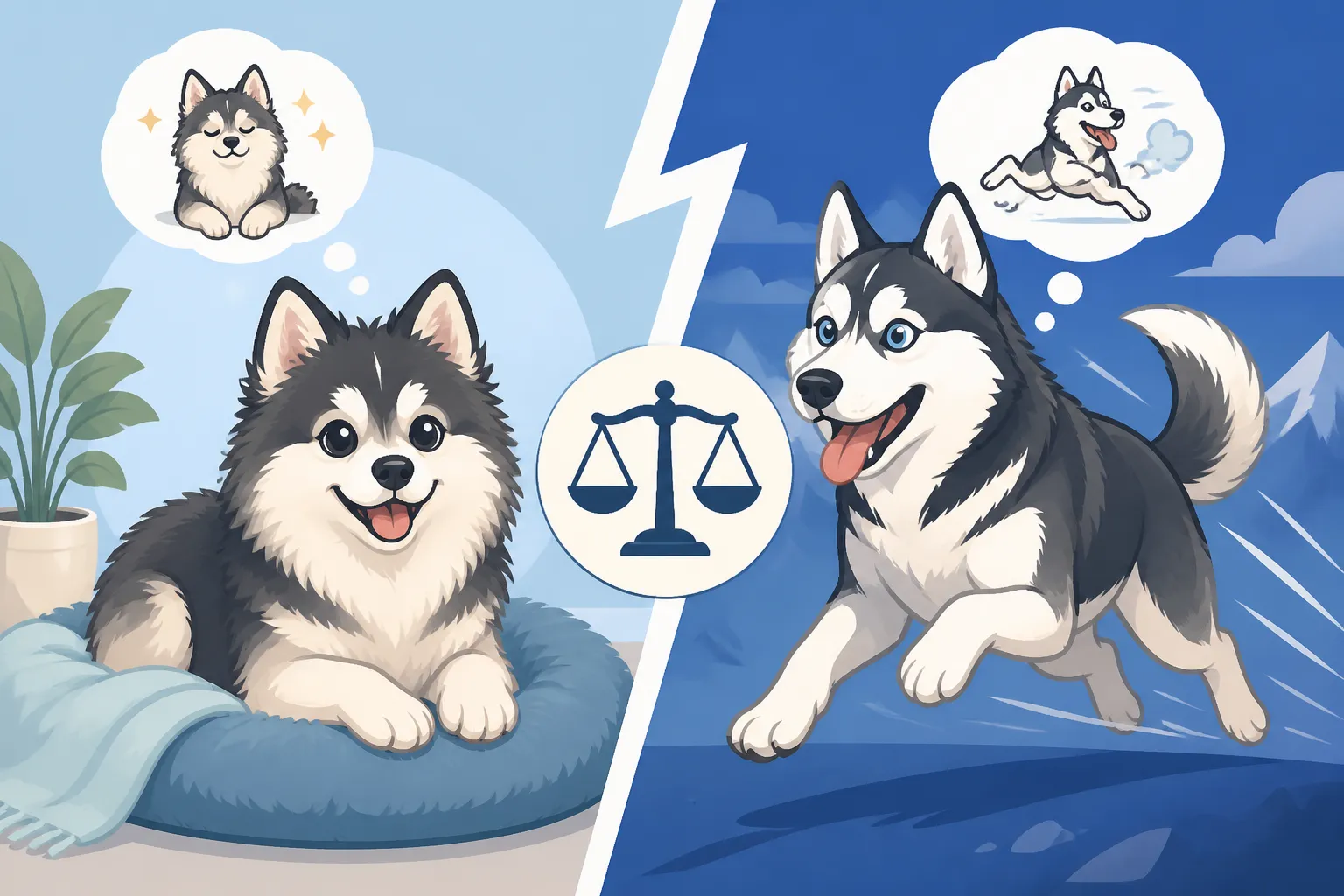
Whether a Pomsky Is Calmer Than a Husky
A Pomsky’s smaller size can make people expect a calmer, easier version of a Siberian Husky. That expectation can be frustrating when a Pomsky still needs vigorous exercise, invents its own entertainment, or vocalizes at the window. This guide explains what “calmer” really means, why individual Pomskies vary, and how to judge whether one suits your household.
Is a Pomsky Usually Calmer Than a Husky
Smaller does not automatically mean lower energy
Pomskies are a cross between Pomeranians and Siberian Huskies, and their size, energy, and temperament can vary. A Pomsky may be smaller than a typical Husky, but that does not make it a low-energy dog by default. Some are busy, athletic, and eager to explore; others are more moderate, especially once their needs are met and they have learned how to settle indoors.
It helps to separate physical size from daily demands. A small dog can still be intensely curious, persistent, and quick to notice movement or sound. A Pomsky that spends the day pacing, barking at passersby, or finding ways to escape a yard may not need a bigger home so much as more purposeful activity and consistent training.
A purebred Husky’s athleticism and stamina can be substantial, so a Pomsky may be easier to exercise than a large, highly active Husky. But “easier” is not the same as “calm without effort.” If you are comparing the breeds, The Pomsky Against a Purebred Husky offers helpful context on what the cross may share with its Husky parent.
What owners mean when they say calm
“Calm” can describe several different things. One owner may mean a dog that naps quietly while they work. Another may mean a dog that walks without pulling, greets visitors politely, or doesn’t howl when left alone. A Pomsky might be settled at home but excitable on walks, or quiet around strangers but highly vocal when it hears a siren.
Temperament also changes with age, experience, health, and routine. A young Pomsky may seem restless because it is still learning how to manage excitement, not because it will always be frantic. A dog that is uncomfortable, under-stimulated, overtired, or anxious may also appear unsettled. Those situations call for different responses, so it is more useful to identify what is happening than to label the dog as simply “hyper.”
A better comparison is to ask whether the individual dog can recover after excitement. Does it eventually lie down after a walk? Can it pause before rushing to the door? Will it switch from play to a chew or resting spot? Those everyday moments give you a clearer picture than comparing breeds by reputation alone.
Why Pomsky Temperaments Vary
A cross does not produce one predictable personality
Pomskies can inherit different combinations of traits from their parents. One may be outgoing and persistent; another may be watchful, independent, or especially interested in chasing moving things. Even puppies from the same litter can develop differently, and their home experiences shape how those tendencies show up.
Generation and parentage may offer clues, but they are not guarantees of a particular personality. A puppy’s behavior can also be influenced by early socialization, health, training, and the way its needs are met. For more on this uncertainty, see Whether Generation Affects a Pomsky's Temperament. When meeting a puppy or adult dog, ask about the individual’s observed behavior rather than relying on a generation label or a promise that the dog will be “easy.”
If calmness is important to you, consider how the dog responds to ordinary situations: a visitor arriving, a short period of quiet, a walk past other dogs, or a pause in play. Ask what the breeder, foster carer, or rescue has actually seen. A description such as “settles after a sniff walk and a chew” is more useful than a broad claim that a dog is calm.
Energy can show up as noise, persistence, or mischief
High energy does not always look like running around the house. A Pomsky may show it by barking at sounds in the hallway, following its person from room to room, pawing at a toy, digging, or testing a gate. Some dogs are physically active, while others are mentally busy and determined to investigate anything interesting.
Vocal behavior can be part of the picture, too. Pomeranians can be alert and vocal, while Huskies are known for a broad range of sounds. A Pomsky may bark, whine, howl, or “talk” in ways that surprise someone expecting a quiet companion. The details are individual, but noise is worth considering if you share walls or have a household that depends on quiet. Whether a Pomsky Is Loud discusses why volume and vocal habits deserve their own consideration.
Independence can also be mistaken for unruliness. A dog that pauses to assess a cue or would rather investigate a scent may need more rewarding, engaging training—not harsher corrections. If that sounds familiar, Whether a Pomsky Is Stubborn or Independent can help frame the behavior more accurately.
What a Pomsky Needs to Settle at Home
Match exercise to the dog, not just the breed label
Most Pomskies benefit from regular walks, play, and opportunities to sniff and explore. The right amount depends on the individual dog’s age, health, build, and temperament. A brisk walk may help one dog settle, while another needs a shorter outing followed by training games and downtime. Watch how your dog behaves afterward: contented resting is a useful sign, while frantic play or constant pestering may mean the routine needs adjusting.
Exercise should be safe as well as satisfying. Young puppies need age-appropriate activity, and a dog that is not reliable off leash should be kept on a secure lead in unenclosed areas. A fenced yard can offer space, but it does not necessarily replace walks, training, or shared play. For a deeper look at practical routines, see The Exercise a Pomsky Needs Every Day and The Exercise a Pomsky Needs to Stay Sane.
Try not to use exercise as a contest to tire the dog out at any cost. Repeatedly increasing distance or intensity can be hard on a young or unfit dog and may create a dog that expects ever more stimulation. A balanced day often includes movement, sniffing, a little training, and quiet rest.
Give the brain something appropriate to do
Mental activities can make a real difference for a dog that seems busy indoors. Scatter a portion of its meal in a safe area for sniffing, teach a simple cue in a short session, or offer a suitable food puzzle. Rotate toys rather than leaving every option out all the time, and supervise new items until you know how your dog uses them.
Food puzzles, snuffle mats, and durable chew options are available from many pet retailers, including Chewy. The specific item matters less than choosing something appropriate for your dog’s size and chewing style. A puzzle that is too easy may not hold attention; one that is frustrating can lead to barking, pawing, or chewing the wrong object.
Settle skills are just as important as enrichment. Reward your dog for lying quietly on a mat, pausing while you prepare a meal, or relaxing after a walk. Keep early practice brief and easy. The goal is not to force a dog to be still when it is distressed or uncomfortable, but to teach it that calm behavior is worthwhile and that rest is part of the routine.
| What you notice | Possible explanation | A useful first step |
|---|---|---|
| Restlessness after a quiet day | The dog may need more activity or sniffing opportunities | Add a suitable walk or a short scent game |
| Barking at every hallway sound | Alertness, boredom, or a learned response may be involved | Reduce window access if needed and reward quiet check-ins |
| Pacing after intense play | The dog may be overstimulated or struggling to settle | End play calmly and offer a predictable rest activity |
| Chewing furniture | The dog may need supervision, appropriate chew options, or help with alone-time skills | Manage access and reward chewing a suitable item |
| Whining when left alone | Separation-related distress may be involved | Build absences gradually and seek qualified help if distress persists |
Deciding Whether a Pomsky Fits Your Home
Consider your schedule and tolerance for activity
A Pomsky may suit an active household that enjoys daily walks, training, and interactive time. It may be a harder fit for someone who wants a dog that is content with only brief bathroom trips and minimal engagement. The question is not whether you can keep a Pomsky busy every minute; it is whether your normal routine can provide regular activity, company, training, and rest.
Think about what a typical weekday looks like. If you work away from home for long stretches, consider how the dog will cope with being alone and what support might be available. A second dog is not an automatic fix for loneliness or separation distress. Read Whether a Pomsky Can Be Left Alone before assuming that a compact dog will comfortably manage long periods by itself.
Also consider your living space realistically. Pomskies can live in apartments, but that does not mean every Pomsky will be quiet or content in one. A reliable routine, opportunities to sniff outdoors, and management of barking triggers matter more than having a large home alone. Whether a Pomsky Suits an Apartment can help you assess the practical trade-offs.
Choose the individual, not the promise of a “mini Husky”
People often picture a small, calm Husky and are disappointed when the real dog is vocal, energetic, or less predictable than expected. A Pomsky may share some recognizable Husky traits, but appearance and size do not tell you exactly how it will behave. It may grow larger than expected, too, so factor in the uncertainty discussed in How Big a Pomsky Gets.
If you are choosing a puppy, ask what the parents are like in everyday life and how the puppies have responded to handling, household sounds, and new experiences. If you are considering an adult dog, ask about its established routine, comfort around visitors, response to being alone, and ability to settle. A foster home may be able to describe behavior in a normal household more clearly than a brief meeting can.
Be cautious of guarantees that a Pomsky will be calm simply because it is small, a certain generation, or from a particular-looking litter. No responsible description can promise that an individual dog will never bark, chase, dig, or become excited. As What Pomsky Owners Wish They Had Known suggests, realistic expectations are part of choosing well: plan for a clever, active companion whose temperament may be more Husky-like than its size suggests.
A Pomsky can be calmer than a Husky in some ways, particularly if it is smaller or has a more moderate individual temperament. But it is not safe to assume that every Pomsky is an easygoing, low-energy alternative. Meet the individual dog, ask specific questions about its routine and behavior, and be prepared to provide exercise, enrichment, training, and time to settle.
Disclaimer
This article is for general informational purposes only and does not constitute professional advice. Laws, prices and regulations vary by location and change over time. Consult a qualified professional for guidance on your specific situation.