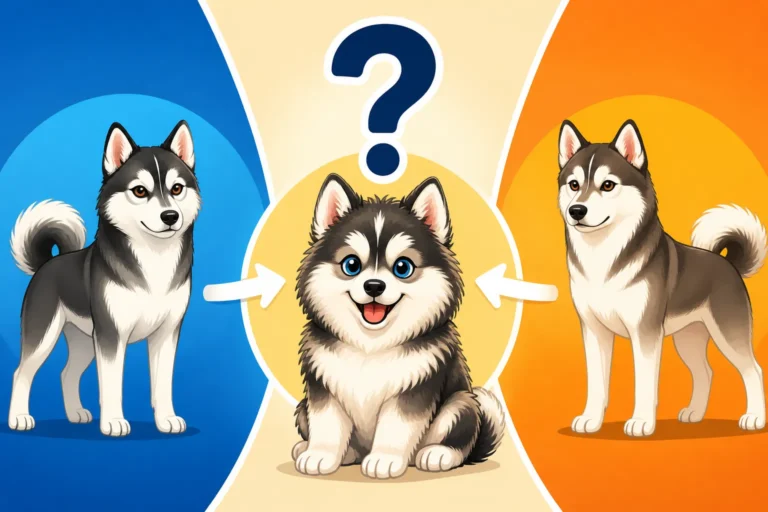
Pomsky or Pomeranian for a Family
A family choosing between a Pomsky and a Pomeranian is often weighing two very different kinds of small dog: one can be energetic and unpredictable in size, while the other is compact but delicate. This guide compares their likely needs around children, exercise, training, grooming, and daily life so you can think beyond puppy photos and choose a better fit.
Pomsky or Pomeranian for a family with children
How each dog may handle family life
A Pomeranian can be affectionate, alert, and closely attached to its people. Its small body, however, is easy to injure if a child picks it up awkwardly, drops it, or trips over it during play. That doesn’t mean Pomeranians can’t live happily with children. It does mean the adults need to teach children how to interact gently and make sure the dog has a quiet place to retreat.
A Pomsky may be sturdier than a very small Pomeranian, but the label does not guarantee a particular adult size, build, or temperament. Pomskies are a cross between a Pomeranian and a Siberian Husky, and individual puppies can inherit traits in different combinations. One may be small and cautious; another may be larger, more energetic, and less interested in being carried around. That uncertainty matters when you’re choosing a dog for a busy household.
In either case, supervision is not optional when young children and dogs are together. Children should not chase a dog, grab its tail or ears, disturb it while eating, or corner it in a bed or crate. Adults should step in before a dog has to growl or snap to make itself understood. For more on the specific challenges of a Pomsky in a family home, see A Pomsky in a House With Children and Whether a Pomsky Is Safe With Toddlers.
Matching the dog to your children’s ages
A household with teenagers who understand animal boundaries may be able to manage either breed with thoughtful introductions and clear routines. A household with a toddler may face a tougher daily balancing act: the child is still learning impulse control, while the dog needs protection from rough handling and the option to get away.
Consider what everyday life actually looks like. Will the dog be expected to sit on a child’s lap? Will kids carry it from room to room? Is there a calm adult available to supervise play and separate the dog when the house gets noisy? If a Pomeranian is being considered, these questions are especially important because its small size can make accidental injury a greater concern. A Pomsky may be physically larger, but a larger or more active dog can still bowl over a small child or become overwhelmed by constant attention.
Don’t judge a puppy’s suitability by whether it tolerates being handled in one short visit. Ask about the parents’ temperaments, the puppy’s behavior around everyday household sounds, and how the breeder has introduced it to people and handling. A calm puppy still needs gradual socialization and patient training; a lively puppy doesn’t necessarily become a difficult adult. The fit depends on the dog, the family’s expectations, and the adults’ willingness to guide both sides.
Comparing size, energy, and training needs
A Pomsky is less predictable in size and activity
A Pomeranian is a small dog, while a Pomsky’s eventual size can vary because it inherits from two breeds with markedly different typical builds. Parent sizes can offer clues, but they can’t promise exactly how big a puppy will become. If you need a dog that can safely fit into a particular routine—such as frequent travel in a carrier or life around very young children—ask for realistic information about the puppy’s parents and relatives rather than relying on a label such as “mini.”
Pomskies also may inherit a strong interest in activity, exploration, or chasing. A dog that looks small enough to carry can still have the drive and stamina to need regular walks, play, and training. A Pomeranian needs exercise and engagement too, but the daily rhythm may look different from that of a more active Pomsky. Neither breed should be chosen on the assumption that small size means low effort.
| Family consideration | Pomsky | Pomeranian |
|---|---|---|
| Adult size | Can vary; puppy size alone is not a guarantee | Typically very small |
| Activity needs | May be lively and need regular outlets | Needs daily activity, though the amount varies by dog |
| Around young children | Supervision and boundaries are essential | Extra care is needed because of its delicate size |
| Predictability | Traits and size may vary between dogs | Often more consistent in general size, but temperament still varies |
| Grooming | Often has a dense coat that needs regular care | Has a profuse coat that also needs consistent grooming |
| Training focus | Recall, settling, and managing energy may be important | Barking, handling, and confidence-building may be important |
The table describes general tendencies, not promises. Breed mix, upbringing, health, and individual temperament all affect what life with a particular dog will be like.
Training and household routines
Both breeds benefit from reward-based training, short practice sessions, and consistent rules. A Pomsky may need extra work on coming when called, walking calmly, and settling indoors, especially if it is easily distracted by movement or smells. A fenced yard is not a substitute for walks or supervision, and off-leash freedom should not be assumed. See Building a Recall a Pomsky Answers for more on building a reliable response.
Pomeranians can be alert and vocal, so families in apartments or homes with shared walls should think about how they’ll respond when the dog barks at hallway sounds, visitors, or activity outside. Training a quiet cue can help, but it works best alongside practical management: close curtains if passersby trigger barking, reward calm behavior, and avoid yelling back, which can add to the excitement.
Whichever breed you choose, settle household expectations before the dog arrives. Decide who handles walks, feeding, grooming, and training. Give the dog a protected resting area where children know not to disturb it. If you’re making a supply list, resources from Chewy can help you compare basic items such as leashes, grooming tools, and feeding equipment, but choose items to suit the individual dog’s size and needs rather than buying by breed label alone.
Grooming, health, and everyday care
Coat care is a regular commitment for both
Pomskies often have a thick coat, but coat type and shedding can vary. A Pomsky may shed noticeably, particularly when its undercoat is being released, and loose hair can collect on clothing, furniture, and floors. Regular brushing helps remove loose coat and catch tangles before they become uncomfortable. Families should be prepared for grooming as part of the weekly routine, not an occasional tidy-up.
Pomeranians also need consistent coat care. Their long, abundant coat can tangle, especially around areas that rub or stay damp. Brushing should be gentle and thorough enough to reach through the coat rather than smoothing only the surface. Both breeds need routine nail care, dental care, and occasional bathing as appropriate. If a family has limited time for brushing, consider whether it can realistically fit into the week before choosing either dog.
Shaving a double-coated dog is not a simple shortcut for shedding or warm weather. Ask a veterinarian or experienced groomer what care suits the individual coat, and focus on regular brushing and keeping the dog comfortable. If you’re comparing coat expectations, The Three Pomsky Coat Types and The Standard Pomsky Coat explain why Pomsky coats can differ. Chewy may be one place to browse brushes and other grooming basics, but a tool should feel comfortable for the dog and work with its actual coat.
Health and handling deserve attention
No breed is free of health concerns, and mixed breeding does not automatically guarantee a healthier dog. A Pomeranian’s small size makes careful handling important, while a Pomsky may inherit health risks associated with either parent breed. Ask the breeder what health screening has been done on both parents and request records rather than relying on verbal assurances. For background on how inherited risks can differ, see The Two Opposite Disease Lists a Pomsky Inherits.
Pay attention to routine preventive care as well as obvious symptoms. Small dogs can have crowded teeth, and dental care is easier to maintain when a puppy is gradually taught to accept tooth brushing. A dog that suddenly limps, seems uncomfortable, coughs repeatedly, or changes its eating or activity habits should be assessed by a veterinarian. Don’t assume a symptom is just a quirky breed trait.
Handling practice can make care safer and less stressful. Teach the dog to accept gentle examination of its paws, ears, and mouth, using rewards and brief sessions. Children should not be responsible for lifting or restraining a small dog. When shopping for food or dental-care supplies, Chewy’s listings can be a starting point for comparing categories, but your veterinarian is the better person to ask about a diet or product choice for a dog with a specific health need.
Making the choice that fits your household
Choose based on the real dog, not the label
A Pomeranian may suit a family that wants a very small companion and can protect it from rough handling, give it regular coat care, and work calmly on barking and confidence. A Pomsky may suit a family prepared for variation in adult size, coat, and energy, and willing to provide consistent exercise, training, and supervision. Neither is an automatic “family dog” simply because it is small or cute.
Think through a typical weekday, not just the first few weeks with a puppy. Who will take the dog out in rain or cold? How will it cope with school runs, visitors, and time alone? Can the household provide a safe resting area? If the dog needs more activity than expected, will someone have time to add training games or walks? Honest answers are more useful than hoping the dog will adapt to a schedule that leaves its needs unmet.
If you’re choosing a Pomsky, remember that a puppy’s appearance doesn’t reliably predict its adult size or behavior. Ask to meet the mother when possible, learn about both parents, and review the breeder’s health testing and contract. What a Pomsky Actually Weighs Full Grown and Whether a Pomsky Suits a First Time Owner can help you consider some of the questions buyers commonly overlook.
A practical decision checklist
Before making a commitment, write down the needs your family can reliably meet and the situations that would be difficult. Include child supervision, grooming time, exercise, barking tolerance, veterinary care, and safe handling. Then compare those needs with the specific dog you’re considering—not just broad expectations about the breed.
Use questions like these to guide the decision:
- Can every child in the home follow rules about gentle handling and giving the dog space?
- Is an adult available to supervise interactions and manage the dog’s routine?
- Can the household handle regular brushing and seasonal shedding?
- Are you prepared for a Pomsky whose adult size and activity level may be difficult to predict?
- Can you provide daily exercise and training even when family schedules are busy?
- Have you checked health records and asked how the dog has been raised and socialized?
- Is there a plan for safe separation when the dog needs rest or the children need attention?
If you’re unsure, spend time with adult dogs of each breed before deciding. Ask owners about the less photogenic parts of daily life: the hair on the sofa, the noisy moments, the grooming sessions, and the adjustments they made around children. A thoughtful match is not about finding the universally better breed. It is about choosing a dog whose needs your family can meet consistently, and whose presence can be safe and comfortable for everyone in the home.
Disclaimer
This article is for general informational purposes only and does not constitute professional advice. Laws, prices and regulations vary by location and change over time. Consult a qualified professional for guidance on your specific situation.