Whether a Pomsky Is Ever Part Klee Kai
A dog advertised as a Pomsky may look strikingly like a small Husky, but appearance alone cannot tell you whether an Alaskan Klee Kai is in the mix. This guide explains what “part Klee Kai” can mean, how that differs from a conventional Pomsky, what DNA tests and paperwork can actually establish, and what to ask before you accept a breeder’s description.
What “part Klee Kai” means for a Pomsky
The usual Pomsky parentage
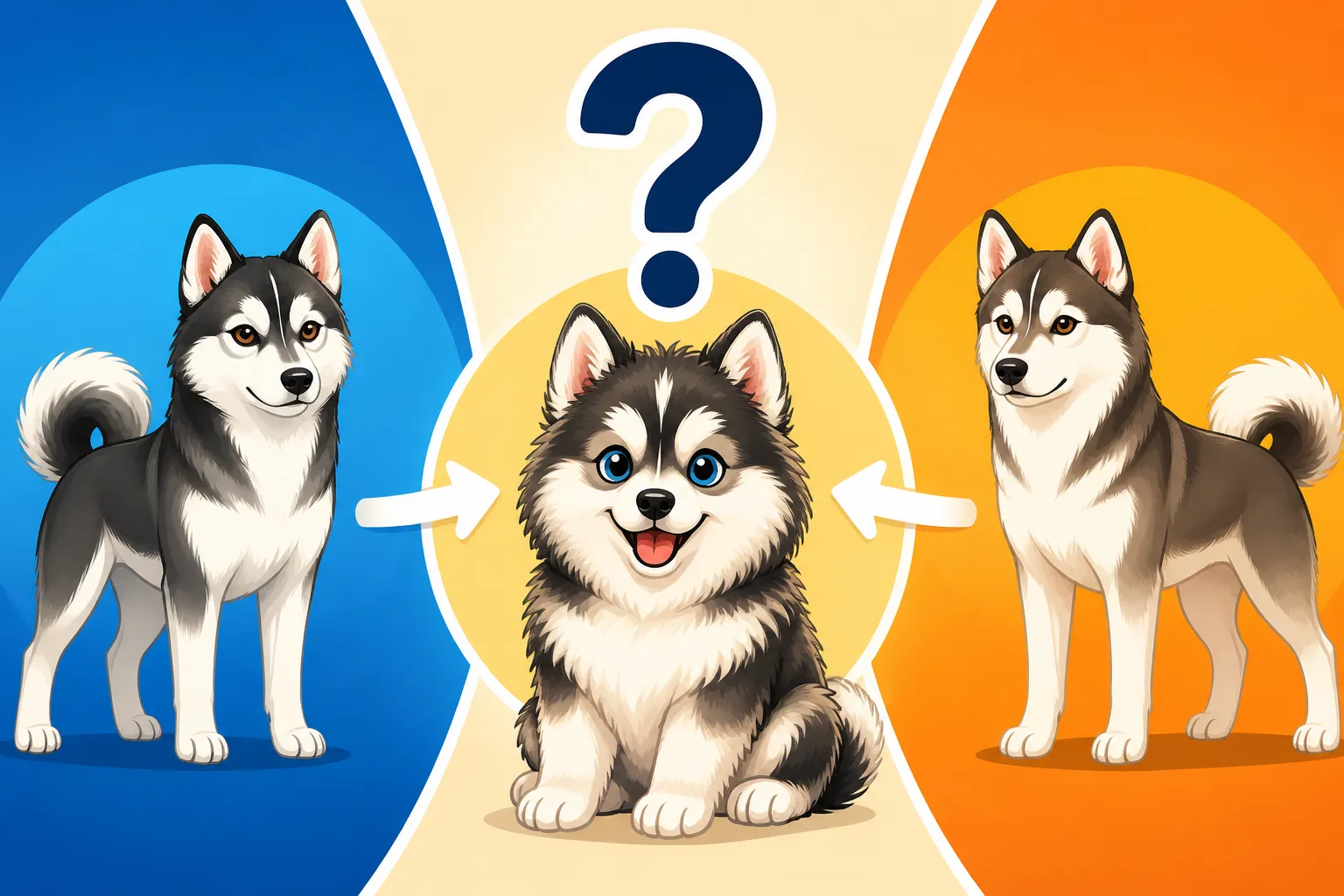
A Pomsky is generally described as a cross between a Siberian Husky and a Pomeranian. That description matters: if a dog has Alaskan Klee Kai ancestry, it may still be sold using the Pomsky name, but it is not simply the conventional two-breed cross implied by that label.
There is no universally accepted kennel-club breed standard that makes every dog marketed as a Pomsky fit one fixed definition. Generations and breeding choices vary, and a seller’s label is not a pedigree. Still, when someone asks whether a Pomsky can be part Klee Kai, the most accurate answer is that it can happen in an individual dog or a breeding line—but the Klee Kai ancestry should be disclosed rather than quietly folded into the word “Pomsky.”
Alaskan Klee Kai and Siberian Huskies are related northern breeds, so their looks can overlap. Both can have erect ears, a facial mask, a curled or carried tail, and a compact, double-coated appearance. A dog displaying those traits does not prove Klee Kai ancestry, just as blue eyes or a Husky-style coat do not prove that a dog is a purebred Husky.
For a closer look at the distinction between the breeds, see The Pomsky Against the Alaskan Klee Kai. If a seller describes a dog as “part Klee Kai Pomsky,” ask them to state the parent breeds and generation plainly, rather than relying on a nickname.
How Klee Kai ancestry could enter a line
Klee Kai ancestry could enter a dog’s background through a deliberate cross between a Klee Kai and a Pomsky, or through a breeding program that uses Klee Kai in later generations. It could also appear in a dog sold with an inaccurate or incomplete breed description. Those are different situations, so “part Klee Kai” is not a complete explanation by itself.
For example, imagine a breeder crosses an Alaskan Klee Kai with a Pomeranian-Husky mix and sells the puppies as Pomskies. The puppies have Klee Kai ancestry, and the label should make that clear. In another case, a breeder may have several generations of mixed dogs but provide only the word “Pomsky” in an advertisement. Without a transparent family tree, a buyer cannot tell whether the dog is a conventional Pomsky cross, a Klee Kai cross, or another mixture.
This is why the question Whether Crossing Klee Kai Into Pomsky Lines Is Honest depends in large part on disclosure. Crossbreeding itself does not make a dog a bad companion. The concern is whether buyers are given accurate parentage information and whether they can evaluate the health, temperament, and expected adult size of the dog they are considering.
A seller’s explanation should be specific enough to follow. “There might be a little Klee Kai in there” is not the same as naming the Klee Kai parent, sharing the known ancestry, and explaining how the breeder arrived at the label. When the history is uncertain, “mixed breed” may be a more honest description than a confident-sounding but unsupported claim.
Why a dog may be mistaken for a Klee Kai or Pomsky
Similar looks are not proof of ancestry
Pomskies can vary widely in size, coat, markings, and build. Some resemble a small Husky; others look more like a fluffy Pomeranian or an entirely different mix. Klee Kai can also have a miniature northern-breed appearance. That overlap makes casual visual identification unreliable, especially when a dog is young and its adult coat and proportions have not developed.
Consider a puppy with a black-and-white mask, upright ears, and bright eyes. Those features may prompt someone to guess “Klee Kai,” but they can also occur in a Pomsky or other northern-breed mixes. Even an experienced dog owner may be able to offer only a visual impression—not a verified family history.
Size can mislead, too. A small Husky-looking dog is not automatically a Klee Kai, and a Pomsky’s adult weight cannot be reliably confirmed by its appearance in a single puppy photo. For background on why Pomsky size can be difficult to predict, read Whether a Pomsky Puppy's Size Can Be Predicted. A breeder’s estimates should be treated as estimates, not guarantees.
Why labels can become confusing
The word “Pomsky” is widely used for dogs that differ in generation and breeding history. Some sellers may use the label because it is familiar to buyers, while others may use it loosely for a small Husky-like mix. Klee Kai may be involved in some dogs’ ancestry, but the label alone does not tell you that.
A buyer may also see a dog described as “Pomsky-type,” “Klee Kai Pomsky,” or “miniature Husky mix.” Those phrases are not interchangeable proof of breed composition. Ask what each term means to that seller and request the actual parentage information. If the answer keeps changing, or the seller relies only on photographs and appearance, treat the ancestry as unconfirmed.
| What you are told | What it may mean | What to ask for |
|---|---|---|
| “Pomsky” | Usually intended to mean a Pomeranian-Husky cross, but the label may be used loosely | The named breeds and generations of both parents |
| “Part Klee Kai Pomsky” | Klee Kai may be included somewhere in the dog’s ancestry | Which parent or ancestor was the Klee Kai, and whether records support that claim |
| “Miniature Husky” | A descriptive phrase, not a reliable statement of breed ancestry | The actual parent breeds and any available pedigree records |
| “Looks like a Klee Kai” | A visual comparison only | Whether the seller has documented ancestry or is making an appearance-based guess |
| “DNA-tested Pomsky” | A genetic test may suggest breed ancestry, depending on the test and its reference data | The full report, the tested dog’s identity, and what the test can and cannot conclude |
If you encounter a Klee Kai advertised as a Pomsky, Whether an Alaskan Klee Kai Is Sold as a Pomsky is a useful related question. The practical point is simple: ask for the dog’s history rather than trying to settle the matter from a breed label or a photograph.
How to check ancestry without overreading the evidence
Ask for records and a clear family tree
Start by asking the breeder or seller to identify the puppy’s parents and explain what is known about each one. If they claim Klee Kai ancestry, ask where it occurs in the pedigree. Request records that support the account, such as parent information, breeder documentation, or any registration records that are relevant to the dogs involved.
Paperwork is useful only when you understand what it represents. A document may show that a dog was registered with a particular organization or recorded under a particular description; that does not automatically prove every claim about its ancestry. Likewise, the absence of formal pedigree papers does not, on its own, tell you exactly which breeds are in a mixed-breed dog. For a fuller discussion, see Whether a Pomsky Pedigrees Can Be Verified.
Look for consistency across the conversation and documents. Do the names and descriptions of the parents match the listing? Does the seller explain whether the Klee Kai was a parent, grandparent, or more distant ancestor? Are they willing to say when a detail is unknown? Clear answers are more useful than a confident promise that a dog is “100 percent Pomsky” when the breeding history is not available.
If a seller cannot establish the ancestry, that does not automatically make the dog unsuitable as a pet. It does mean you should make your decision based on the information that is actually known, not on a breed claim that cannot be checked.
Understand what a DNA test can and cannot show
A canine DNA test may provide clues about ancestry, but it should not be treated as a perfect pedigree certificate. Test results depend on the company’s reference samples and methods, and closely related breeds can be difficult to distinguish with certainty. The result may suggest a northern-breed background without resolving whether a particular ancestor was a Siberian Husky, an Alaskan Klee Kai, or another related breed.
A test also cannot tell you everything a buyer wants to know. It does not guarantee adult size, temperament, health, or the accuracy of a seller’s entire breeding history. If you are considering a test, read the report carefully and ask what the company means by each result. The related guide Whether Embark or Wisdom Panel Confirms a Pomsky covers why breed-test results need to be interpreted with care.
When a seller offers a DNA report, check that it belongs to the puppy or a named parent, rather than assuming a test from another dog proves the puppy’s ancestry. Ask for the full report, not just a screenshot of a breed percentage or a verbal summary. A report can be one piece of evidence, but it should be weighed alongside the documented parentage.
This is also where the difference between “genetic clues” and “verified lineage” matters. A DNA result may support a claim of Klee Kai ancestry, while the breeder’s records explain how that ancestry entered the line. Neither appearance nor a short test summary tells the whole story.
What to do if you are choosing a dog
Compare the dog you want, not just the label
Before choosing a puppy, decide what information matters most to your household. If your priority is a specific adult size, coat, exercise level, or temperament, ask about the individual parents and relatives rather than assuming that “Pomsky” or “Klee Kai” guarantees a predictable outcome. A dog’s behavior and care needs depend on more than its breed name.
Ask to meet the puppy in a setting where you can observe how it responds to ordinary handling and surroundings, if that is possible. Ask about the parents’ temperaments, health history, grooming needs, and activity levels. If the seller cannot answer questions about the dog’s background, consider whether you are comfortable making a decision with that uncertainty.
It may help to compare the options directly. A well-documented Klee Kai, a transparent Pomeranian-Husky cross, and an unknown mixed-breed dog can each be a good companion for the right home. They are not necessarily interchangeable choices, though. The guide Choosing Between a Pomsky and a Klee Kai can help frame that comparison without relying on looks alone.
Also be cautious about claims that a particular mix is automatically healthier, calmer, smaller, or easier to train. A Klee Kai influence does not guarantee any of those outcomes. Ask for evidence about the individual dog and the breeding practices, and speak with a veterinarian about health questions once you are considering a specific puppy.
Make the decision with honest expectations
If you adopt or buy a dog whose ancestry is uncertain, you can still prepare thoughtfully. Plan for the dog in front of you: monitor its growth, ask a veterinarian to assess its body condition and health, and choose equipment that fits safely as it matures. Whether you shop locally or use a retailer such as Chewy for routine supplies, a product listing is not evidence of the dog’s breed or pedigree.
The same applies to food, grooming tools, and accessories. A dog’s actual size and coat may become clearer over time, so avoid making long-term assumptions based on a label like “toy Pomsky” or “Klee Kai mix.” If you use Chewy to browse supplies, use the dog’s measured size and practical needs to guide the choice rather than selecting products because a listing mentions a particular breed. When the dog is still growing, check fit regularly.
If you are working through a breeder or rescue, keep copies of written descriptions and records, and ask questions before paying a deposit or taking the dog home. Chewy can be a place to shop for ordinary pet-care items, but the seller or rescue is the source to ask about the animal’s history. For more on the paperwork question, see Whether a Pomsky Without Papers Is Real.
In the end, a Pomsky can have Alaskan Klee Kai ancestry, but that makes the ancestry part of the dog’s story—not something that can be reliably inferred from a Husky-like face. The most useful approach is to separate appearance, marketing language, DNA clues, and documented parentage. Ask for specific records, be wary of guarantees that outrun the evidence, and choose based on the individual dog’s needs and the information you can verify.
Disclaimer
This article is for general informational purposes only and does not constitute professional advice. Laws, prices and regulations vary by location and change over time. Consult a qualified professional for guidance on your specific situation.