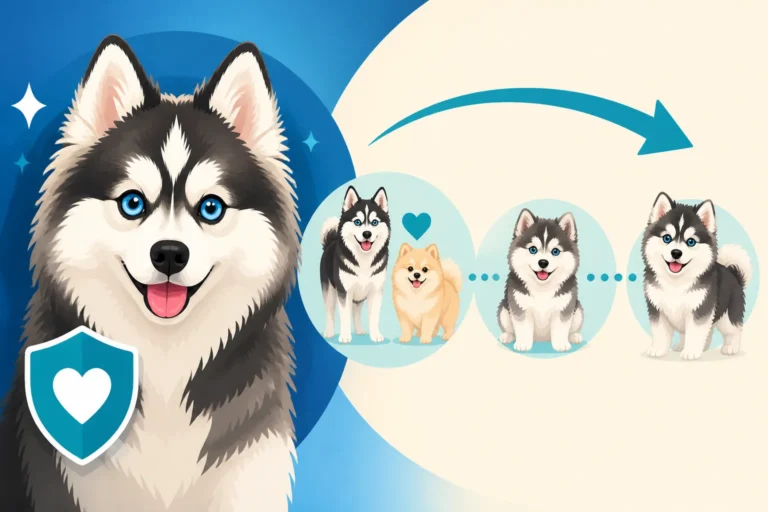
Whether Pomsky Pedigrees Can Be Verified
A Pomsky puppy can come with a polished certificate, a generation label, and a family tree that looks reassuring—but those documents do not all prove the same thing. If you are trying to confirm a Pomsky’s parents, ancestry, or breeding history, this guide explains what records can establish, what DNA testing can and cannot show, and what to ask a breeder before relying on a pedigree.
What a Pomsky pedigree can and cannot prove
Pedigree records trace reported ancestry
A pedigree is a family tree: it records a dog’s parents and, when records extend back far enough, earlier generations. For a Pomsky, the pedigree may identify the parent breeds, individual dogs, registration details, and the generation the breeder assigns to the puppy. It is useful only to the extent that the underlying identities and parentage have been recorded accurately.
A document can look official without independently proving every claim on it. A printed chart, breeder-created certificate, or registration entry may reflect information someone submitted rather than a verified chain of parentage. Ask who issued the record, what information was checked, and whether you can confirm the dogs and registration numbers with the organization named on the paperwork.
Pedigree is also different from a prediction. A family tree may describe the puppy’s recorded ancestry, but it cannot guarantee adult size, coat type, eye color, temperament, or health. Pomsky littermates can vary, and a generation label does not make every puppy predictable. For size context, see What a Pomsky Actually Weighs Full Grown.
A Pomsky’s generation label is not a pedigree by itself
Labels such as F1, F2, or multigenerational describe a breeding relationship, not a complete identity check. An F1 is generally used for a first-generation cross between a Siberian Husky and a Pomeranian. Later-generation labels refer to subsequent crosses, but breeders and registries may use terminology differently, so ask for the exact mating behind the label rather than relying on the letters alone.
For example, a seller might describe a puppy as “F2” but provide no records for the parents or grandparents. That label tells you what the seller says about the cross; by itself, it does not establish which dogs were bred or confirm that their identities are correct. A useful record should connect the puppy to named parents and explain how the generation description was determined.
If a breeder uses “multigen,” ask how many generations are documented and whether the records are continuous. The answer should be specific enough to follow: which parent was a Pomsky, what that parent’s recorded ancestry was, and what the other parent’s background was. The broader topic of generation labels is covered in What F1 Means on a Pomsky and Whether a Multigen Pomsky Is More Predictable.
Registration is not automatically independent verification
A registry entry can be valuable because it gives you a place to check a dog’s recorded details. But registration should not be treated as a blanket guarantee that every ancestor, health claim, or breeding decision has been independently verified. Different registries have different rules, and the word “registered” alone does not tell you what checks were performed.
Ask what the registration actually covers. Does it record a dog’s name and parentage as supplied by the breeder? Does the organization require evidence for parentage? Can you search or contact the registry to confirm the entry? These are practical questions, not accusations. A responsible breeder should be able to explain what the paperwork means and what it does not mean.
The International Pomsky Association is one organization you may encounter in Pomsky paperwork. Review the details of its registration process directly, and distinguish registration from proof of parentage or health screening. For more context, see What an IPA Registered Pomsky Guarantees and Whether the IPA Keeps a Pomsky Studbook.
How to check a Pomsky’s parentage and paperwork
Start with the puppy’s identity and its parents
Before trying to interpret a pedigree, make sure the documents refer to the puppy you are considering. Ask for the puppy’s full registered or recorded name, registration number if applicable, date of birth, and identifying information. Check that the same details appear consistently across the contract, veterinary records, registration paperwork, and any pedigree chart.
Then ask for the names and records of both parents. Request their registration details, breed or cross description, and the records supporting the breeder’s generation claim. If the breeder says a parent is an F1 Pomsky, for instance, ask for the parent’s own parentage records rather than accepting the label alone. Keep copies so you can compare names and numbers later.
Pay attention to small inconsistencies. A spelling difference may be a clerical error, but a missing parent, mismatched date, or registration number that leads to a different dog needs an explanation. If the breeder provides only cropped screenshots or refuses to let you inspect complete documents, pause before placing a deposit. You can also compare the breeder’s explanation with guidance in The Health Tests a Pomsky Breeder Should Show, since health screening and ancestry records answer different questions.
Ask what DNA testing was done
DNA testing can mean more than one thing. A consumer breed-ancestry test estimates which breeds may appear in a dog’s genetic background. A parentage test compares a puppy’s DNA with samples from proposed parents to assess whether those dogs are its biological parents. Those are different purposes, and one kind of test does not automatically substitute for the other.
If a breeder says DNA confirms the puppy’s pedigree, ask what test was used, which dogs were sampled, and what the report actually concluded. Parentage testing is most useful when the puppy and the claimed parents are all included in a suitable comparison. A report showing broad breed ancestry may help characterize a dog, but it does not establish a named family tree across generations.
A consumer test result can be interesting, but treat it as one piece of information rather than a complete pedigree audit. Test interpretation depends on the company’s reference data and the question being asked. For a closer look at those limits, read Whether a DNA Test Confirms a Pomsky. If the breeder says testing was performed, request the report itself or a clear explanation of its scope—not just a badge or a verbal assurance.
Use a simple document checklist
Keep the review practical. You do not need to become a canine geneticist; you need enough consistent information to understand what is being claimed and how it can be checked.
| Record or claim | What to look for | What it does not prove by itself |
|---|---|---|
| Puppy registration or certificate | Matching name, identifying details, and registration number | That every ancestor has been independently confirmed |
| Pedigree chart | Named parents and recorded generations | That the listed parentage is biologically correct |
| Parent registration records | Details that match the pedigree and breeder’s account | That the puppy is the offspring of those parents |
| Parentage DNA report | A comparison involving the puppy and claimed parents | Health status or a complete multigenerational pedigree |
| Breed-ancestry DNA result | An estimate of ancestry categories | A verified family tree with named ancestors |
| Health-test records | The tested dog, test performed, and results | Parentage unless the test was specifically for that purpose |
Save digital copies in one folder and note any questions beside the relevant document. Some owners keep vet records and routine purchase records together; for example, a Chewy order confirmation may help you remember when you bought a particular food or care item, but it is not evidence of pedigree. Keeping that distinction clear prevents ordinary ownership records from being mistaken for ancestry documentation.
Warning signs and sensible next steps
Notice claims that sound stronger than the evidence
Be cautious when a breeder promises that a puppy is “guaranteed pure Pomsky,” “fully verified,” or “perfectly predictable” without explaining what those phrases mean. Pomsky is a cross between Pomeranian and Siberian Husky, and the usefulness of a pedigree depends on the records behind the claim. A confident description is not a replacement for documents you can review.
Another warning sign is pressure to pay before you can see the paperwork or ask questions. You should have time to read a contract, compare names and numbers, and understand whether the puppy’s records are complete. A breeder who responds to reasonable questions with irritation—or insists that a certificate proves everything—may not be giving you enough information to make an informed decision.
A registry logo, DNA-test logo, or veterinary document may all be genuine and still answer different questions. Look at the actual content: a health screening report addresses a health issue, while a parentage report addresses a biological relationship. A Chewy receipt, microchip record, or vaccination history can support an ownership or care timeline, but none can establish which dogs produced a puppy. If a seller is presenting any of these as pedigree proof, ask them to clarify the distinction.
Ask direct questions before you commit
A straightforward conversation can reveal whether a breeder understands the claims they are making. Ask questions in writing so you can refer back to the answers when reviewing the documents.
- What does the generation label mean in this specific litter?
- Can I see the puppy’s records and the records for both parents?
- Which organization issued each registration, and how can I confirm the entries?
- Was parentage DNA testing performed on the puppy and both claimed parents?
- If DNA testing was done, does the report verify parentage or estimate breed ancestry?
- Are the dogs’ health-screening records available, and which conditions were assessed?
- What does the contract say if a record or ancestry claim turns out to be inaccurate?
The best answers are clear and consistent, not necessarily wrapped in technical language. If you are told that a record is confidential, ask whether the breeder can provide a redacted copy that still shows the relevant names, numbers, and results. If the explanation changes from one conversation to another, or key documents remain unavailable, consider waiting or looking elsewhere.
Keep pedigree separate from the decision to buy
A verified pedigree is useful, but it should not be your only measure of a breeder or puppy. Review the contract, the living conditions of the dogs, the breeder’s willingness to discuss health and temperament, and whether the puppy’s needs fit your household. Pedigree cannot promise that a dog will be easy to train, quiet in an apartment, or free from inherited health concerns.
Likewise, do not confuse an appealing appearance with proof of ancestry. Blue eyes, a husky-like mask, or a compact size may be part of what draws people to Pomskies, but physical traits alone cannot confirm parentage. If a breeder’s claims focus heavily on appearance while avoiding records, bring the conversation back to documentation and testing.
If you have already brought a puppy home, organize the paperwork you received and ask the breeder to fill in missing details. A Chewy purchase history can be useful for tracking supplies and routine care purchases alongside your vet file, but keep it in a separate category from registration and DNA documents. The goal is not to collect the most paperwork; it is to know what each record actually establishes. For broader background on the breed’s identity and records, see Whether Anyone Had Bred a Pomsky Before 2011 and Whether Pomsky Pedigrees Can Be Verified.
Disclaimer
This article is for general informational purposes only and does not constitute professional advice. Laws, prices and regulations vary by location and change over time. Consult a qualified professional for guidance on your specific situation.