Whether Breeders Cross a Pomsky Back to the Small Side
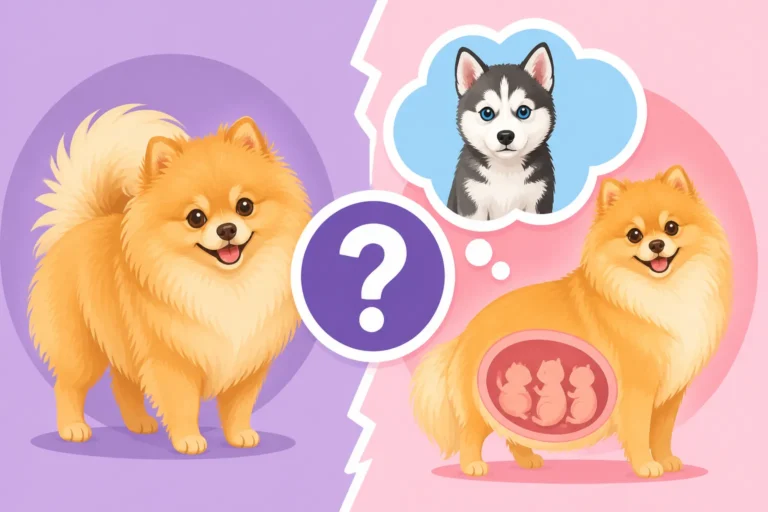
When a Pomsky breeder says a litter is “bred back to the small side,” they usually mean a Pomsky has been paired with a Pomeranian. That can shift a litter’s expected ancestry toward Pomeranian, but it does not guarantee tiny puppies, a particular coat, or a predictable temperament. Here’s what the breeding choice means, what it can and cannot tell you, and what to ask before choosing a puppy.
What breeding a Pomsky back to the small side means
A backcross is not the same as an F2
A Pomsky bred back to a Pomeranian is generally described as a backcross to the Pomeranian side. If the Pomsky parent is an F1, with one Husky parent and one Pomeranian parent, the resulting puppies would be expected to have roughly three-quarters Pomeranian ancestry and one-quarter Husky ancestry on average. That is an ancestry expectation, not a promise that every puppy will look or behave like a Pomeranian.
This pairing differs from an F2 Pomsky, which is typically produced by breeding two F1 Pomskies together. The terms describe different pairings, so it’s worth asking a breeder exactly which dogs were bred rather than relying on a generation label alone. For background, see What an F2 Pomsky Is and Why Pomsky Breeders Prefer F2 and Beyond.
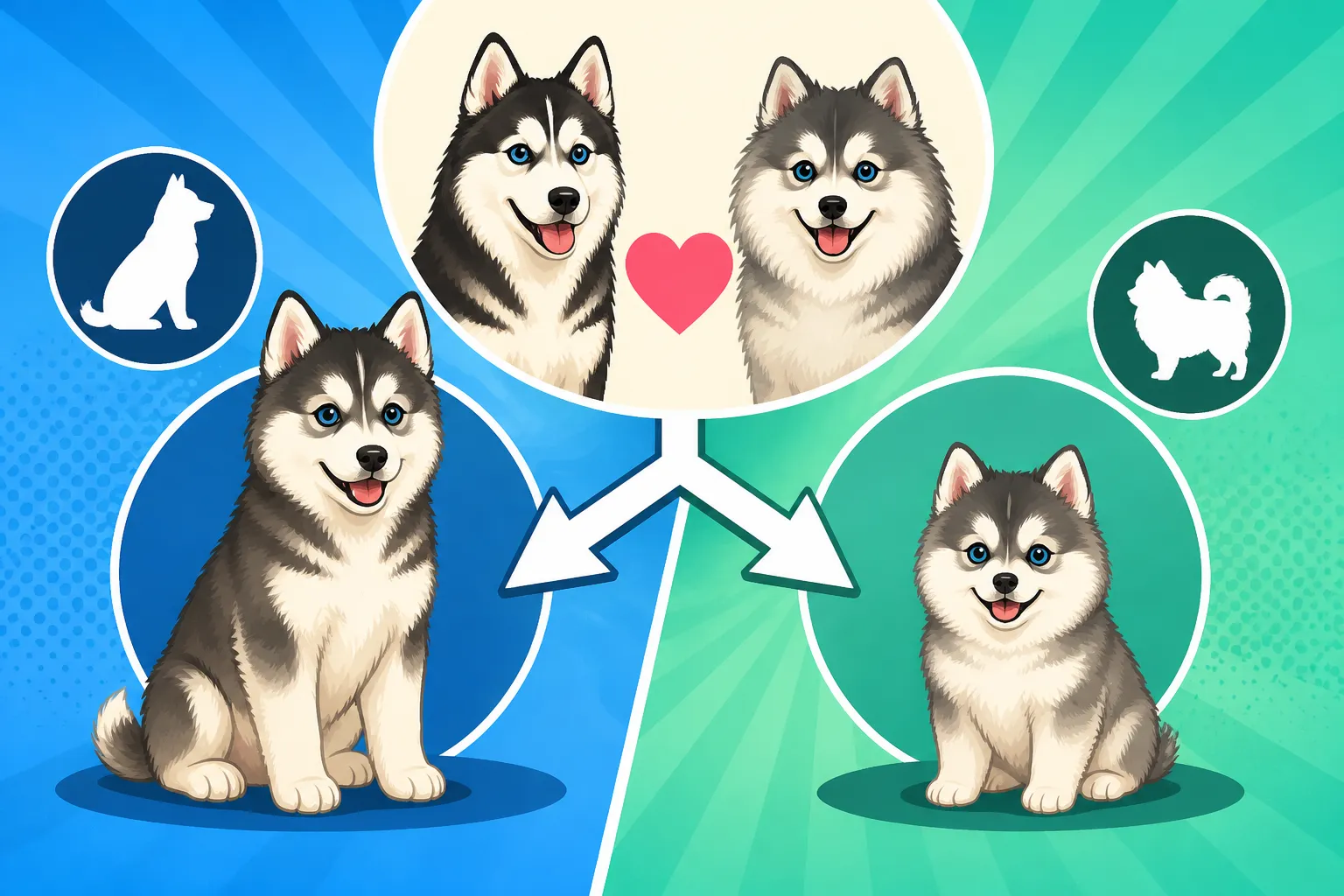
A breeder may use the backcross to try to influence size, coat, or other traits. But puppies inherit a mix of genes from both parents, and siblings can turn out quite differently. A puppy with more Pomeranian ancestry may still inherit a Husky-like build, energy level, coat, or other characteristics.
“Small side” usually means Pomeranian, not a guaranteed small puppy
The phrase can sound like a size guarantee, but it is not one. Pomeranians vary, Pomskies vary, and a puppy’s adult size depends on many inherited traits. Even when breeders choose smaller parents, littermates may mature at different sizes. That is why Whether a Pomsky Puppy's Size Can Be Predicted is a more complicated question than a puppy’s current weight or the size of one parent.
It also matters what the breeder means by “small.” Ask whether they mean a smaller adult weight, shorter legs, a finer build, or simply a higher proportion of Pomeranian ancestry. Those are related in some dogs, but they are not interchangeable outcomes. A small-looking puppy can still grow larger than expected, while a puppy that looks sturdy early on may mature into a more compact adult.
Be cautious of labels such as “micro” or “toy” when they are used as if they guarantee a specific adult size. Ask what the parents weigh, how related litters matured, and whether the breeder tracks adult weights over time. The article Whether a Toy or Micro Pomsky Is Real explains why marketing language should not replace clear information about the dogs.
Backcrossing does not automatically make a Pomsky more predictable
Some breeders use later-generation pairings in the hope of producing more consistent puppies. A backcross can move average ancestry toward one breed, but it does not neatly combine traits into a uniform result. One puppy might inherit the Pomeranian’s compact frame and a denser coat; another might be larger, leggier, or more Husky-like.
Predictability depends on more than the generation label. The particular parents’ health, size, structure, temperament, and family histories all matter. A breeder who says a backcross “locks in” a certain size or appearance should be able to explain what evidence supports that claim. For a broader look at generation and consistency, see Whether a Multigen Pomsky Is More Predictable and Whether Generation Changes a Pomsky's Size.
What a Pomeranian backcross may change
Adult size is a possibility, not a promise
Choosing a Pomeranian parent may shift the litter’s likely size range downward compared with some Pomsky pairings, but it cannot set a firm upper limit. The puppy’s inherited traits come from both parents and earlier generations. A breeder’s estimate should be treated as an estimate, not a contract with biology.
Ask about the actual parents rather than just their breed names. Their weight and build offer useful context, but they still cannot predict every puppy precisely. The relatives behind them matter too: adult sizes among parents, grandparents, and previous offspring can reveal whether a line tends to produce a wider range. See Whether Parent Weights Predict a Pomsky's Size for more on why even two small parents do not guarantee a tiny adult.
A responsible breeder should be comfortable explaining uncertainty. They might describe the size range seen in related dogs and explain how they arrived at an estimate, while making clear that individual puppies can fall outside it. A confident promise of a precise adult weight deserves careful follow-up.
Appearance and coat can still vary across the litter
A Pomeranian backcross may increase the chance of some Pomeranian-associated traits, but each puppy can inherit a different combination. Coat length, density, color, markings, ear shape, tail carriage, and facial appearance may vary among littermates. Even puppies with similar ancestry can develop noticeably different coats as they mature.
Photos of the parents and older relatives can help you understand the family, but they are not a guarantee of a puppy’s adult appearance. Ask whether the breeder can show mature dogs from related litters, not only young puppies. Puppy fluff can be especially misleading: a soft, rounded coat at eight weeks does not necessarily tell you exactly how the adult coat will look or how much grooming it will need.
Think about daily care as well as looks. A thicker double coat can mean regular brushing and more hair around the home. If you are preparing for a puppy, you might compare appropriately sized grooming tools and other basics through retailers such as Chewy, while asking the breeder which coat-care routine has worked for adult dogs in the line.
Temperament does not follow a simple ancestry formula
A puppy with more Pomeranian ancestry is not automatically calm, easy to train, or suited to every household. Temperament is influenced by inherited tendencies, early experiences, socialization, and the individual dog. Both parent breeds can be lively and alert, and a Pomsky may be vocal, energetic, or inclined to chase moving animals.
Ask how the adult parents behave in ordinary situations: around visitors, other dogs, grooming, handling, and time alone. Ask what the breeder does to introduce puppies to everyday sounds and gentle handling, and how they match puppies to homes. A thoughtful breeder will talk about individual differences rather than promising that every puppy in a backcross litter has the same personality.
How to assess a breeder’s backcross claims
Ask for a clear family tree and breeding explanation
Start by asking which generation the Pomsky parent is, what breed the other parent is, and how the breeder uses terms such as “backcross,” “F1,” or “multigen.” If the answer is vague, ask the breeder to describe the actual parents and grandparents in plain language. A pedigree or written family history can help you understand the pairing, but it should be consistent with the breeder’s explanation.
Ask whether the breeder has information about adult offspring from related pairings. Useful details include mature size, coat type, temperament, and health issues reported by owners. No family history can guarantee a puppy’s future, but transparent records help you judge whether the breeder’s claims are grounded in experience. For more on documentation, see Whether Pomsky Pedigrees Can Be Verified.
| Ask the breeder | What a useful answer should clarify |
|---|---|
| What exactly does “bred back to the small side” mean here? | The breeds and generations of both parents |
| What are the parents’ adult sizes and builds? | Real measurements or weights, not just labels such as “mini” |
| How did related puppies mature? | The range of adult sizes and traits, including variation |
| What health information is available? | Relevant examinations, test results, and family history |
| What happens if the puppy grows larger than estimated? | The written contract and the breeder’s expectations |
| How are puppies matched with homes? | Whether temperament and household needs are considered |
A clear answer does not mean a breeder can predict everything. It means they can distinguish between what they know, what they estimate, and what remains uncertain.
Evaluate health and breeding decisions separately from size
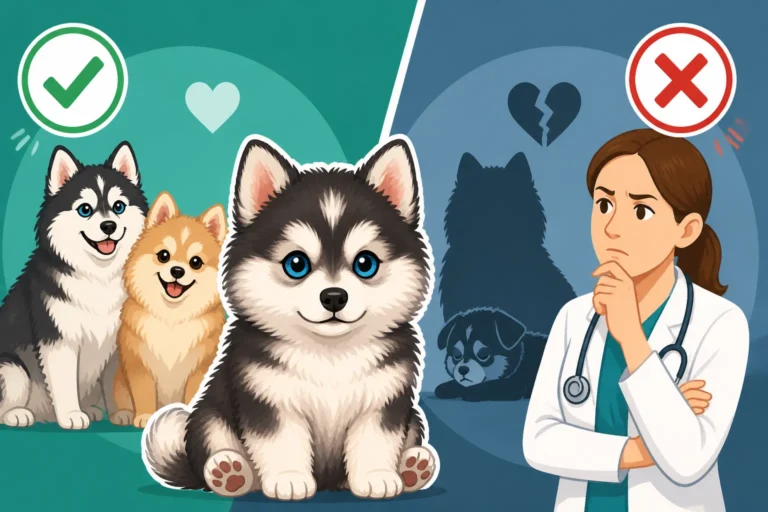
A smaller target is not, by itself, evidence of responsible breeding. Ask about the health of both parents and the approach used to assess risks in the dogs’ family lines. A breeder should be able to discuss relevant veterinary evaluations and explain what health concerns they monitor, rather than relying only on a general statement that the dogs are healthy.
Ask how the pairing was chosen and what safeguards were considered for the individual dogs. Size differences, reproductive health, and the welfare of the mother and puppies should be discussed with a veterinarian experienced in canine reproduction. No pairing should be treated as automatically safe or unsafe based on breed labels alone; the individual dogs and professional assessment matter.
Also pay attention to how the breeder talks about the puppies’ future. Claims that a cross will eliminate health problems or guarantee a longer life are not a substitute for health records. A smaller body does not automatically mean a healthier dog, and selecting for extreme smallness can create welfare concerns. Whether the Smallest Pomskies Are Healthy offers more context on why size should not be the only breeding goal.
Read the agreement and plan for the puppy you may actually get
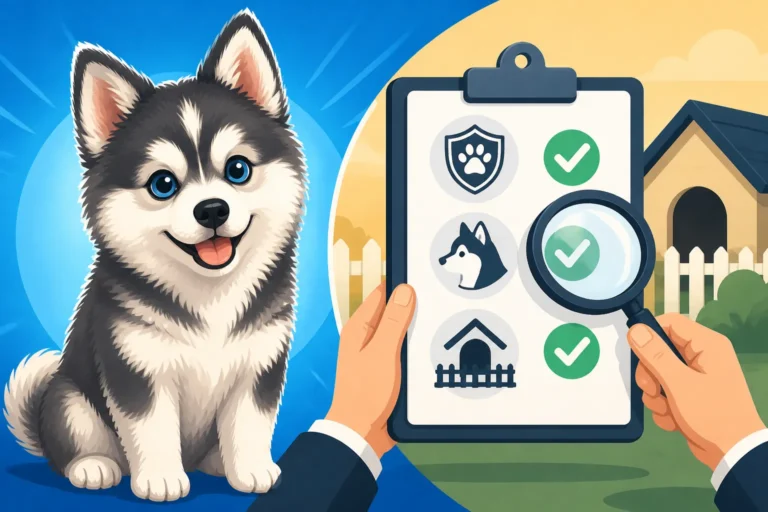
Before placing a deposit, read the purchase agreement carefully. Look for how the breeder describes the puppy’s estimated size, what health information is provided, and what support is available if the puppy develops a problem or grows beyond the estimate. Verbal reassurance is easy to remember differently later, so ask for important details in writing.
Plan for a range of adult outcomes rather than buying only if the puppy stays under a specific number. That includes being ready for the dog’s exercise needs, coat care, training, and everyday equipment. If you are comparing harnesses, food, or grooming supplies while planning, Chewy may be one place to browse options, but check that each item fits the puppy as it grows and suits its coat and body.
The same practical approach applies to your home. A puppy described as small may still need secure fencing, consistent training, and close supervision around larger dogs or young children. Retailers such as Chewy can help you look at basic supplies, but equipment choices should follow the dog’s actual measurements and behavior, not a “toy” label. As the puppy matures, revisit those choices; Chewy listings may be useful for comparing categories, while your veterinarian or groomer can help you identify what is appropriate for your individual dog.
What to remember when considering a small-side Pomsky
A backcross to a Pomeranian is a real breeding choice, but it is not a shortcut to a guaranteed miniature dog. It can shift expected ancestry toward the Pomeranian side, while adult size, appearance, coat, and temperament remain variable. Generation labels help describe a pairing, but they do not replace details about the actual dogs.
The most useful questions are specific: Who are the parents? What are their adult sizes and health histories? How did earlier puppies mature? What does the breeder mean by “small”? And what does the written agreement say about estimates and support? A breeder who answers candidly—including acknowledging uncertainty—gives you a better basis for deciding whether a puppy and its likely range of needs suit your home.
Disclaimer
This article is for general informational purposes only and does not constitute professional advice. Laws, prices and regulations vary by location and change over time. Consult a qualified professional for guidance on your specific situation.