Whether a Pomsky Can Be Bred Back to a Husky
A Pomsky can be bred back to a Siberian Husky, but the resulting puppies are not simply “more Husky-looking” Pomskies. Their expected ancestry shifts toward Husky, while size, coat, temperament, and health remain variable. This guide explains what a backcross means, what breeders should consider, and why the pairing deserves careful health and welfare planning.
What breeding a Pomsky back to a Husky means
How a backcross changes expected ancestry
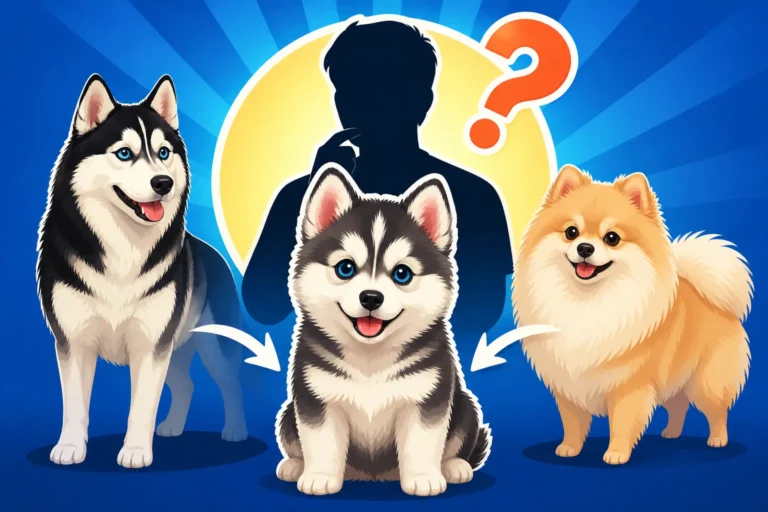
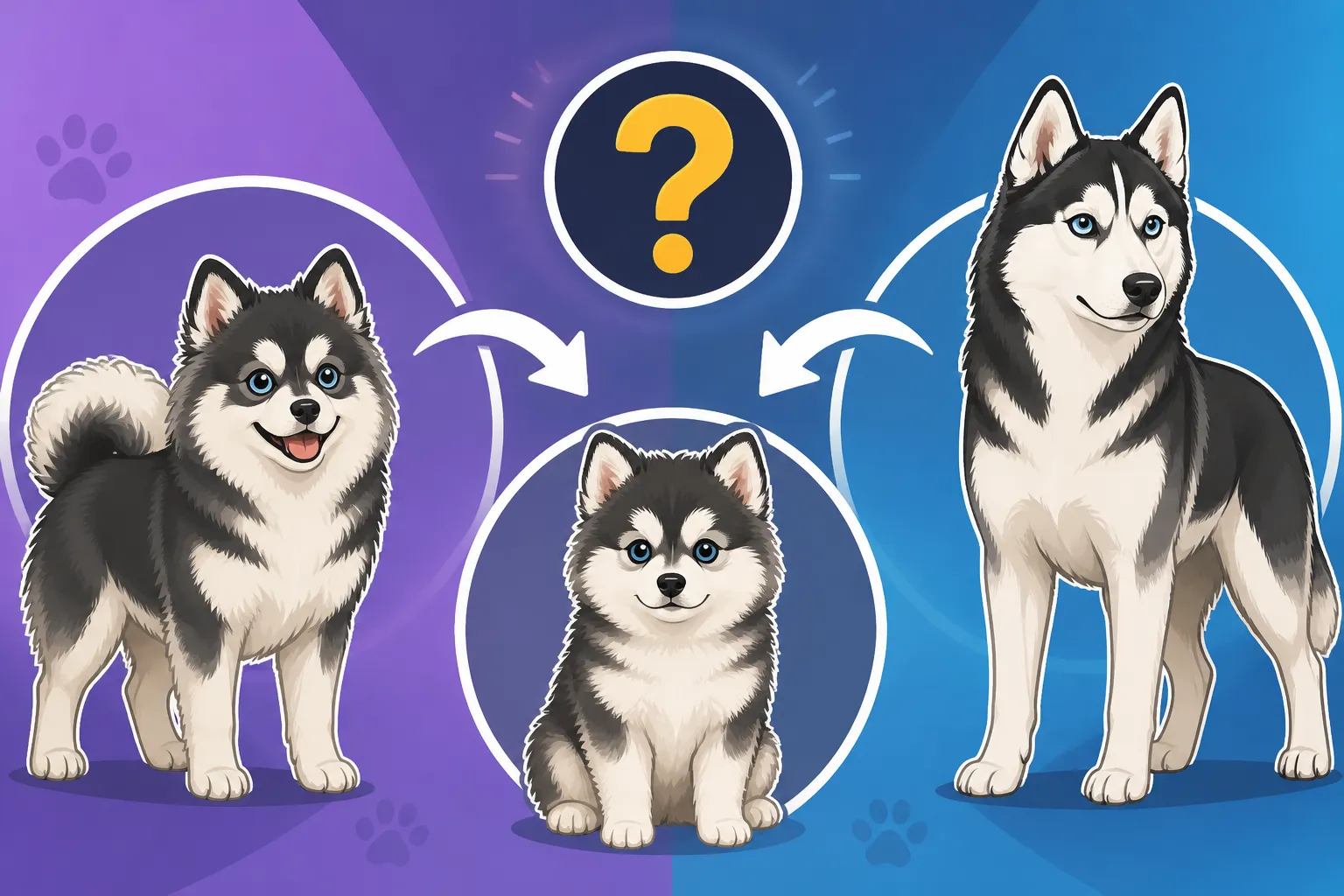
A Pomsky bred back to a Siberian Husky is usually described as a backcross: one parent is a Pomsky, and the other is a Husky. If the Pomsky parent is a first-generation cross between a Pomeranian and a Husky, the puppies have an expected average of roughly three-quarters Husky ancestry and one-quarter Pomeranian ancestry.
That figure describes the family tree, not a promise about any individual puppy. A puppy does not inherit a perfectly even, predictable set of traits from each breed. Littermates can differ in build, coat, facial features, energy level, and behavior. A puppy with more Husky ancestry on paper might still show conspicuous Pomeranian traits, while another may look much more like a Husky.
The starting generation matters, too. If the Pomsky parent is already several generations removed from the original cross, its ancestry may not be an even half Husky and half Pomeranian. The expected proportions in the new litter depend on that parent’s verified lineage. This is why a clear pedigree matters more than a label such as “second generation” or “multigenerational.” For background on the first cross, see What an F1 Pomsky Is.
What breeders mean by a breed-back
Breeders may use terms such as “backcross,” “BC1,” or “bred back to the Husky.” These terms describe a breeding relationship, but naming conventions can differ. Ask the breeder to explain the actual parents and generations rather than relying on a generation label alone.
A simple example helps. Imagine a first-generation Pomsky whose parents were a Pomeranian and a Siberian Husky. If that Pomsky is paired with an unrelated purebred Husky, the puppies have a higher expected Husky ancestry than the original Pomsky did. If one of those puppies is later bred to another Husky, the expected Husky share rises again. At each step, however, inherited traits still recombine rather than following a tidy visual recipe.
Breeders may choose a backcross to pursue a particular size, coat, or temperament profile. That does not mean the goal is guaranteed, or that increasing Husky ancestry automatically improves health or predictability. A backcross can also pass along unwanted traits carried by either parent. A well-explained breeding plan should say what traits the breeder is aiming for, what risks are being managed, and how the puppies will be described honestly.
What a backcross does not guarantee
Breeding a Pomsky to a Husky does not guarantee a puppy that looks like a small Husky. Puppies may grow larger than expected, shed heavily, have a coat that needs regular brushing, or show a mix of physical traits. A breeder’s estimate is not a firm adult-size guarantee, especially when the parents differ substantially in size and type.
Temperament is also not a predictable blend. Huskies can be energetic, independent, and strongly motivated to explore; Pomeranians may bring alertness and a different social style. A puppy may show some, all, or few of the traits people associate with either breed. Individual behavior is also shaped by early experiences, training, socialization, and the home environment.
That uncertainty is worth taking seriously before choosing a puppy. If someone wants a dog with the appearance and behavior of a purebred Husky, a backcross litter may not reliably meet that expectation. If the appeal is a particular mix, the prospective owner still needs to prepare for a range of adult sizes, exercise needs, and coat-care demands.
Is it physically and ethically responsible to make this pairing
Which parent is the Pomsky matters
The direction of the pairing is important. A Pomsky female bred to a much larger Husky male may face serious pregnancy and delivery risks, particularly if the puppies are large relative to her body. A responsible breeding plan must consider the female’s size, pelvic structure, health, and veterinary history—not just the desired look of the litter.
The reverse pairing, a Husky female and a smaller Pomsky male, avoids that particular size mismatch in the mother, but it is not automatically safe or suitable. The individual dogs still need health and temperament evaluation, and the breeder must plan for responsible care through pregnancy, birth, and puppy placement. Artificial insemination may be considered in some pairings, but using it does not resolve health or welfare concerns by itself. For more on why breeding this cross often involves veterinary assistance, see Why a Pomsky Requires Artificial Insemination.
A breeder should be able to explain why these specific dogs are being paired and how the female’s welfare will be protected. If the answer focuses only on producing a rarer look, a smaller Husky-like dog, or puppies that will sell well, that is not enough. Breeding decisions should put the health and well-being of the parent dogs and puppies first.
Size and delivery need veterinary planning
A Pomsky can vary widely in size, and the word “Pomsky” alone does not tell you whether a particular dog is physically suited to breeding with a Husky. The actual height, weight, body structure, and reproductive health of both dogs matter. The risk is especially concerning when a smaller female could be carrying puppies sired by a substantially larger male.
A veterinarian can assess the individual dogs and advise on reproductive risks, pregnancy monitoring, and the need for additional planning. Breeders should not treat a past uncomplicated litter as proof that a future pairing is safe. Each pregnancy is its own situation, and puppy size cannot be known precisely in advance.
The broader size gap between the two breeds is one reason this pairing should not be treated casually. Why the Size Gap Makes a Pomsky Breeding Dangerous explores why choosing the right parent combination is a welfare issue, not just a matter of genetics. If a breeder cannot describe how veterinary guidance fits into the plan, consider that a serious warning sign.
Health testing should come before the breeding decision
Both dogs should receive appropriate health screening based on their breeds, family history, and veterinary advice. A visual check or a DNA ancestry result is not a substitute for health evaluation. A DNA test may provide information about certain inherited conditions, but it cannot certify that a dog is free of every disease or predict the overall health of future puppies.
Ask what tests were performed, who reviewed the results, and whether the results belong to the actual parents. Ask about known health issues in close relatives, too. Relevant screening can vary with the dogs involved, so a breeder should be prepared to explain the choices rather than offer a vague claim that the dogs are “health tested.” See The Health Tests a Pomsky Breeder Should Show for questions to bring to that conversation.
Breeding decisions should also take temperament into account. Dogs with severe fearfulness, persistent aggression, or other significant behavioral concerns should not be bred simply because they have appealing markings or ancestry. Health and sound temperament are part of responsible breeding, not optional extras after a litter is planned.
What the puppies might look like and how predictable they are
Appearance and size can vary across a litter
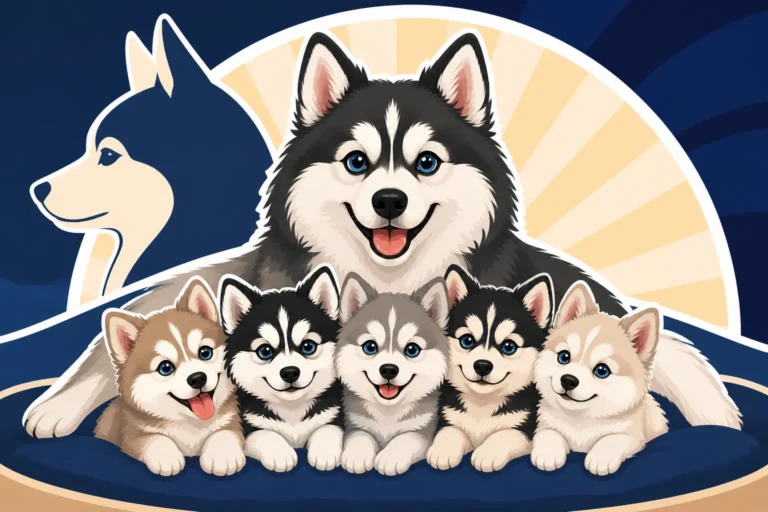
A Husky backcross may increase the likelihood of some Husky-associated traits, but it does not make each puppy a miniature version of the Husky parent. Puppies could differ in coat pattern, face shape, eye color, ear carriage, body proportions, and adult size. Even puppies raised in the same home can develop into noticeably different-looking adults.
Size is one of the hardest outcomes to promise. Parent size is useful context, but it does not reliably tell you exactly how big each puppy will become. Ask for the adult weights and health histories of both parents, and ask whether the breeder has records from previous litters produced by similar pairings. Treat a precise weight prediction as an estimate rather than a guarantee.
A puppy’s fluffy appearance at a young age is not a dependable preview of its adult coat or grooming needs. A denser coat can mean regular brushing and more loose hair around the home. Before committing, consider whether your schedule and household can handle the range of coat-care needs a puppy may inherit.
Backcrossing does not automatically make a line predictable
Repeatedly breeding toward one parent breed can shift expected ancestry over generations, but it does not make every trait steadily more uniform. Some characteristics are influenced by many genes, and the puppies inherit different combinations. Other differences come from the specific dogs selected, not simply the generation number.
That is why the label “backcross” should be viewed as information about the pedigree, not a guarantee of consistent looks, size, or behavior. Breeders who want more predictable puppies need clear records, careful selection across generations, and a willingness to disclose when the outcome remains uncertain. Whether a Multigen Pomsky Is More Predictable explains why extra generations alone do not necessarily remove variation.
The breeding goal also matters. Selecting mainly for a Husky-like appearance can overlook health, stable temperament, or suitability for the homes that will take the puppies. Responsible selection weighs all of these factors rather than treating one visual trait as the measure of success.
Ask what generation labels actually describe
Generation labels can become confusing when a family tree includes multiple Pomsky-to-Pomsky pairings or breed-backs. Ask the breeder to draw or describe the parentage plainly: which dog was the Husky, which was the Pomeranian, and where each Pomsky parent sits in the lineage. A simple, transparent account is more useful than a string of abbreviations without explanation.
The table below shows the general idea, assuming each Pomsky in the example began as an even first-generation cross. These are expected pedigree averages, not promises about individual puppies.
| Pairing example | Expected average Husky ancestry | What the label does not guarantee |
|---|---|---|
| Pomeranian crossed with Husky | About 50% | A precise size, coat, or temperament |
| First-generation Pomsky crossed with Husky | About 75% | A puppy that looks or behaves like a small Husky |
| A 75% Husky-ancestry offspring crossed with Husky | About 87.5% | Uniform puppies or freedom from inherited health issues |
If the Pomsky parent has a different ancestry profile, the expected averages change. The breeder should be able to explain the calculation from the actual pedigree and avoid presenting an estimate as certainty. For broader context on generations and health, see Whether an F1 Pomsky Is Healthier Than an F2.
How to assess a breeder and prepare for a puppy
Questions to ask before reserving a puppy
Ask the breeder to describe the planned pairing, the parents’ health screening, and the reasons for choosing those dogs. Ask which parent is the Pomsky, which is the Husky, and whether the pair has produced puppies before. If there are previous litters, ask what the breeder knows about the puppies’ adult size, health, and temperament.
Request written records rather than relying on informal assurances. You should understand what testing was completed, what the results mean, and what risks remain. Ask how the breeder handles veterinary care for the parents and puppies, what support is available after adoption, and what happens if a puppy develops a significant health concern.
Also ask how the puppies are matched to homes. A responsible breeder should be willing to discuss exercise, grooming, training, and the possibility that an adult dog may be larger or more energetic than a buyer expects. The breeder should not pressure you to choose based on a photograph or promise that a puppy will stay unusually small.
Prepare for the care needs, not just the look
Plan for daily activity and training before bringing a puppy home. A dog with Husky ancestry may be energetic and curious, and secure handling matters if the dog is inclined to chase or roam. Early training should include calm leash skills, recall practice in safe enclosed areas, and thoughtful socialization. A fenced yard does not replace supervision or training.
Coat care is another practical consideration. Ask the breeder what brushing tools and routine suit the puppies’ coat types, and arrange gentle handling practice early. If you are making a household supply list, a retailer such as Chewy may be one place owners use to find routine items like brushes, puppy gates, or washable bedding. The important part is choosing equipment that fits the dog and using it safely, not relying on a particular brand.
Budget for veterinary care and everyday needs as well as the initial adoption costs. Food, grooming, training, preventive care, and unexpected veterinary visits all belong in the plan. Some owners use Chewy to organize recurring household pet supplies, but ordering convenience does not replace a veterinarian’s advice about diet or health needs. For coat-related planning, The Pomsky That Carries a Husky Coat at Twenty Pounds offers useful context on why a small-to-medium dog may still need substantial grooming.
Look for honest descriptions instead of certainty
A trustworthy breeder will be clear about what is known and what cannot be predicted. They should not claim that backcrossing guarantees a particular adult weight, a specific eye color, a hypoallergenic coat, or a certain temperament. They should also be willing to explain the breeding dogs’ health information and the welfare safeguards in place.
Be cautious if you hear that a backcross is automatically healthier, that a high percentage of Husky ancestry guarantees a pure-Husky personality, or that a puppy will remain tiny because one parent is small. Those claims make complex inheritance sound certain when it is not. A seller’s confidence is not evidence that the outcome can be guaranteed.
Before committing, consider whether you would still be prepared to care for the puppy if it grows bigger, sheds more, or needs more exercise than expected. If the answer is no, it may be better to choose a dog with a more established adult profile. Chewy and other supply retailers can help owners assemble everyday care items, but no shopping list can compensate for a mismatch between a dog’s needs and a household’s expectations. For another perspective on selection and breeding choices, see Whether Breeding Pomsky to Pomsky Concentrates Faults.
Disclaimer
This article is for general informational purposes only and does not constitute professional advice. Laws, prices and regulations vary by location and change over time. Consult a qualified professional for guidance on your specific situation.