Whether a DNA Test Proves a Pomsky’s Parentage
It's a question that keeps many prospective Pomsky owners up at night: "Am I truly getting a Pomsky, or am I about to invest in a mixed breed that might not be what the breeder claims?" The worry about misrepresentation is real, especially with a popular designer breed. This guide will walk you through how canine DNA tests work, what they can and cannot definitively prove regarding your Pomsky's parentage, and other crucial steps you can take to ensure you're bringing home the genuine article.
The Burning Question: Is My Pomsky Really a Pomsky?
Bringing a Pomsky into your home is a huge decision, both emotionally and financially. You've likely spent countless hours dreaming of that perfect furry companion, perhaps one with striking blue eyes and a fluffy double coat, a miniature version of a Siberian Husky but with the charming sass of a Pomeranian. The internet, with its viral images, truly set the stage for the demand for this adorable crossbreed. But with that popularity comes a very real concern: how do you know the puppy you're looking at truly has a Siberian Husky parent and a Pomeranian parent, or is at least a descendant of those two distinct breeds?
The fear of getting scammed or unknowingly purchasing a "Pomsky" that's actually a different mix altogether is a valid one. Maybe you've seen stories online about people who thought they were getting one thing and ended up with something entirely different. This isn't just about appearances; it's about temperament, potential health issues, and overall fit for your lifestyle. The unique blend of the Siberian Husky's energetic, independent spirit and the Pomeranian's clever, sometimes stubborn, personality is what defines a Pomsky. If your dog isn't truly this mix, you might be in for some unexpected surprises that differ greatly from what you anticipated when researching the breed's characteristics. Understanding how to verify parentage isn't just about peace of mind; it's about informed ownership.
Why Verification Matters So Much for Pomsky Owners
When you're looking at the significant investment required for a Pomsky, you want to be sure you're getting what you pay for. The price of a Pomsky often reflects the specialized breeding process, which almost always involves artificial insemination due to the vast size difference between the parents. Because of this, breeders often face high costs, which naturally get passed on to the buyer. This isn't like finding a stray mixed-breed puppy at a shelter; this is a deliberate cross, and you're paying for that specific genetic combination.
Beyond the financial aspect, verifying your Pomsky's parentage directly impacts your expectations for their health and behavior. For instance, knowing the true lineage can help you understand potential predispositions to conditions like Slipping Kneecaps in a Pomsky from the Pomeranian side, or certain eye issues such as The Eyes a Pomsky Gets From the Husky. It also gives you a better idea of their probable adult size. Many people are drawn to the Pomsky hoping for a miniature husky, and if your puppy turns out to be mostly Pomeranian or another small breed, their adult size might be much smaller than you envisioned, or conversely, if more Husky, larger than expected. This verification isn't just about status; it's about genuinely preparing for the unique traits and needs of your specific dog, including understanding their expected The Twelve to Fifteen Years a Pomsky Lives.
Understanding Canine DNA Tests: What They Can and Can't Tell You
Canine DNA tests have become incredibly popular in recent years, offering pet owners a fascinating glimpse into their dog's genetic makeup. These tests typically involve a simple cheek swab, which is then sent to a lab for analysis. The labs compare your dog's DNA markers against a vast database of purebred dogs to identify the breeds present in their ancestry. For a typical mixed-breed rescue, these tests can be incredibly insightful, revealing surprising combinations of breeds and helping owners understand where their beloved mutt truly comes from. They can also screen for certain genetic health markers, which is a fantastic benefit for proactive pet care.
However, it's crucial to understand the limitations, especially when it comes to proving exact parentage for a designer breed like the Pomsky. Most consumer-grade DNA tests are designed for breed identification, not parentage verification. Think of it this way: they can tell you what breeds are in the family tree, but not necessarily who the direct parents are, unless you also submit DNA samples from the alleged parents for a separate, more specific comparison. This distinction is paramount when you're trying to confirm that your adorable fluffball is indeed the product of a Siberian Husky and a Pomeranian, rather than a mix of something else entirely.
How Breed Identification Works
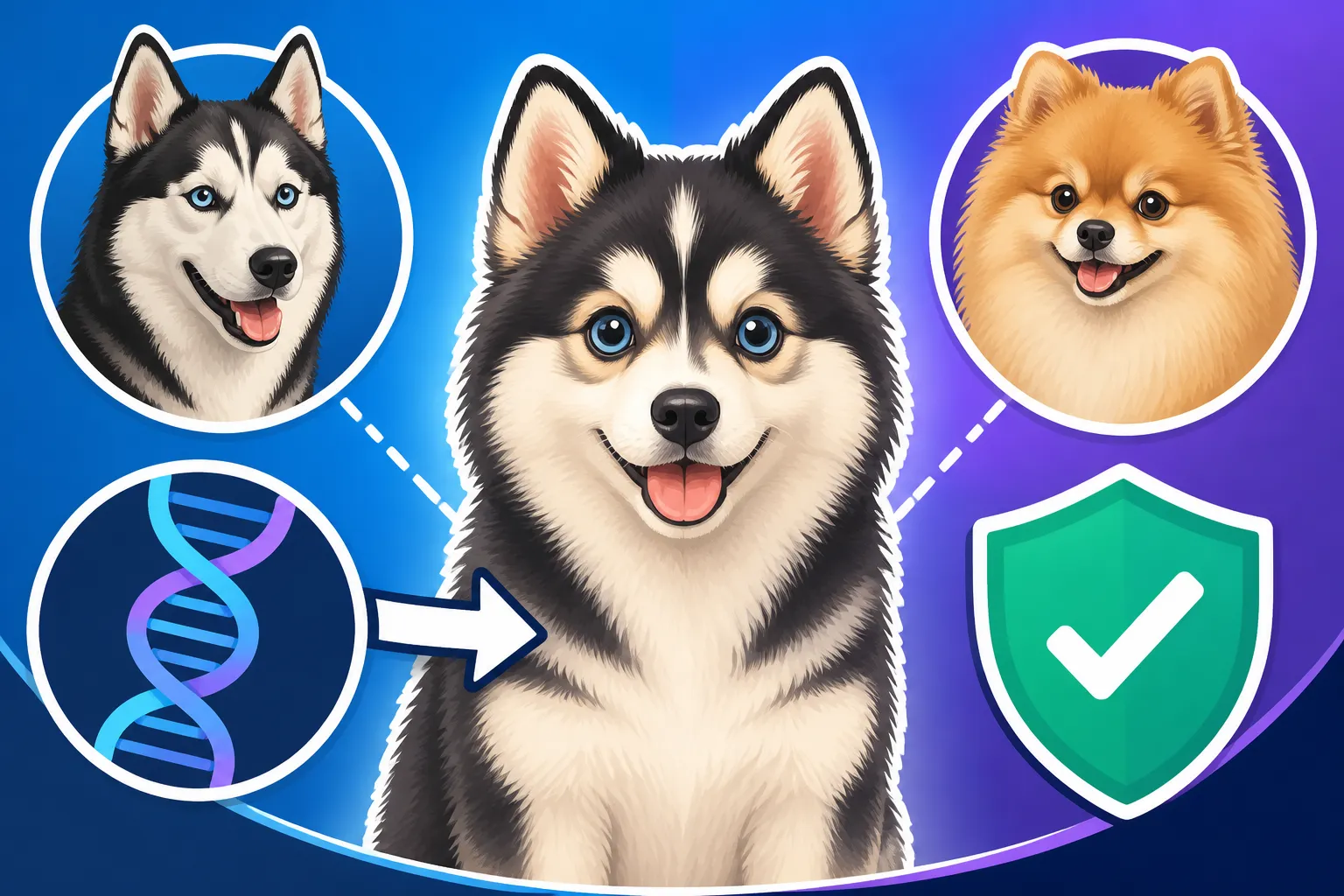
When you send in that cheek swab, the lab extracts DNA and looks for specific genetic markers, often called single nucleotide polymorphisms (SNPs). These SNPs act like signposts along the DNA, and certain patterns of SNPs are unique to specific breeds. The more of these breed-specific patterns your dog's DNA matches, the higher the percentage of that breed is assigned. For a first-generation (F1) Pomsky, meaning a direct cross between a purebred Siberian Husky and a purebred Pomeranian, a reliable DNA test should ideally show a very clear 50% Husky and 50% Pomeranian breakdown. This is the simplest scenario, and the one where breed identification tests are most accurate in inferring direct parentage.
The test might also tell you if your dog carries genes for certain traits, like coat color or length, or specific health conditions. For example, some tests can flag if your Pomsky is predisposed to Zinc Responsive Dermatosis in a Pomsky or other breed-specific ailments inherited from either parent. This information can be incredibly valuable for future health planning and discussions with your veterinarian. You might even find yourself consulting resources from places like Chewy for specialized diets or supplements if your dog has particular needs identified through genetic screening.
The Difference Between Breed Identification and Parentage Verification
Here's where many people get confused. A breed identification test will tell you, for example, "50% Siberian Husky, 50% Pomeranian." This suggests an F1 Pomsky if the percentages are clean. But it doesn't prove that specific Husky A and Pomeranian B are the direct parents of your puppy C without also testing Husky A and Pomeranian B. For that, you need a parentage verification test, which is a different type of DNA analysis. This kind of test compares the puppy's DNA directly to the alleged parents' DNA to confirm a genetic match, much like human paternity tests.
The challenge for many Pomsky buyers is that breeders might not always provide DNA samples from the parent dogs for this specific verification, or the cost for such a detailed test for every puppy might be prohibitive. So, while a breed identification test can give you a strong indication of your dog's genetic makeup, especially for an F1, it typically won't, on its own, serve as absolute legal proof of specific parentage from two named dogs unless those parents were also tested and submitted for comparison. This is particularly relevant when considering claims about Whether an F1 Pomsky Is Healthier Than an F2 or other generational distinctions.
Here's a quick look at what different types of DNA tests typically provide:
| Test Type | Primary Purpose | What It Confirms for a Pomsky | What It Doesn't Confirm (Usually) |
|---|---|---|---|
| Breed Identification | Identify ancestral breeds | Presence and percentages of Husky/Pomeranian. Can strongly suggest F1 if 50/50 split. | Specific identity of sire and dam. |
| Parentage Verification | Confirm direct genetic relationship | If provided samples, confirms puppy's relationship to tested sire and dam. | Broad breed composition across generations. |
| Health Screening | Identify genetic disease markers | Predisposition to certain inherited Pomsky health conditions. | Whether the dog will develop the disease, only risk. |
Navigating Pomsky Parentage: The Nuances of Hybrid DNA
The world of designer dogs, and Pomskies in particular, adds layers of complexity to genetic testing. While a DNA test can be a powerful tool, it's not a magical solution that answers every question about your Pomsky's lineage, especially when you move beyond the straightforward F1 generation. The very nature of a hybrid breed means there can be more variability and less predictability than with purebred dogs, and this affects how DNA tests are interpreted.
The "Pomsky" isn't a recognized breed by major kennel clubs like the AKC, which means there isn't a universally accepted breed standard or a strict lineage tracking system enforced by a governing body. While organizations like the International Pomsky Association (IPA) do exist to promote responsible breeding and maintain standards, DNA tests still operate on the principle of comparing your dog's genes to established purebred databases. This works well for F1 crosses, but can become a bit more convoluted for later generations or if there's any uncertainty about the parent stock.
F1, F2, and Beyond: How Generations Affect DNA Results
The generation of your Pomsky significantly impacts what a DNA test can tell you about parentage.
-
F1 Pomsky (First Generation): This is a direct cross between a purebred Siberian Husky and a purebred Pomeranian. As mentioned, a DNA test for an F1 Pomsky should ideally show a clear 50% Husky and 50% Pomeranian genetic breakdown. This is the gold standard for verifying the "Pomsky" claim through a breed identification test. If the results come back with other breeds, or vastly different percentages, it's a red flag. This directly addresses the query of Whether a DNA Test Confirms a Pomsky in its most straightforward form.
-
F2 Pomsky (Second Generation): This is a cross between two F1 Pomskies. Here, the genetic percentages become less predictable. While you'd expect a mix of Husky and Pomeranian, it won't necessarily be a clean 50/50 split. One F1 parent might contribute slightly more Husky genes, the other slightly more Pomeranian, leading to a puppy that is, for example, 60% Husky and 40% Pomeranian, or vice versa. The breed identification test will still show both breeds, but the exact percentages will vary. This is important to remember when understanding What an F2 Pomsky Is and its genetic implications.
-
Multigenerational (F3, F4, etc.): As you move further down the generations, breeding Pomsky to Pomsky, the genetic makeup can become even more varied. While the core breeds (Husky and Pomeranian) should still be present, the ratios will fluctuate. It's also possible, though reputable breeders aim to avoid this, for other breeds to have been introduced into the lineage somewhere down the line, either accidentally or intentionally. A DNA test would reveal these additional breeds, which could be a surprise if you were expecting a pure Pomsky lineage. Understanding these generational differences is key to appreciating What a Multigen Pomsky Costs and its genetic predictability.
Potential for Misrepresentation and What DNA Can Uncover
Unfortunately, not all breeders are scrupulous. There are instances where unscrupulous individuals might market a mixed-breed dog as a Pomsky when it's not. For example, a dog that is part Miniature American Shepherd or Alaskan Klee Kai might be passed off as a Pomsky, especially if it shares similar physical traits. This is where a DNA breed identification test becomes invaluable. If your "Pomsky" puppy’s DNA test comes back showing a significant percentage of a breed other than Siberian Husky or Pomeranian, or if one of those two core breeds is entirely absent, then you have clear evidence of misrepresentation. This is especially true if you are concerned Whether a Cheap Pomsky Is Really a Pomsky, as lower prices can sometimes hide questionable breeding practices.
It can also reveal if your puppy isn't a direct F1 cross, even if it has both Husky and Pomeranian in its makeup. For example, if you were promised an F1 but the test shows 70% Husky and 30% Pomeranian, it suggests it's likely an F2 or later generation, or perhaps one of the parents wasn't a purebred in the first place. This is where a combination of breeder transparency and DNA testing can give you a fuller picture.
Beyond the Swab: Comprehensive Approaches to Verifying Your Pomsky's Origin
While a DNA test is a powerful tool for breed identification, it's just one piece of the puzzle when it comes to truly verifying your Pomsky's origin and ensuring you're working with an ethical breeder. A holistic approach that combines genetic screening with thorough breeder vetting and careful observation will provide the most comprehensive picture. After all, you're not just buying a genetic code; you're bringing a living, breathing companion into your home, and you want to be sure they're healthy and well-adjusted.
Many reputable Pomsky breeders understand the buyer's desire for transparency and are proactive in providing proof of parentage and health. They know that your peace of mind is paramount, and they're usually happy to share documentation and answer all your questions. This is crucial because the journey of a Pomsky begins long before they're born, involving specific breeding techniques. For instance, you might want to ask Why a Pomsky Cannot Be Bred Naturally and what that implies for the breeding process.
The Importance of a Reputable Breeder and Documentation
The single most important step in verifying a Pomsky's parentage is to choose a reputable, transparent breeder. A good breeder will welcome your questions and openly share information about their breeding program. They should be able to provide:
- Pedigrees of the parent dogs: This shows the purebred lineage of the Siberian Husky dam and the Pomeranian sire. Even if the Pomsky itself isn't a recognized purebred, its parents certainly are.
- Health clearances for both parents: This is crucial for avoiding inherited conditions. Ask for proof of screenings for issues common in Huskies and Pomeranians, such as hip and elbow evaluations (especially for the Husky), eye clearances, and patella evaluations for the Pomeranian. Knowing The Health Tests a Pomsky Breeder Should Show can help you ask the right questions.
- Proof of artificial insemination: Given the size difference, artificial insemination is almost always required. A reputable breeder should be able to discuss this process, demonstrating their investment in responsible breeding. They might also share information about Whether a Pomsky's Mother Must Always Be the Husky and the reasons behind it.
- Previous DNA test results: Some breeders proactively DNA test their parent dogs for breed purity and genetic health markers, and may even test the F1 puppies to confirm the 50/50 split.
- Membership in breed associations: While the Pomsky isn't AKC recognized, involvement with organizations like the International Pomsky Association (IPA) indicates a breeder's commitment to ethical practices and maintaining breed standards. You can learn more about The International Pomsky Association and What It Sets to understand their role.
Don't be afraid to ask for vet records, visit the breeding facility (if possible, or at least video calls), and speak to references from previous buyers. A responsible breeder will prioritize the health and well-being of their dogs, not just profit. They'll also be transparent about the potential range of sizes, reminding you that while some Pomskies are indeed small, others might grow larger, sometimes even reaching How Big a Pomsky Gets.
Observing Physical Traits and Temperament
While DNA tests delve into genetics, physical traits and temperament can offer supporting evidence, though they are not definitive proof on their own. For example, a true F1 Pomsky should exhibit a blend of characteristics from both parent breeds. You might look for:
- Coat type: A double coat is standard for both parent breeds, and your Pomsky should have one. The texture and density can vary, but the presence of both guard hairs and a soft undercoat is a strong indicator. You can explore The Pomsky That Carries a Husky Coat at Twenty Pounds for more details.
- Ear set: Pomskies typically have upright, triangular ears like both Huskies and Pomeranians, though some might start floppy as puppies and stand up later.
- Tail: The curled tail over the back is a common trait inherited from both breeds.
- Eyes: While many desire blue eyes, Pomskies can have brown, blue, bi-colored, or parti-colored eyes, all within the expected range for the Husky influence.
- Size and build: At maturity, a Pomsky should fall within a certain weight and height range, smaller than a Husky but larger than a toy Pomeranian. If your adult "Pomsky" remains exceptionally tiny like a purebred Pomeranian, or grows to the size of a standard Husky, it might raise questions about its true parentage, especially concerning claims about Whether a Toy Pomsky Exists.
- Temperament: A blend of the Husky's independence, energy, and vocal nature, combined with the Pomeranian's alertness, intelligence, and potential for sass. If your dog acts drastically different from these expected traits, it could be a sign of a different genetic makeup.
Remember, a dog’s appearance can sometimes be deceiving. Other breeds, like the Alaskan Klee Kai, can look remarkably similar to a Pomsky, making it difficult to tell the difference just by looking. This is why a DNA test combined with breeder due diligence is the most reliable approach, especially given concerns like Whether an Alaskan Klee Kai Is Sold as a Pomsky. When considering the lifelong health of your pet, exploring options like pet insurance from providers such as Healthy Paws can also offer valuable protection against unexpected veterinary costs, regardless of parentage. And ensuring your Pomsky has a nutritious diet, perhaps even exploring fresh food options from services like Ollie, contributes to their overall well-being and can sometimes impact their coat health and energy levels.
Disclaimer
This article is for general informational purposes only and does not constitute professional advice. Laws, prices and regulations vary by location and change over time. Consult a qualified professional for guidance on your specific situation.