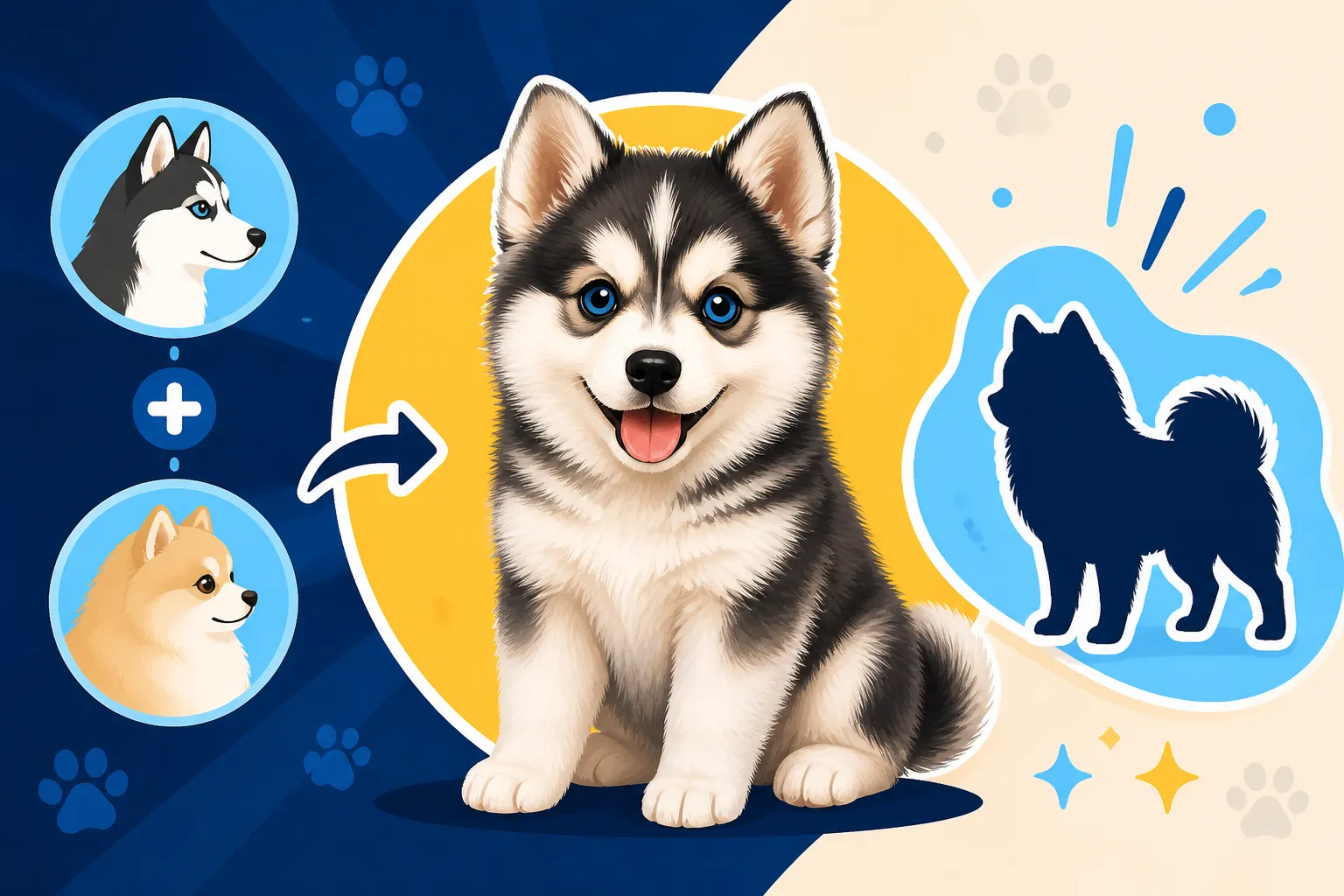
What an F2 Pomsky Is
It's completely understandable to feel a bit lost in the alphabet soup of F1, F2, and multigen when you're looking into Pomskies. This isn't just jargon; it really impacts what kind of companion you might bring home. This guide is here to shed light specifically on what an F2 Pomsky is, demystifying the genetic makeup and helping you set realistic expectations for these captivating second-generation crossbreeds.
Understanding the "F" in Pomsky Generations
Before we dive specifically into the F2, it helps to understand the system breeders use to categorize these wonderful hybrids. The "F" simply stands for "Filial," which is a genetics term referring to generations after the parental cross. It's a way of tracking how far removed a Pomsky is from its purebred Siberian Husky and Pomeranian roots. This system helps breeders and potential owners understand the likely range of traits, but it's crucial to remember that with hybrids, there's always an element of charming unpredictability.
The Foundation: What an F1 Pomsky Is
An F1 Pomsky is the very first generation, the direct offspring of a purebred Siberian Husky mother and a purebred Pomeranian father. This is where the magic (and sometimes the most variability) happens. Each F1 puppy receives exactly 50% of its genes from the Husky parent and 50% from the Pomeranian parent. Because of this direct 50/50 split from two distinct breeds, an F1 litter can be quite diverse. You might see some puppies that lean heavily towards the Husky in appearance, others that look much more like a large Pomeranian, and some that are a beautiful, even blend. What an F1 Pomsky Is delves deeper into this initial cross.
Defining F2: The Second-Generation Pomsky
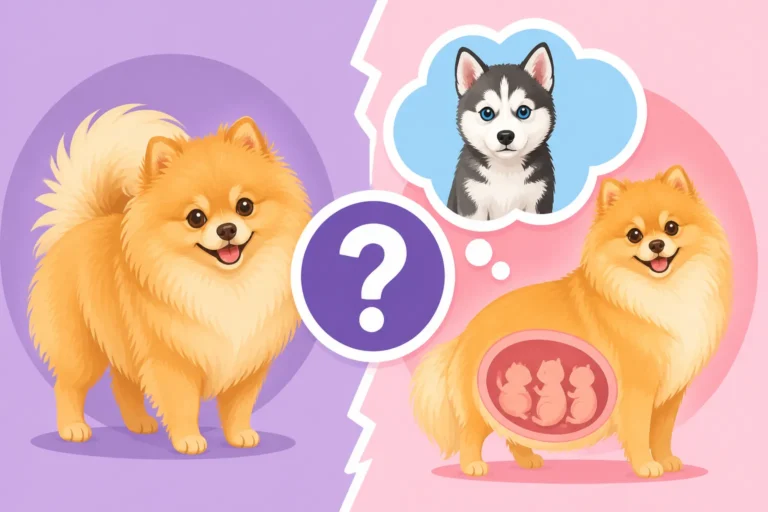
So, what exactly is an F2 Pomsky? Simply put, an F2 Pomsky is the result of breeding two F1 Pomskies together. This means both parents are already 50/50 Husky-Pomeranian mixes themselves. Instead of getting genes directly from a purebred Husky and a purebred Pomeranian, an F2 puppy gets its genetic material from two F1 Pomskies. This might sound like it leads to more predictability, and in some ways, it can, but it also introduces another layer of genetic shuffling that's fascinating to explore. Think of it like a deck of cards that's been shuffled once (F1) and then shuffled again (F2) – you still have all the same cards, but the order can change dramatically.
Beyond F2: The World of Multigen Pomskies
Once you move past the F2 generation, you enter the realm of "multigen" or "multi-generational" Pomskies. This refers to F3, F4, and subsequent generations where Pomskies are bred to other Pomskies. For example, an F3 Pomsky would be the offspring of two F2 Pomskies, or an F1 bred to an F2. The goal with multigen breeding is often to stabilize certain desired traits – perhaps a particular size range, a specific coat type, or a more consistent temperament. Whether a Multigen Pomsky Is More Predictable is a great resource if you're curious about how these later generations develop. It’s an ongoing process for responsible breeders to refine lines, aiming for more consistency while still retaining the wonderful qualities of the Pomsky hybrid.
The Genetic Blend: What Makes an F2 Pomsky Unique?
The beauty of the F2 Pomsky lies in its inherent genetic complexity. While both parents are F1 Pomskies, each carrying a mix of Husky and Pomeranian traits, how those traits combine in their offspring can still lead to some delightful surprises. It's not as simple as averaging out the parents, because genetics don't always work that way. Dominant and recessive genes from both original parent breeds are still in play, ready to express themselves in new combinations.
Inheriting Traits from Two Pomsky Parents
When two F1 Pomskies breed, their puppies inherit a mix of genes from both F1 parents, which means they are still inherently a blend of Husky and Pomeranian. However, since the F1 parents themselves are already mixed, the genetic dice are rolled again. An F1 Pomsky might have a Husky's coat type but a Pomeranian's ear set, or vice versa. When two such F1s breed, their F2 offspring can inherit any combination of these already-mixed traits. This means an F2 puppy could end up with a coat that leans heavily Husky, or one that's much fluffier like a Pomeranian, even if its F1 parents looked fairly balanced. It's a testament to the power of genetic recombination.
For example, imagine two F1 Pomskies. One might have very prominent Husky markings and a strong prey drive, while the other might have the playful, attention-seeking nature of a Pomeranian. Their F2 puppies could show a wide spectrum: some might be little escape artists with a tendency to talk (like a Husky), while others might prefer to be lap dogs and bark at every leaf that blows by (like a Pomeranian). There's no guarantee that an F2 will be a perfect split of its grandparents' original breeds.
The Potential for More Uniformity
Despite the inherent variability, F2 Pomskies can sometimes show more uniformity within a litter compared to F1s. Why? Because the F1 parents have already undergone that initial genetic mixing. If breeders are carefully selecting F1 parents that exhibit desirable and consistent traits, then the chances of those traits appearing in the F2 generation can increase. This is where responsible breeding truly comes into play – breeders aren't just putting any two F1 Pomskies together; they're trying to select for specific characteristics, temperament, and health.
Consider a breeder aiming for a particular adult size, say around 20 pounds. If they breed two F1 Pomskies that both matured to approximately 20 pounds, the F2 litter might have a higher likelihood of falling within that 15-25 pound range, as opposed to an F1 litter where you might get puppies anywhere from 15 to 35 pounds because of the direct Husky/Pomeranian input. This isn't a guarantee, of course, but it's the goal of many F2 breeding programs.
Still a Mix: Why Surprises Can Happen
Even with the best intentions and careful selection, F2 Pomskies are still crossbreeds, and genetic surprises can and do happen. This is part of their charm, but also something potential owners must be prepared for. You might expect a certain coat color based on the parents, only for a recessive gene to pop up and give you a unique shade. Or you might anticipate a quiet demeanor, only to discover your F2 Pomsky has inherited the full vocal range of a Husky. The Husky Howl in a Pomsky can be quite impressive, even in a small package!
This unpredictability is why it's so important to choose a reputable breeder who understands the genetic complexities and is transparent about the potential variations in their F2 litters. They should be able to show you the parents and even grandparents, giving you a better idea of the genetic pool. No matter how many generations deep, a Pomsky is still a blend, and that blend means a rich tapestry of possible traits.
Expectations vs. Reality: What You Might Get with an F2 Pomsky
Bringing home an F2 Pomsky means embracing the wonderful blend of traits that come from its unique lineage. While breeders work towards more predictability with each generation, there are still ranges in size, coat, and temperament. Understanding these potential variations is key to finding the right Pomsky for your home and avoiding disappointment.
Predicting Size, Coat, and Appearance
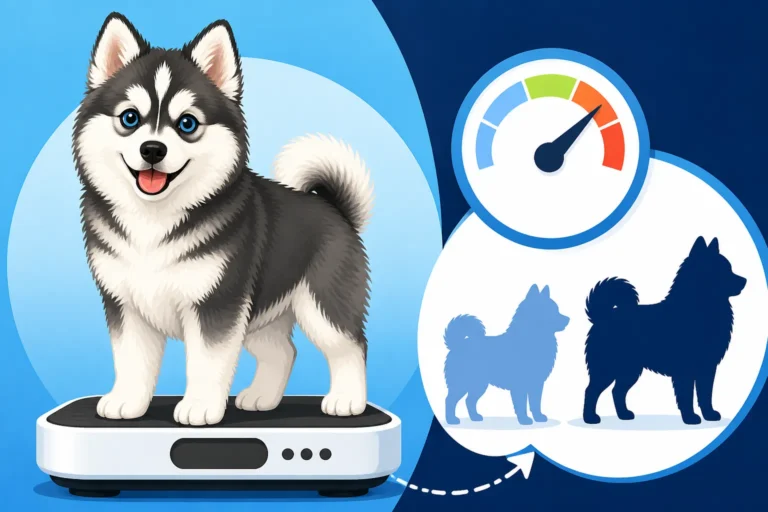
The million-dollar question for many Pomsky enthusiasts is, "How big will my F2 get?" While F2 breeders aim for more consistency, predicting the exact adult size of an F2 Pomsky can still be a bit of a guessing game. Generally, F2s are expected to fall within the typical Pomsky size range, which is usually between 15 to 35 pounds. However, some can still be smaller or larger. What a Pomsky Actually Weighs discusses this in detail. A larger F1 parent could pass on genes that result in a larger F2 offspring, even if the other F1 parent was smaller. It’s less about a strict 50/50 split and more about how the genes from two mixed parents combine.
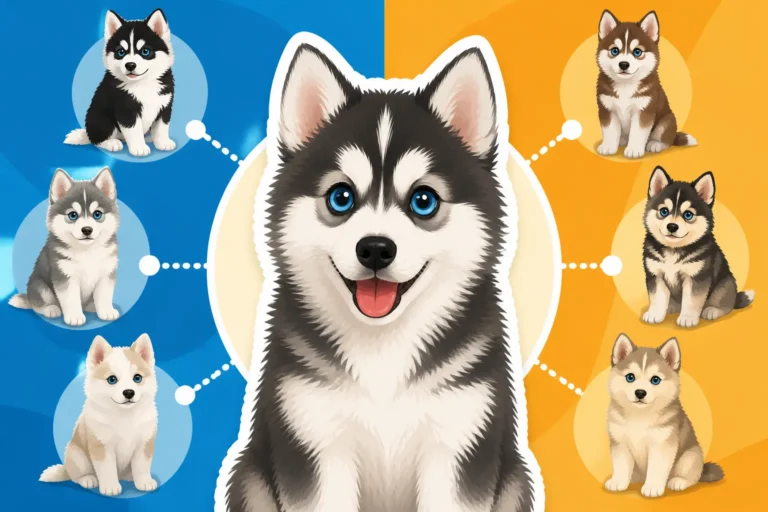
When it comes to appearance, F2 Pomskies can still display a dazzling array of coat colors, markings, and eye colors. You might see the striking blue eyes and masks of a Husky, or the lush, stand-off coat of a Pomeranian. The Three Pomsky Coat Types—standard, wooly, and short-coated—are all possibilities in an F2 litter, depending on the genes passed down from the F1 parents. It’s not uncommon to see a single F2 litter with puppies displaying quite different looks, even if they share the same F1 parents. This genetic lottery is part of the fun, but it means if you have a very specific look in mind, you need to manage your expectations.
Temperament and Trainability
An F2 Pomsky's temperament is another fascinating mix. They inherit the intelligence and independence that can make training a Pomsky a unique experience. Whether a Pomsky Is Stubborn or Independent is a battle many owners face! You might find your F2 to be highly energetic and vocal, much like a Husky, loving to "talk" and demand attention. Or, it could lean towards the more affectionate, sometimes reserved nature of a Pomeranian. Most F2s will display a combination of both. Early socialization is absolutely crucial to help shape their personality, exposing them to different people, environments, and other animals. Consistent, positive reinforcement training from a young age is also vital to harness their intelligence and navigate their sometimes stubborn streak.
For instance, your F2 Pomsky might have the notorious "selective hearing" of a Husky when it comes to recall, especially if there's an interesting scent or a squirrel to chase. Recall on a Pomsky Bred From a Dog That Runs is a vital read for any Pomsky owner. At the same time, they might have the eagerness to please of a Pomeranian when it comes to learning new tricks, especially if high-value treats are involved. Managing these contrasting traits requires patience, consistency, and a good sense of humor. They are often incredibly intelligent, meaning they can learn quickly, but also get bored quickly if not adequately stimulated.
Health Considerations in F2 Pomskies
Just like any dog, F2 Pomskies are susceptible to certain health conditions, some of which can be inherited from their Husky and Pomeranian ancestry. It's incredibly important that both F1 parents of an F2 litter have undergone comprehensive health testing. Conditions like Slipping Kneecaps in a Pomsky (patellar luxation from the Pomeranian side), The Collapsing Trachea a Pomsky Gets From the Pomeranian, or The Eyes a Pomsky Gets From the Husky (like juvenile cataracts or progressive retinal atrophy) are all concerns.
Responsible breeders will screen for these potential issues to minimize the risk in their F2 offspring. Don't be shy about asking a breeder for proof of health clearances for both F1 parents. While hybrid vigor can sometimes offer a broader genetic pool, it doesn't make any dog immune to inherited conditions. Regular vet check-ups, a high-quality diet (you can find many great options on Chewy), and adequate exercise are essential for keeping your F2 Pomsky healthy throughout its life. Being proactive about their health history can save a lot of heartache and expense down the road.
Why F2 Pomskies Are Often a Breeder's Goal
When you hear about an F2 Pomsky, you're often looking at a generation that breeders are actively striving for. It’s not just about creating puppies; it's about trying to refine and stabilize the characteristics of the Pomsky hybrid. This dedication is what helps move the Pomsky closer to becoming a recognized breed in its own right, rather than just a first-generation cross.
Aiming for Consistency
One of the primary reasons breeders focus on F2 and subsequent generations is the pursuit of greater consistency. With F1 Pomskies, the range of possible outcomes in terms of size, coat, and temperament can be quite wide, even within the same litter. By breeding two F1 Pomskies, breeders hope to select for individuals that most embody the "ideal" Pomsky traits they are aiming for. This means if a breeder has F1s that consistently mature at a certain weight, have a desirable coat type, and exhibit a friendly, balanced temperament, breeding those F1s together is an effort to reproduce those qualities in the F2 generation.
It's a step towards standardizing the Pomsky. While they might never be as uniform as a purebred, F2s offer a better chance of predicting what a puppy might look like or how it might behave as an adult compared to the often wild card nature of an F1. This helps prospective owners have a clearer picture of what to expect, making for happier matches between dogs and their families.
The Role of Health Testing
The journey to an F2 Pomsky isn't just about looks and personality; it's critically about health. Reputable breeders of F2 Pomskies place immense importance on the health testing of their F1 breeding pairs. They understand that by breeding two already mixed dogs, they are consolidating the genetic pool for future generations. If the F1 parents carry genetic predispositions to certain diseases, those are more likely to appear in the F2 offspring.
Therefore, comprehensive health screenings for conditions common to both Huskies and Pomeranians are paramount. This includes evaluations for hip and elbow dysplasia Hip Dysplasia in a Twenty Pound Pomsky, patellar luxation, eye conditions, and heart issues. By ensuring that the F1 parents are as healthy as possible, breeders significantly reduce the risk of passing on debilitating conditions to the F2 generation. This commitment to health testing is a hallmark of responsible breeding and ensures the welfare of the puppies.
Ethical Breeding Practices
The breeding of F2 Pomskies requires a deep understanding of genetics, diligent health screening, and a commitment to ethical practices. It’s not a simple process; it involves careful selection of breeding pairs, often involving significant travel and expense for artificial insemination (since natural breeding between two Pomskies can still be challenging due to size differences). Breeders who prioritize the health and well-being of their dogs will often have a strong community connection, offering support and advice to their puppy buyers. They will often be transparent about the challenges and triumphs of breeding F2s, providing insight into their breeding philosophies and goals.
If you're considering an F2 Pomsky, always look for a breeder who is open about their practices, eager to answer your questions, and willing to provide health clearances. They should also be educating you about the nuances of the F2 generation, rather than just selling you on the idea of a "mini Husky." You might even find comprehensive care guides or product recommendations, like specific brushes or food available at Chewy, from responsible breeders looking to ensure their puppies thrive. Choosing an F2 Pomsky from an ethical breeder means you're supporting a program that values the long-term health and improvement of the breed.
| Feature | F1 Pomsky | F2 Pomsky |
|---|---|---|
| Parentage | Purebred Siberian Husky x Purebred Pomeranian | F1 Pomsky x F1 Pomsky |
| Genetic Mix | Approximately 50% Husky, 50% Pomeranian | Still a mix of Husky & Pomeranian, but shuffled again |
| Variability | High variability in appearance and temperament | Potentially more consistent than F1, but still variable |
| Predictability | Least predictable in size, coat, and temperament | Aims for more predictability, but surprises can occur |
| Appearance | Wide range, can lean heavily to either parent breed | Often more "Pomsky-like," but diverse looks still possible |
| Breeding Goal | To create the initial hybrid cross | To stabilize traits and improve consistency |
| Health | Inherits potential issues from both purebred parents | Inherits potential issues from F1 Pomsky parents |
Disclaimer
This article is for general informational purposes only and does not constitute professional advice. Laws, prices and regulations vary by location and change over time. Consult a qualified professional for guidance on your specific situation.