Whether a Pomsky Has the Husky Mask
A Pomsky may have the dark, contrasting facial markings people associate with a Siberian Husky, but there is no guarantee. Some Pomskies have a bold mask; others have a partial, pale, or barely noticeable one. Puppy markings can also change as the coat matures. This guide explains what a Husky mask looks like, why it varies, and how to judge it without relying on a photo alone.
What a Husky mask looks like on a Pomsky
The mask is a pattern, not a breed feature every Pomsky gets
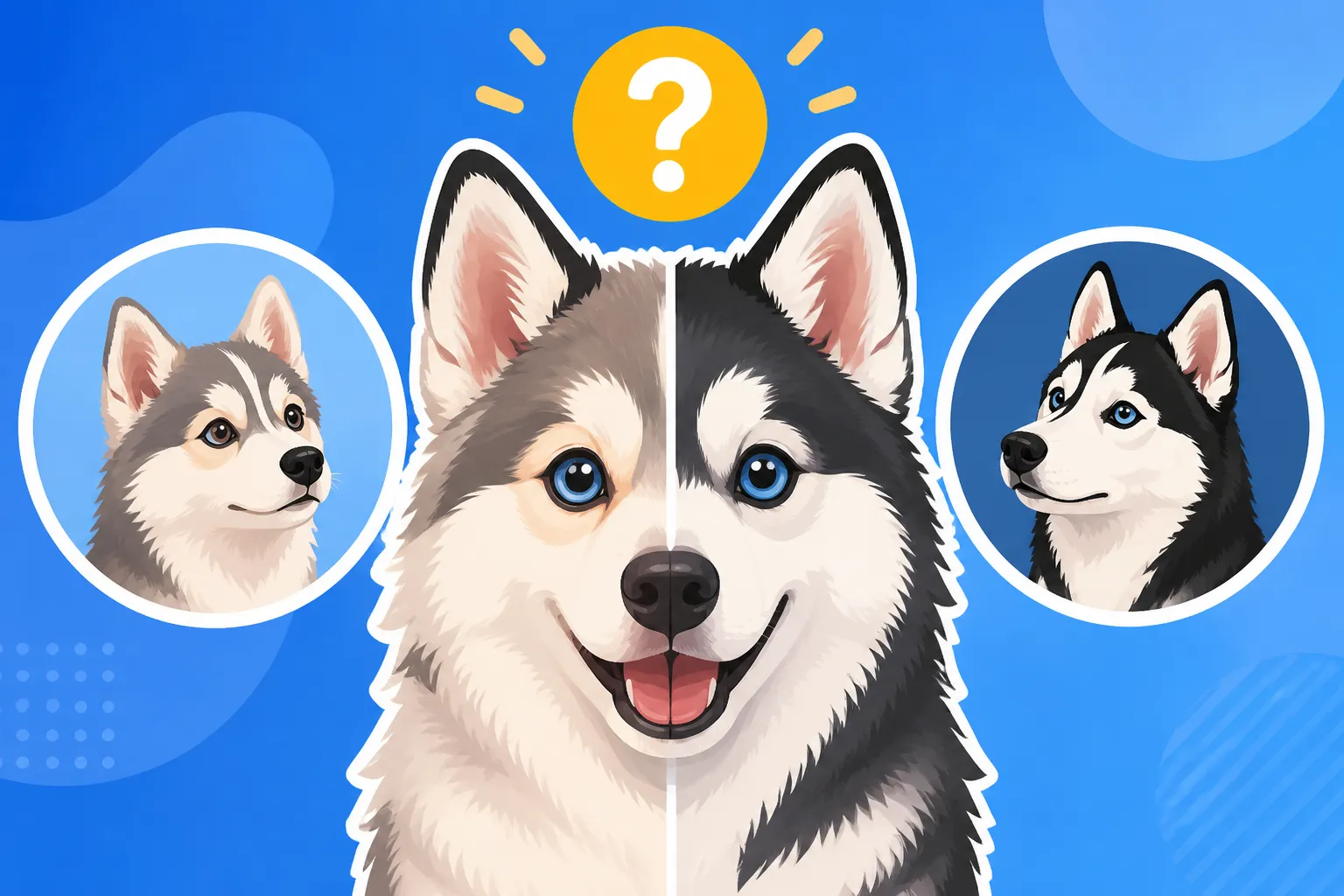
When people say a dog has a “Husky mask,” they usually mean contrasting facial coat markings that create a framed or banded look. A Pomsky might have dark fur around the eyes, a stripe down the forehead, shading across the muzzle, or a combination of these against a lighter face. The result can resemble the familiar facial patterns seen in some Siberian Huskies.
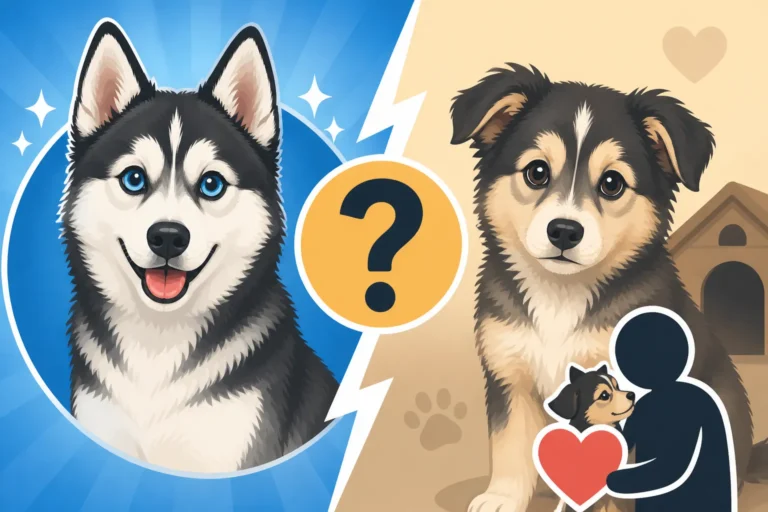
There is no single mask shape that every Husky—or every Pomsky—must have. One Pomsky may have a strong cap of dark fur over the forehead, while another has lighter markings that look more like spectacles around the eyes. Some have a narrow blaze down the center of the face, and some have little contrast at all. Owners and breeders may use words such as “mask,” “cap,” “spectacles,” or “facial markings” somewhat differently.
A mask is about coat color and pattern, not the dog’s expression or eye color. A blue-eyed Pomsky can have a mask, but blue eyes do not cause one, and brown-eyed Pomskies can have prominent facial markings too. If you are comparing coat colors, The Colors and Masks a Pomsky Comes In gives broader context about the range of appearances in the cross.
Pomskies inherit an unpredictable mix of appearance traits
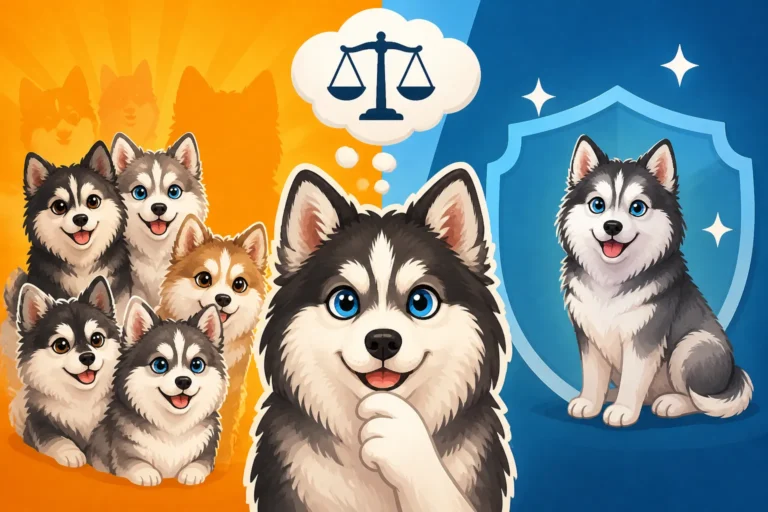
A Pomsky is a Pomeranian and Siberian Husky cross, and puppies in the same litter can inherit different combinations of their parents’ traits. Coat color and markings are part of that mix. A puppy may resemble the Husky parent in its facial pattern, the Pomeranian parent in its coat texture, or neither in a way that is easy to predict.
That is why a breeder cannot reliably promise a particular mask based only on the parents’ photographs. Even if both parents have striking facial markings, their puppies may show a range of patterns and contrast. Conversely, a puppy with a subtle face as a baby may develop more noticeable markings as its coat changes. Genetics influence the outcome, but appearance is not a simple copy-and-paste from either parent.
It also helps to remember that “Husky mask” is a descriptive phrase, not a guarantee of ancestry or a formal measure of breed quality. A Pomsky can look Husky-like without having a dramatic mask, and a pronounced mask does not make a dog more authentic. For a closer look at why facial resemblance varies, see Whether a Pomsky Looks More Pomeranian Than Husky and Whether a Pomsky Has the Husky Mask.
Why a Pomsky’s mask can look different as it grows
Puppy coats may change in shade and contrast
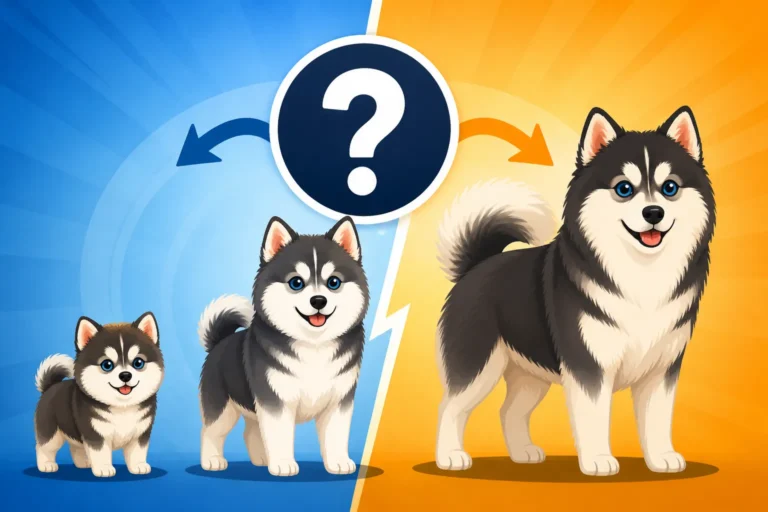
Many puppies look especially fluffy and high-contrast, which can make their facial markings seem sharply defined in early photos. As the puppy coat gives way to an adult coat, the color, length, and texture of the fur can change. Those changes may make the mask look softer, lighter, or differently shaped, even though the underlying pattern has not suddenly “moved.”
A puppy’s face can also appear different as the head grows. A narrow blaze may look wider on a larger face, or dark areas around the eyes may seem less prominent once the surrounding coat grows longer. Seasonal shedding can affect the appearance too: when loose undercoat comes out, the coat may look less full and the contrast may read differently in photos.
Color shifts are not unique to facial markings. Pomsky coats may lighten or change in other ways as they mature, so a puppy picture is only a snapshot. If you are trying to understand how the overall color may develop, Whether a Pomsky's Color Changes as It Grows and Whether a Gray Pomsky Lightens are useful related reads.
Lighting, grooming, and photographs can exaggerate a mask
Photos can make a mask look darker or more dramatic than it appears in person. Warm indoor bulbs, bright sun, shadows around the eyes, camera filters, and automatic image processing can all change the apparent contrast. A close-up image may also hide the shape of the rest of the coat, leaving the face to look more strongly patterned than it does at normal viewing distance.
Grooming affects how clearly you can see the pattern, too. A recently brushed coat may look neat and sharply outlined; a damp, tangled, or shedding coat can blur the edges. Dirt or tear staining around the eyes may also draw attention to the face, but it does not create a genetic mask. Gently cleaning the area with dog-safe products is different from trying to change the coat’s natural color.
If you need routine grooming supplies, a pet retailer such as Chewy can be one place to look for a suitable comb or dog-formulated cleanser. Choose products intended for dogs and follow their directions; do not use human hair dye, bleach, or harsh cleaners to make markings look stronger. Chewy’s grooming listings are for supplies, not a way to verify what a puppy’s adult pattern will be. For more on normal color variation, see Whether a Pomsky's Coat Sunbleaches.
How to assess a Pomsky’s mask before choosing a puppy
Ask for clear, unedited pictures over time
If facial markings matter to you, ask the breeder for recent, well-lit photos taken in natural daylight, ideally from the front and both sides. A short video can help show the face in motion and reduce the risk of judging a pattern from one flattering angle. Ask whether the images are unfiltered and whether the puppy has been photographed at different ages.
It is reasonable to ask for pictures of the parents and previous puppies, but treat them as examples rather than a promise. A littermate’s mask does not guarantee that your puppy will develop the same markings. Nor does a parent’s appearance settle the question: puppies inherit combinations of traits, not an exact replica of either adult.
A useful question is, “How have this puppy’s markings changed since birth?” That encourages a concrete answer based on dated photos, rather than a confident prediction about the final look. You can also ask what the breeder means by “mask,” since the word may refer to a bold dark face, lighter shading around the eyes, or simply a contrasting pattern. To compare overall puppy and adult appearance, see Whether a Pomsky Puppy's Fluff Predicts the Adult Coat.
Give appearance claims less weight than health and care
It is easy to get attached to a particular look, especially when a puppy has a striking face in a photograph. Still, a mask cannot tell you whether a puppy is healthy, well socialized, or a good match for your household. Ask about the parents’ health screening, veterinary care, the puppy’s behavior, and the breeder’s support after placement. The Health Tests a Pomsky Breeder Should Show is a helpful companion topic when you are assessing a litter.
Be cautious if a seller presents a dramatic mask as proof that the dog is rare, guaranteed to keep a particular look, or necessarily more Husky-like in temperament. Coat markings do not reliably predict personality, adult size, energy level, or health. If a specific color or eye combination is being used to justify a premium, consider the puppy’s overall welfare and documentation rather than letting appearance do all the persuading.
It is also worth thinking about the everyday coat care that comes with a Pomsky, whatever the face looks like. Their coat may shed and need regular brushing, and the grooming needs can vary between individual dogs. Chewy may be a convenient source for basic brushes or dog shampoo, but a seller’s product range—or the puppy’s mask—does not substitute for advice from your veterinarian or groomer. For coat maintenance, The Three Pomsky Coat Types and Whether Any Brush Keeps Up With a Pomsky explain what owners may encounter.
Common questions about the Husky mask in Pomskies
Does every Pomsky have a Husky mask?
No. Some Pomskies have bold, high-contrast facial markings; others have partial markings, pale shading, or no obvious mask. The appearance depends on the individual puppy’s inherited coat traits. A Pomsky’s name alone does not guarantee a particular face pattern.
If a breeder says every puppy in a litter will have the same mask, ask what that prediction is based on and request photos of past litters at different ages. Even then, past puppies are examples, not a certainty. A breeder can describe what is visible now, but exact adult appearance is difficult to promise.
Does a mask mean a Pomsky is more Husky?
Not necessarily. A mask can make a Pomsky look more like a Husky, but one visual feature does not establish how much the dog resembles either parent overall. A Pomsky with a strong mask may have a compact build or coat that looks more Pomeranian, while another with little facial contrast may have a more Husky-like silhouette.
If you are considering a Pomsky because you want a smaller version of a Husky, look beyond facial markings. Size, coat, behavior, exercise needs, and adult appearance can all vary. What a Pomsky Actually Weighs Full Grown is a good reminder that a puppy’s look does not settle questions about its eventual size.
Will a Pomsky’s mask fade or disappear?
It may look different as the puppy grows, but there is no reliable rule that every mask fades or stays equally sharp. Coat development, shedding, lighting, and changes in the surrounding fur can all alter how strong the markings appear. Some adult dogs retain clear contrast; others look softer than they did in puppy photos.
The most helpful approach is to compare clear, unedited photos taken over time and keep expectations flexible. If your main concern is whether the puppy will match a particular image, remember that a photo captures one age, coat condition, and lighting setup—not a guaranteed adult appearance.
Can grooming change the mask?
Brushing and bathing can make the coat look cleaner and more defined, but grooming does not change the inherited pattern. Trimming may alter the outline of longer facial fur temporarily, while shaving or dyeing to force a different look is not a sensible way to manage a Pomsky’s coat. The natural markings should be treated as part of the dog’s appearance, not something that needs correcting.
For ordinary coat care, use dog-safe tools and gentle handling. If you are unsure whether a product is suitable around the eyes or face, ask a veterinarian or professional groomer before using it. Chewy can be a source for routine pet-care supplies, but product choice should be guided by the dog’s needs rather than a promise to intensify its markings.
Disclaimer
This article is for general informational purposes only and does not constitute professional advice. Laws, prices and regulations vary by location and change over time. Consult a qualified professional for guidance on your specific situation.